
Chapter 2. Atomic Structure and Interatomic Bonding
• The remaining nonvalence electrons and atomic nuclei form “ion cores”, which posses a net positive charge equal in magnitude to the total valence electron charge per atom. • The metallic bond is nondirectional. • Metallic bonding is found in …
Download Chapter 2. Atomic Structure and Interatomic Bonding

Information
Domain:
Source:
Link to this page:
Documents from same domain
Chapter 4 : ERP Implementation Methodologies and Strategies
web.eng.fiu.eduimplementation, and are kept at the forefront of the strategy. It is crucial that management executives and project stakehold-ers establish expectations for the project. Their role is to ensure ... • Budget • Funding CHAPTER 4 Dunaway – ERP …

Mechanical Vibrations FUNDAMENTALS OF VIBRATION
web.eng.fiu.edu• Joseph Sauveur (1653–1716) coined the word “acoustics” for the science of sound. • Sir Isaac Newton (1642–1727) his law of motion is routinely used to derive the equations of motion of a vibrating body. • Brook Taylor (1685–1731), obtained the natural frequency of vibration observed by Galilei and Mersenne.

Chapter 9: Phase Diagrams
web.eng.fiu.eduPhase Diagrams • Indicate phases as function of T, Co, and P. • For this course:-binary systems: just 2 components.-independent variables: T and Co (P = 1 atm is almost always used). • Phase Diagram for Cu-Ni system Adapted from Fig. 9.3(a), Callister 7e. (Fig. 9.3(a) is adapted from Phase Diagrams of Binary Nickel Alloys , P. Nash

Practice Problems for FE Fluid Mechanics
web.eng.fiu.eduExample 30 Inthepipesystemdepictedbelow,thedischargeinpipeABis100 m3/sec. Branch 1 is 500 m long, and it has a diameter of 2 m and a friction factor of 0.018. Branch 2 has a length of 400 m, diameter of 3 m, and a friction factor of 0.02.

OVERVIEW OF HEURISTIC OPTIMIZATION
web.eng.fiu.eduOPTIMIZATION (Eberhart Kennedy -1995) A robust stochastic optimization technique inspired by the social behavior of swarms of insects or flocks of birds –maximize “food”. Apply the concept of social interaction to problem solving. Developed in 1995 by James Kennedy (social-psychologist) and Russell Eberhart (electrical engineer).
Chapter 16: Composite Materials
web.eng.fiu.edustrength of a ceramic • structure materials for aircraft engine: low densities, strong, stiff, abrasion and impact resistant and corrosion resistant. Chapter 16 - 2 ... Composite Hybrid Materials, The Macmillan Company, New York, 1981.] • Stacked and bonded fiber-reinforced sheets

Experiment One (1) Tensile Stress Testing
web.eng.fiu.eduor Pa). In Equation (3.3-2), å is the strain measured in in/in (m/m) in the direction of the applied load. Since strain is dimensionless, the elastic modulus is measured in units of psi (Pa). It is important to realize that Equations above is valid only for uniaxial tension and is a special case of a generalized set of relations known as Hooke ...

Milliequivalents, Millimoles, and Milliosmoles
web.eng.fiu.eduStep 2: Calculate equivalent weight Equiv weight = molecular weight KCl divided by valence Since valence of KCl = 1, Equiv weight = 74.5/ 1 Step 3: 1 mEq KCl = 1/1000 x 74.5 g = 0.0745 g = 74.5 mg Step 4: 4 mEq KCl = 74.5mg x 4 = 298 mg/ml OR using the equation listed before: mg/ml = mEq/ml * atomic, molecular or formula weight valence ...

Experiment Two (2) Torsional testing of Circular Shafts
web.eng.fiu.eduDetermination of Modulus of Rigidity, Shear Modulus G and Torsional Stress for Steel and Aluminum. A. Using the reading of above to calculate the shear modulus and torsional stress for Steel, Aluminum and Brass, by using the following formulas. Compare the experimental results with theoretical values. Θ = [180*T*L/(π*J*G)] (eq. 1) τ= T*C/J ...
Related documents

The Free High School Science Texts: A Textbook for High ...
www.nongnu.org†The Periodic Table of the Elements: Periodicity of ionization energy to support the arrangements of the atoms in the Perodic Table Successive ionization energies to …

Cosmic Chemistry: The Periodic Table: Atoms, Elements, …
genesismission.jpl.nasa.govATOMIC SYMBOLS Atomic symbols are a symbolic way for people to refer to elements in the periodic table. For instance, the box on the top left contains information about the simplest chemical element, hydrogen. The symbol of this element is H. Note: The atomic symbol is made up of the first letter of the word hydrogen. This is not always the case.
Atomic Structure & Chemical Bonding - Harvard University
projects.iq.harvard.eduatom’s nucleus, its atomic number, determines the identity of that atom as an element. The elements are numbered and arranged on the periodic table by their atomic numbers. Protons and electrons both possess electrical charges that are key determinants of …
Periodic Table and Atomic Structure: Secret Agent
labsci.stanford.eduAtomic and Molecular Structure: The periodic table displays the elements in increasing atomic number and shows how periodicity of the physical and chemical properties of the elements relates to atomic structure. • 1a. Students know how to relate the position of an element in the periodic table to its atomic number and atomic mass. • 1c.
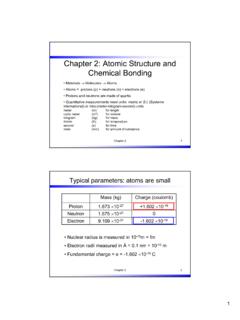
Chapter 2: Atomic Structure and Chemical Bonding
physics.uwo.caPeriodic Table of Elements Chapter 2 14 2.4 Types of atomic and molecular bonds • Primary atomic bonds 1. Ionic (large interatomic forces, nondirectional, electron transfer, coulombic forces) 2. Covalent (large interatomic forces, localized (directional), electron sharing) 3. Metallic (large interatomic forces) nondirectional
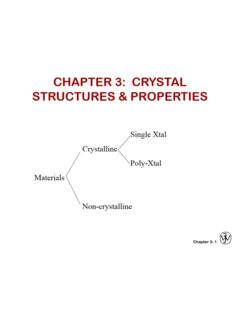
CHAPTER 3: CRYSTAL STRUCTURES & PROPERTIES
srjcstaff.santarosa.educrystal structure = FCC: 4 atoms/unit cell atomic weight = 63.55 g/mol (1 amu = 1 g/mol) atomic radius R = 0.128 nm (1 nm = 10-7cm) = a3 For FCC, a = 4.75 x Result: theoretical pcu 8.89 g/cm3 Compare to actual: pcu 8.94 g/cm3 Chapter 3-14

3.1 Atomic Structure and The Periodic Table
www.barnsleysixthformcollege.co.uk3.1 Atomic Structure and The Periodic Table Question Paper Level IGCSE Subject Chemistry (0620) Exam Board Cambridge International Examinations (CIE) Topic Atoms Elements and Compounds Sub-Topic 3.1 Atomic Structure and The Periodic Table ... 14 Two atoms have the same relative atomic mass but different chemical properties.
CLASSIFICATION OF ELEMENTS AND PERIODICITY IN …
www.ncert.nic.inproperty of an element than its atomic mass. Mendeleev’s Periodic Law was, therefore, accordingly modified. This is known as the Modern Periodic Law and can be stated as : The physical and chemical properties of the elements are periodic functions of their atomic numbers. The Periodic Law revealed important analogies among the 94 naturally ...

ATOMIC STRUCTURE PAST PAPER QUESTIONS
www.scienceexamssorted.co.ukExplain why fluorine and chlorine are in the same group of the periodic table. ... Atomic structure P ast Paper Q uestions Science Exams Sorted 9. An atom of potassium has an atomic number of 19 and a mass number of 39. ... Which two of these atoms have similar chemical properties?