
Chapter 2. Atomic Structure and Interatomic Bonding
• The covalent bond is directional. • The number of covalent bonds that is possible for a particular atom is determined by the number of valence electrons. • Most bonds between two different types of atoms are somewhere in between ionic and covalent. Very few compounds exhibit pure ionic or covalent bonding.
Download Chapter 2. Atomic Structure and Interatomic Bonding

Information
Domain:
Source:
Link to this page:
Documents from same domain
Chapter 4 : ERP Implementation Methodologies and Strategies
web.eng.fiu.eduimplementation, and are kept at the forefront of the strategy. It is crucial that management executives and project stakehold-ers establish expectations for the project. Their role is to ensure ... • Budget • Funding CHAPTER 4 Dunaway – ERP …

Mechanical Vibrations FUNDAMENTALS OF VIBRATION
web.eng.fiu.edu• Joseph Sauveur (1653–1716) coined the word “acoustics” for the science of sound. • Sir Isaac Newton (1642–1727) his law of motion is routinely used to derive the equations of motion of a vibrating body. • Brook Taylor (1685–1731), obtained the natural frequency of vibration observed by Galilei and Mersenne.

Chapter 9: Phase Diagrams
web.eng.fiu.eduPhase Diagrams • Indicate phases as function of T, Co, and P. • For this course:-binary systems: just 2 components.-independent variables: T and Co (P = 1 atm is almost always used). • Phase Diagram for Cu-Ni system Adapted from Fig. 9.3(a), Callister 7e. (Fig. 9.3(a) is adapted from Phase Diagrams of Binary Nickel Alloys , P. Nash

Practice Problems for FE Fluid Mechanics
web.eng.fiu.eduExample 30 Inthepipesystemdepictedbelow,thedischargeinpipeABis100 m3/sec. Branch 1 is 500 m long, and it has a diameter of 2 m and a friction factor of 0.018. Branch 2 has a length of 400 m, diameter of 3 m, and a friction factor of 0.02.

OVERVIEW OF HEURISTIC OPTIMIZATION
web.eng.fiu.eduOPTIMIZATION (Eberhart Kennedy -1995) A robust stochastic optimization technique inspired by the social behavior of swarms of insects or flocks of birds –maximize “food”. Apply the concept of social interaction to problem solving. Developed in 1995 by James Kennedy (social-psychologist) and Russell Eberhart (electrical engineer).
Chapter 16: Composite Materials
web.eng.fiu.edustrength of a ceramic • structure materials for aircraft engine: low densities, strong, stiff, abrasion and impact resistant and corrosion resistant. Chapter 16 - 2 ... Composite Hybrid Materials, The Macmillan Company, New York, 1981.] • Stacked and bonded fiber-reinforced sheets
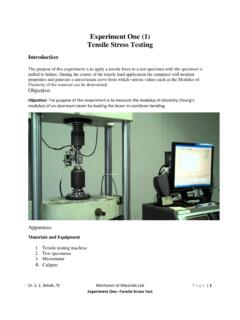
Experiment One (1) Tensile Stress Testing
web.eng.fiu.eduor Pa). In Equation (3.3-2), å is the strain measured in in/in (m/m) in the direction of the applied load. Since strain is dimensionless, the elastic modulus is measured in units of psi (Pa). It is important to realize that Equations above is valid only for uniaxial tension and is a special case of a generalized set of relations known as Hooke ...
Milliequivalents, Millimoles, and Milliosmoles
web.eng.fiu.eduStep 2: Calculate equivalent weight Equiv weight = molecular weight KCl divided by valence Since valence of KCl = 1, Equiv weight = 74.5/ 1 Step 3: 1 mEq KCl = 1/1000 x 74.5 g = 0.0745 g = 74.5 mg Step 4: 4 mEq KCl = 74.5mg x 4 = 298 mg/ml OR using the equation listed before: mg/ml = mEq/ml * atomic, molecular or formula weight valence ...

Experiment Two (2) Torsional testing of Circular Shafts
web.eng.fiu.eduDetermination of Modulus of Rigidity, Shear Modulus G and Torsional Stress for Steel and Aluminum. A. Using the reading of above to calculate the shear modulus and torsional stress for Steel, Aluminum and Brass, by using the following formulas. Compare the experimental results with theoretical values. Θ = [180*T*L/(π*J*G)] (eq. 1) τ= T*C/J ...
Related documents

Chapter 17: Alcohols and Phenols - Vanderbilt University
as.vanderbilt.eduChapter 17: Alcohols and Phenols phenol (aromatic alcohol) pKa~ 10 alcohol pKa~ 16-18 O C H C O CC H ... non covalent interaction between a hydrogen atom ... a ~ 9.9 9.38 9.35 7.15 10.16 10.21 10.46 ~ pK a X= -Cl 9.38 8 ...

Chapter 14
capricorn.bc.eduChapter 14 Objectives. 124 Chapter 14 SDS-PAGE is widely used to analyze the proteins in complex extracts. The most ... any covalent bonds between cysteine residues. Like other detergents, SDS is an amphipathic ... is 9.6, considerably higher than the …

1331 – CHAPTER 11 QUESTIONS IGNORE QUESTIONS 3, 10, …
uh.edu9. When liquid bromine is cooled to form a solid, which of the following types of solid would it form? A. atomic B. metallic C. molecular D ionic E. covalent network 10. Which one of the following substances does not exist in the indicated solid type? A. graphite – network covalent B. Na – metallic C. SiO2 - molecular
Chapter 10: Chemical Bonding
webs.anokaramsey.eduForm covalent bonds between the central atom and the surrounding atoms -called the "skeletal structure". Count how many electrons have been used to form these bonds. 3. Subtract electrons used to form covalent bonds from total number of valence electrons in the molecule or ion to determine how many electrons remain (if any). 4.
CHAPTER 6: ACID-BASE AND DONOR-ACCEPTOR CHEMISTRY
www.chem.uci.edu6.9 These data indicate that triphenylphosphine (PPh 3) is more basic than triphenylamine (NPh 3) in the gas phase. On the sole basis of electronics, triphenylamine would be expected to be more basic by virtue of the higher electronegativity of N relative to P, leading to the N center being more electron rich than the P center.
Answers – Naming Chemical Compounds
www.npsd.k12.nj.us9) CO carbon monoxide. 10) P4 phosphorus. For each of the following questions, determine whether the compound is ionic or covalent and write the appropriate formula for it. 11) dinitrogen trioxide N2O3. 12) nitrogen N2. 13) methane CH4. 14) lithium acetate LiC2H3O2. 15) phosphorus trifluoride PF3. 16) vanadium (V) oxide V2O5

CHAPTER 3: CRYSTAL STRUCTURES & PROPERTIES
www3.nd.edu• Rare due to poor packing (only Po [84] has this structure) • Close-packed directions are cube edges. Coordination number = 6 Simple Cubic (SC) Structure •Coordination number is the number of nearest neighbors •Linear density (LD) is the number of atoms per unit length along a specific crystallographic direction a1 a2 a3 . . . LD