CHAPTER 2: Limits and Continuity - kkuniyuk.com
CHAPTER 2: Limits and Continuity 2.1: An Introduction to Limits 2.2: Properties of Limits 2.3: Limits and Infinity I: Horizontal Asymptotes (HAs)
Download CHAPTER 2: Limits and Continuity - kkuniyuk.com

Information
Domain:
Source:
Link to this page:
Documents from same domain
www.kkuniyuk.com
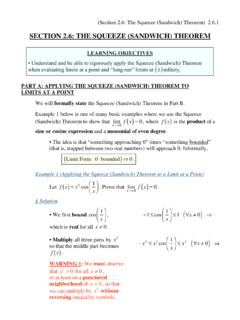
www.kkuniyuk.com(Section 2.6: The Squeeze (Sandwich) Theorem) 2.6.3 In Example 2 below, fx() is the product of a sine or cosine expression and a monomial of odd degree. Example 2 (Handling Complications with Signs)
SECTION 2.5: FINDING ZEROS OF POLYNOMIAL …
www.kkuniyuk.com2.49 Method 2 We may also use the Synthetic Division process and see if we get a 0 remainder. We do not get a 0 remainder, so 1 is not a zero of fx(). Method 3 Observe from both previous methods that we can

SECTION 2.2: PROPERTIES OF LIMITS and …
www.kkuniyuk.com(Section 2.2: Properties of Limits and Algebraic Functions) 2.2.3 6) The limit of a constant multiple equals the constant multiple of the limit. (“Constant Factors Pop Out.”)
SECTION 3.4: DERIVATIVES OF TRIGONOMETRIC …
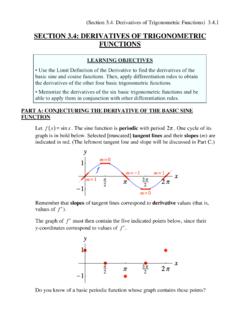
www.kkuniyuk.com(Section 3.4: Derivatives of Trigonometric Functions) 3.4.3 We conjecture that gx ()= sinx.If f is the sine function from Part A, then we also believe that fx ()= gx ()= sinx.We will prove these in Parts D and E.
CHAPTER 3: DERIVATIVES - kkuniyuk.com
www.kkuniyuk.com(Answers to Exercises for Chapter 3: Derivatives) A.3.1 CHAPTER 3: DERIVATIVES SECTION 3.1: DERIVATIVES, TANGENT LINES, and RATES OF CHANGE 1) a)
SECTION 1.10: DIFFERENCE QUOTIENTS - kkuniyuk.com
www.kkuniyuk.com(Section 1.10: Difference Quotients) 1.10.3 The average velocity is 50 mph on 0, 2 in the three scenarios below. It is the slope of the orange secant line.
CHAPTER 7: SYSTEMS AND INEQUALITIES - kkuniyuk.com
www.kkuniyuk.com(Sections 7.1-7.3: Systems of Equations) 7.06 The figure is helpful, however, in that it seems to confirm that the system has three real solutions (corresponding …
CHAPTER 1: Functions - kkuniyuk.com
www.kkuniyuk.com(Section 1.1: Functions) 1.1.4 TIP 1: Think of a function button on a basic calculator such as the x2 or button, which represent squaring and square root functions, respectively. If a function is applied to the input 5, the calculator can never imply, “The outputs are 1 and .” Example 4 (Ages of People) For a relation R, • The set of inputs is the set of all living people.

CALCULUS - kkuniyuk.com
www.kkuniyuk.com(Front Matter) 0.1 COLOR CODING WARNINGS are in red. TIPS are in purple. TECHNOLOGY USED This work was produced on Macs with Microsoft Word, MathType, Mathematica (for most graphs) and Calculus WIZ, Adobe Acrobat, and Adobe Illustrator.
PRECALCULUS - kkuniyuk.com
www.kkuniyuk.com(Assumptions and Notation) A.1 ASSUMPTIONS and NOTATION Unless otherwise specified, we assume that: • f, g, and s denote functions. (See Section 1.1.) •• g sometimes denotes Earth’s gravitational constant. •• h may denote a function, or it may denote the “run” in some difference quotients in …
Related documents
www.kkuniyuk.com
www.kkuniyuk.com(Section 2.6: The Squeeze (Sandwich) Theorem) 2.6.3 In Example 2 below, fx() is the product of a sine or cosine expression and a monomial of odd degree. Example 2 (Handling Complications with Signs)