Chapter 22. Nucleic Acids - latech.edu
Chapter 22. Nucleic Acids 22.1 Types of Nucleic Acids 22.2 Nucleotides: Building Blocks of Nucleic Acids 22.3 Primary Nucleic Acid Structure ... different nucleotide bases can occur in a nucleic acid and are classified as pyrimidine or purine bases: Though only four different nucleotide bases can occur in a nucleic acid, each
Download Chapter 22. Nucleic Acids - latech.edu

Information
Domain:
Source:
Link to this page:
Documents from same domain

Answers to Assigned Problems from Chapter 2
www.chem.latech.eduAnswers to Assigned Problems from Chapter 2 2.2. 1 mol of ice has a volume of 18.01 g/0.9168 g cmŒ3 = 19.64 cm3 1 mol of water has a volume of 18.01 g/0.9998 g cmŒ3

Chapter 18: Carbohydrates - latech.edu
www.chem.latech.edulife in and of themselves. Yet when these substances are gathered together ... 6. note the highest numbered chiral center to distinguish D and L sugars. ... Plane polarized light is rotated clockwise (to right) or counterclockwise (to left) when passed

Introduction to TG/DTA/DSC - latech.edu
www.chem.latech.eduMetallurgy application Isothermal transformation of a high speed steel First heating 0.51.0 1.52.0 2.53.0Time/ h Heat Flow/ mW 1 2 3 4 5 6 7 8 9 Temperature/

Chapter 19: Lipids
www.chem.latech.edu1. Be familiar with the physical and chemical properties and biological function of each of the families of lipids. 2. Write the structures of simple examples of each of the classes of lipids. Name the common lipids. 3. Know the method of synthesizing glycerides and the reactions of

Chapter 17: Amines and Amides - latech.edu
www.chem.latech.eduto relieve anxiety, tension, insomnia, epilepsy and hypertension. People using barbiturates should be aware of the extreme danger they are in if they combine alcohol and barbiturates. The barbiturate and alcohol combination has proven to be deadly many . ))). The group. N CH C CH NH. amides amides ...

Chemistry 254 Lab Experiment 1: Qualitative Organic ...
www.chem.latech.eduChemistry 254 Lab Experiment 1: Qualitative Organic Analysis Summer 2004 Introduction: Qualitative organic analysis, the identification and characterization of unknown compounds, in an important part of organic chemistry. Every chemist must learn the appropriate methods (physical, chemical, spectroscopic) for
Related documents
CHAPTER 14 Acids and Bases - Tamkang University
www2.tku.edu.twCHAPTER 14 Acids and Bases 326 © Houghton Mifflin Company.All rights reserved. 18. The pH of a solution at 25°C in which [OH–] = 3.4 × 10⁻⁵ M is: a) 4.5 b) 10 ...
Ch 05 Carboxylic Acids and Esters
www.angelo.eduChapter 5 Carboxylic Acids and Esters 27 Chemical Properties of Carboxylic Acids 28 Acids and Bases • Acids: – have a sour taste. – react with active metals to produce H2 gas. – turn blue litmus red. • Bases: – have a bitter taste and a slippery feel. – turn red litmus blue. • When they react with each other, acids and bases
The Structure and Function of Nucleic Acids
www.biochemistry.orgBasically, nucleic acids can be subdivided into two types: deoxy-ribonucleic acid (DNA) and ribonucleic acid (RNA). Both DNA and RNA have been shown to consist of three groups of molecules: pentose (5-carbon-atom) sugars; organic bases; and inorganic phosphate. Sugars There are only two types of sugar present in nucleic acids, ribose which
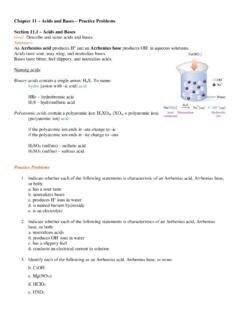
Chapter 11 Acids and Bases Practice Problems Section 11.1 ...
ion.chem.usu.eduChapter 11 – Acids and Bases – Practice Problems Section 11.1 – Acids and Bases Goal: Describe and name acids and bases. Summary: An Arrhenius acid produces H+ and an Arrhenius base produces OH-in aqueous solutions. Acids taste sour, may sting, and neutralize bases. Bases taste bitter, feel slippery, and neutralize acids.
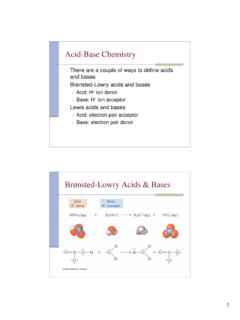
Acid-Base Chemistry
www.calstatela.edu3 Conjugate Acids & Bases ν Acids react with bases and vice versa ν All acids and bases come with a conjugate pair—a base or acid, respectively, that is formed in conjunction with the original species Examples HCl(aq) + H 2O(l) ↔ H 3O+(aq) + Cl …
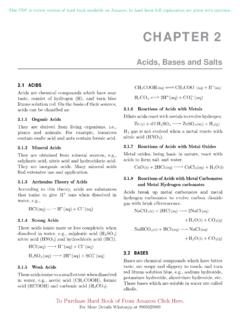
Bcids, Bases and Salts - VAGA Study
vaga.studyChAptER 2 Bcids, Bases and Salts 3.1 acids Acids are chemical compounds which have sour taste, consist of hydrogen (H), and turn blue litmus solution red. On the basis of their sources, acids can be classified as: 3.1.1 Organic Acids They are derived from living organisms, i.e., plants and animals. For example, tomatoes
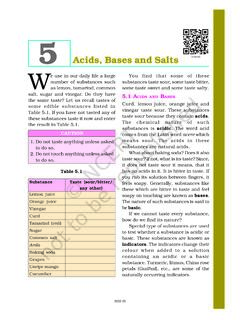
Acids, Bases and Salts W
www.ncert.nic.in5 Acids, Bases and Salts W e use in our daily life a large number of substances such as lemon, tamarind, common salt, sugar and vinegar. Do they have ... have learnt in Chapter 2. But too much of acid in the stomach causes indigestion. Sometimes indigestion is painful. To …
POLYPROTIC ACIDS AND BASES: Very important!
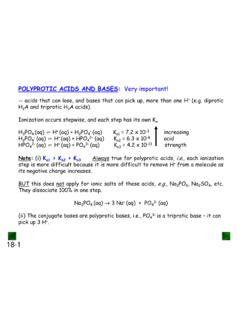
christou.chem.ufl.edu18-1 POLYPROTIC ACIDS AND BASES: Very important!-- acids that can lose, and bases that can pick up, more than one H+ (e.g. diprotic H 2A and triprotic H 3A acids). Ionization occurs stepwise, and each step has its own K
CHAPTER2 Acids, Bases and Salts
www.ncert.nic.inphenolphthalein to test for acids and bases. In this Chapter , we will study the r eactions of acids and bases, how acids and bases cancel out each other’s effects and many more interesting things that we use and see in our day-to-day life. Do Y ou Know? Litmus solution is a purple dye, which is extracted from lichen, a plant belonging to