
Chapter 3 Quadratic Programming
Lemma 3.2 Existence and uniqueness Assume that A 2 lRm£n has full row rank m • n and that the reduced Hessian ZTBZ is positive deflnite. Then, the KKT matrix K is nonsingular. Hence, the KKT system (3.3) has a unique solution (x⁄;‚⁄). Proof: The proof is left as an exercise. †
Download Chapter 3 Quadratic Programming

Information
Domain:
Source:
Link to this page:
Documents from same domain

Lecture notes Math 4377/6308 { Advanced Linear …
www.math.uh.eduLecture notes Math 4377/6308 { Advanced Linear Algebra I Vaughn Climenhaga October 7, 2013

Lecture notes Math 4377/6308 { Advanced Linear …
www.math.uh.eduLecture notes Math 4377/6308 { Advanced Linear Algebra I Vaughn Climenhaga December 3, 2013

Section 3.2 Solving Systems of Linear Equations Using Matrices
www.math.uh.eduSection 3.2 – Solving Systems of Linear Equations Using Matrices 1. Section 3.2 Solving Systems of Linear Equations Using Matrices . In Section 1.3 we solved 2X2 systems of linear equations using either the substitution or

Test 2 Review - UH
www.math.uh.eduJiwen He, University of Houston Math 1431 – Section 24076, Test 2 Review October 28, 2008 32 / 69 Section 4.7 Vertical Aymptotes: Rational Function The line x = 4 is a vertical asymptote for

1 Definition and Properties of the Exp Function - UH
www.math.uh.edu1 Definition and Properties of the Exp Function 1.1 Definition of the Exp Function Number e Definition 1. The number e is defined by ... ∀x > 0, E L = elnx = x. • ∀x > 0, y = lnx ⇔ ey = x. • graph(ex) is the reflection of graph(lnx) by line y = x. ... eudu = eu +C = eg(x) +C.

Jiwen He 1.1 Geometric Series and Variations
www.math.uh.eduVariations on the Geometric Series (II) Closed forms for many power series can be found by relating the series to the geometric series Examples 2.
Chapter 3 Second Order Linear Differential Equations
www.math.uh.edusecond order linear differential equation: a second or- der, linear differential equation is an equation which can be written in the form y 00 + p ( x ) y 0 + q ( x ) y = f ( x ) (1)
Second Order Linear Differential Equations - UH
www.math.uh.eduSecond Order Linear Differential Equations ... This chapter is concerned with special yet very important second order equations, namely linear equations. Recall that a first order linear differential equation is an equation which can be written in the form y0 + p(x)y= q(x)

Introduction to Real Analysis Fall 2014 Lecture Notes
www.math.uh.eduChapter 1 Metric Spaces These notes accompany the Fall 2011 Introduction to Real Analysis course 1.1 De nition and Examples De nition 1.1. Given a set X a metric on X is a function d: X X!R

Introduction to Real Analysis Spring 2014 Lecture Notes
www.math.uh.eduChapter 1 Sequences and Series of Functions In this chapter we introduce di erent notions of convergence for sequence and series of functions and then examine how integrals and derivatives be-
Related documents
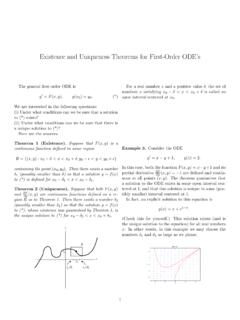
Existence and Uniqueness Theorems for First-Order ODE’s
faculty.math.illinois.eduTheorem 2 (Uniqueness). Suppose that both F(x;y) and @F @y (x;y) are continuous functions de ned on a re-gion R as in Theorem 1. Then there exists a number 2 (possibly smaller than 1) so that the solution y = f(x) to (*), whose existence was guaranteed by Theorem 1, is the unique solution to (*) for x0 2 < x < x0 + 2. x − 0 δ 2 x + 0 δ 2 0 ...
THE CHINESE REMAINDER THEOREM - University of …
kconrad.math.uconn.eduExistence of Solution. To show that the simultaneous congruences x a mod m; x b mod n have a common solution in Z, we give two proofs. First proof: Write the rst congruence as an equation in Z, say x = a + my for some y 2Z. Then the second congruence is the same as a+ my b mod n: Subtracting a from both sides, we need to solve for y in
18.03 LECTURE NOTES, SPRING 2014 - MIT Mathematics
math.mit.eduexistence and uniqueness theorem shows that there is a unique such function f(z) satisfying f0(z) = f(z); f(0) = 1: This function is called the complex exponential function ez. The number eis de ned as the value of ez at z= 1. But it is the function ez, not the number e, that is truly important. De ning ewithout de ning ez rst is a little ...

Galois Theory - University of Oregon
pages.uoregon.eduCONTENTS 2 5.3 Proof that Splitting Fields Are Unique. . . . . . . . . . . . . . . . . . . . .54 5.4 Uniqueness of Splitting Fields, and P(X) = X3 −2 ...
The Gauss-Jordan Elimination Algorithm
people.math.umass.eduDe nitions The Algorithm Solutions of Linear Systems Answering Existence and Uniqueness questions Echelon Forms Row Echelon Form De nition A matrix A is said to be in row echelon form if the following conditions hold 1 all of the rows containing nonzero entries sit above any rows whose entries are all zero,

Variable coefficients second order linear ODE (Sect. 2.1 ...
users.math.msu.eduExistence and uniqueness of solutions. Remarks: I Every solution of the first order linear equation y0 + a(t) y = 0 is given by y(t) = c e−A(t), with A(t) = Z a(t) dt. I All solutions above are proportional to each other: y 1 (t) = c 1 e −A(t), y 2 (t) = c 2 e −A(t) ⇒ y 1 (t) = c 1 c 2 y 2 (t) Remark: The above statement is not true for solutions of second order, linear, homogeneous ...
Differential Equations I - University of Toronto ...
www.math.toronto.edu10.3 Existence and Uniqueness Theorem for Linear First Order ODE’s 155 10.4 Existence and Uniqueness Theorem for Linear Systems . . . . . . 156 11 Numerical Approximations 163

Math 2331 { Linear Algebra - UH
www.math.uh.eduExistence and Uniqueness Theorem Theorem (Existence and Uniqueness) 1 A linear system is consistent if and only if the rightmost column of the augmented matrix is not a pivot column, i.e., if and only if an echelon form of the augmented matrix has no row of the form 0 …