
Chapter 3: The basic concepts of probability
The classical definition of probability If there are m outcomes in a sample space, and all are equally likely of being the result of an experimental measurement, then the probability of observing an event that contains s outcomes is given by e.g. Probability of drawing an ace from a deck of 52 cards. sample space consists of 52 outcomes.
Download Chapter 3: The basic concepts of probability

Information
Domain:
Source:
Link to this page:
Documents from same domain
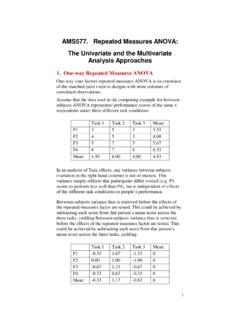
AMS577. Repeated Measures ANOVA: The …
www.ams.sunysb.edu1 AMS577. Repeated Measures ANOVA: The Univariate and the Multivariate Analysis Approaches 1. One-way Repeated Measures ANOVA One-way (one-factor) repeated-measures ANOVA is an extension
Repeated Measures ANOVA - Stony Brook
www.ams.sunysb.eduAs with any ANOVA, repeated measures ANOVA tests ... In the one-way analysis of variance without a repeated measure, we would have each subject receive
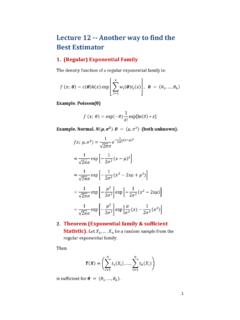
Lecture 12 -- Another way to find the Best Estimator
www.ams.sunysb.edu1 Lecture 12 -- Another way to find the Best Estimator 1. (Regular) Exponential Family The density function of a regular exponential family is:

Examples: Joint Densities and Joint Mass Functions
www.ams.sunysb.eduAMS 311 Joe Mitchell Examples: Joint Densities and Joint Mass Functions Example 1: X and Y are jointly continuous with joint pdf f(x,y) = ˆ cx2 + xy 3 if 0 ≤ x ≤ 1, 0 ≤ y ≤ 2
Vector Autoregression - Stony Brook
www.ams.sunysb.eduOverview Vector Autoregression (VAR) model is an extension of univariate autoregression model to multivariate time series data VAR model is a multi-equation system where all the variables are treated as endogenous (dependent) There is one equation for each variable as dependent variable. In its reduced form, the right-hand side of each
REGRESSION WITH TIME SERIES VARIABLES
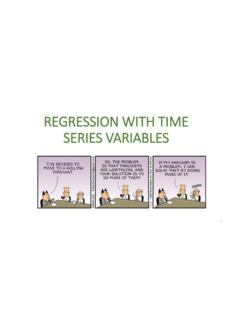
www.ams.sunysb.edu•Regression modelling goal is complicated when the researcher uses time series data since an explanatory variable may influence a dependent variable with a time lag. This often necessitates the inclusion of lags of the explanatory variable in the regression. •If “time” is the unit of analysis we can still regress some dependent

Unit Root & Augmented Dickey-Fuller (ADF) Test
www.ams.sunysb.eduDickey-Fuller Tests • If a constant or trend belong in the equation we must also use D-F test stats that adjust for the impact on the distribution of the test statistic (* see problem set 3 where we included the drift/linear trend in the Augmented D-F test). • The D-F is generalized into the Augmented D-F test to accommodate the general

The Ordinary Least Squares (OLS) Estimator
www.ams.sunysb.eduGauss-Markov Theorem • Given OLS assumptions 1 through 6, the OLS estimator of β k is the minimum variance estimator from the set of all linear unbiased estimators of β

Solutions Manual for Statistical Inference, Second Edition
www.ams.sunysb.edusecond edition, problems were shuffled with no attention paid to numbering (hence no attention paid to minimize the new effort), but rather we tried to put the problems in logical order. A major change from the first edition is the use of the computer, both symbolically through Mathematicatm and numerically using R. Some solutions are given ...
Related documents

Probability, Expectation Value and Uncertainty
physics.mq.edu.aumore or less directly from the classical theory of probability and statistics. Roughly speaking, it represents the (probability-weighted) average value of the results of many repetitions of the mea-surement of an observable, with each measurement carried out on one of very many identically prepared copies of the same system.
7.1 Sample space, events, probability
www3.govst.edu• Probability of an event E = p(E) = (number of favorable outcomes of E)/(number of total outcomes in the sample space) This approach is also called theoretical probability. The example of finding the probability of a sum of seven when two dice are tossed is an example of the classical approach.
Derivation of the Boltzmann Distribution
courses.physics.ucsd.eduaccording to probability theory, the probability of . both. occurrences, that is, of finding one particle with energy . E. 1. and the other with energy . E. 2, is the product of the proba-bilities . f (E. 1) f (E. 2). (This is equivalent to the probability of obtaining heads on two successive coin tosses. The probability of getting heads is 1>2 ...
Chapter 4: Probability and Counting Rules
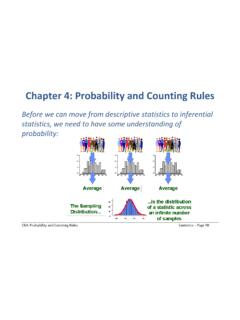
www.math.ucdenver.eduCh4: Probability and Counting Rules Santorico – Page 106 There are three basic interpretations or probability: 1. Classical probability 2. Experimental or relative frequency probability 3. Subjective probability Theoretical (Classical) Probability – uses sample spaces to determine the numerical probability that an event will happen.