
Chapter 4: Design Considerations
4-1 Introduction This chapter covers design considerations which must be addressed during design and review of shop drawings. Subsequent chapters cover specific design methods and procedures. Shop drawings must not be authorized if the applicable design considerations have not been addressed properly in the design. 4-2 Deflection and Camber
Download Chapter 4: Design Considerations

Information
Domain:
Source:
Link to this page:
Documents from same domain
CHAPTER 4 - STRUCTURAL MODELING AND …
dot.ca.govBRIDGE DESIGN PRACTICE FEBRUARY 2015 Chapter 4 – Structural Modeling and Analysis 4-i CHAPTER 4 . S. TRUCTURAL . M ...

Join the Caltrans family
dot.ca.govCommitment to teamwork and collaboration Professional Job training NOW HIRING Join the Caltrans family We value: Dedication to public service Striving for excellence

10-20 GIRDER REINFORCEMENT
dot.ca.govGIRDER REINFORCEMENT 10-20.1 BRIDGE DESIGN DETAILS 10-20 • J UNE 2010 10-20 GIRDER REINFORCEMENT Box Girder Reinforcement The designer will ordinarily furnish moment diagrams with the number, size, and lengths of main reinforcement.
CHAPTER 7 POST-TENSIONED CONCRETE GIRDERS
dot.ca.govpost-tensioned (CIP/PT) concrete box girder bridge. Figure 7.1-1 San Luis Rey River Bridge: A Concrete Box CIP/PT Bridge Basic concepts, definitions …

Join the Caltrans family
dot.ca.govNOW HIRING Join the Caltrans family We value: Dedication to public service Striving for excellence Commitment to teamwork and collaboration Leaders that seek innovative

Chapter 5 Prehistoric Archaeological Resources ...
dot.ca.govJan 02, 2015 · Chapter 5: Prehistoric Archaeological Resources Identification, Evaluation, and Treatment 5.1 Introduction At least 12,000 years of human occupation are represented in California's prehistoric archaeological sites. These resources form an irreplaceable source of knowledge of

CHAPTER 8 PRECAST PRETENSIONED CONCRETE GIRDERS …
dot.ca.govChapter 8 – Precast Pretensioned Concrete Girders 8-1 BRIDGE DESIGN PRACTICE FEBRUARY 2015 CHAPTER 8 PRECAST PRETENSIONED CONCRETE GIRDERS 8.1 INTRODUCTION Precast concrete elements such as girders, piles, deck panels, and pavement are
Chapter 8 Slurry Seals - California Department of ...
dot.ca.govWhy Use Slurry Seals? Cost Effective Benefits: • minimize oxidation/ageing • reduce water infiltration • provide skid resistance • improve aesthetics • correct raveling and weathering Average performance life: 3 to 5 years – Chapter 8 Slurry Seals

Construction Site Best Management Practices (BMP) Manual ...
dot.ca.govThe Manual presents guidance for California Department of Transportat ion (Caltrans) staff, consultants and Contractors to use to determine applicability of Best Management Practices for implementation in construction projects.
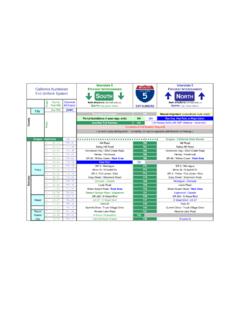
California Interstate 5 Exit List
dot.ca.govOct 09, 2018 · Hilt Road : 793.00. Bailey Hill Road : Bailey Hill Road . 790.40: Hornbrook Hwy / Ditch Creek Road . Hornbrook Hwy / Ditch Creek Road : R 61.55. 789.03: Henley ...
Related documents

CHAPTER 4 DESIGN AND CONSTRUCTION OF SEWAGE …
cpheeo.gov.in4.1.1 Design Flow Refer Chapter 3 of this manual. 4.1.2 Location and Configuration The proper location of the pumping station requires a comprehensive study of the area to be served, to ensure that the entire area can be adequately drained. Special consideration has to be given to
Chapter 4 Thickness Design - APAI
www.apai.netThickness Design 4-1 Chapter 4 Thickness Design GENERAL CONSIDERATIONS Several procedures can be used to calculate the thickness of the proposed asphalt pavement. All are based on the volume and weight of the traffic that will use the facility and on the load-supporting capability of the underlying soil. The AASHTO Road Test and other studies
Chapter 5 Parking Lot Design - APAI
www.apai.net5-2 Parking Lot Design The information in this chapter will provide a general guide to proper parking area design, construction, and facility layout. Minimum pavement thickness designs are given for various size parking lots, heavily-loaded ar eas, and industrial parking lots. In addition, this chapter gives comparable designs for both full
Chapter 6 - Design of PE Piping Systems - plastic pipe
plasticpipe.orgChapter 6 Design of PE Piping Systems 158 (1-1) (1-2) WHERE PR = Pressure rating, psi HDS = Hydrostatic Design Stress, psi (Table 1-1) A F = Environmental Application Factor (Table 1-2) NOTE: The environmental application factors given in Table 1-2 are not to be confused with the Design Factor, DF, used in previous editions of the PPI Handbook and in older standards.
CHAPTER 5: Design of Wood Framing - HUD USER
www.huduser.govChapter 5 - Design of Light-Wood Framing inches by 9.25 inches, and a 1x4 is 3/4-inch by 3.5 inches. This guide uses nominal member size, but it is …

Reinforced Concrete Design CHAPTER COLUMNS
www.assakkaf.comCHAPTER 9a. COLUMNS Slide No. 9 Introduction ENCE 355 ©Assakkaf QColumn load transfer from beams and slabs 1) Tributary area method: Half distance to adjacent columns y x Load on column = area × floor load Floor load = DL + LL DL = slab thickness × conc. unit wt. Example: x = 16.0 ft, y = 13.0 ft, LL = 62.4 lb/ft2, slab thickness = 4.0 in.
Chapter 3 Spacecraft Design Guidelines - NASA
descanso.jpl.nasa.govChapter 3 . Spacecraft Design Guidelines. ... 3.2.4 (Solar Array ESD Design Guidelines), and 3.2.5 (Special Situations ESD Design Guidelines) can be used as aids. ... An approximately 40-mil thickness of aluminum or magnesium will easily provide the desired attenuation if made electromagnetically tight. This