
Chapter 4: Generating Functions - Auckland
Chapter 4: Generating Functions This chapter looks at Probability Generating Functions (PGFs) for discrete random variables. PGFs are useful tools for dealing with sums and limits of random variables. For some stochastic processes, they also have a special role in telling us whether a process will ever reach a particular state.
Download Chapter 4: Generating Functions - Auckland

Information
Domain:
Source:
Link to this page:
Documents from same domain

Computer Organisation and Architecture
www.stat.auckland.ac.nzComputer Organisation and Architecture David J. Scott Department of Statistics, University of Auckland Computer Organisation and Architecture – p.1/
Chapter 1: Stochastic Processes - The University of …
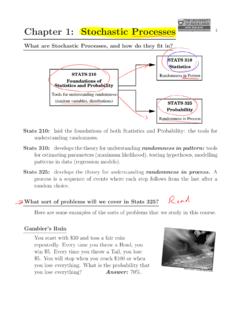
www.stat.auckland.ac.nzChapter 1: Stochastic Processes 4 What are Stochastic Processes, and how do they fit in? STATS 310 Statistics STATS 325 Probability Randomness in Pattern

Time Series Analysis - The University of Auckland
www.stat.auckland.ac.nztime series are related in simple ways to series which are stationary. Two im- ... time spans for stationary series.) ... The theory which underlies time series analysis is quite technical in nature. In spite of this, a good deal of intuition can …
Statistics 120 Good and Bad Graphs - Department of Statistics
www.stat.auckland.ac.nzStatistics 120 Good and Bad Graphs •First •Prev •Next •Last •Go Back •Full Screen •Close •Quit The Plan • In this lecture we will try to set down some basic rules for drawing good graphs. • We will do this by showing that violating the rules produces bad graphs.

SUBJECT MATTER KNOWLEDGE FOR TEACHING
www.stat.auckland.ac.nzupon teachers’ subject matter knowledge involved in the practice of teaching. Findings regarding the knowledge required for teaching correlation coefficient are highlighted, including its computation, interpretation, sensitivity, estimation, and

The Wilcoxon Rank-Sum Test - Department of Statistics
www.stat.auckland.ac.nz1 The Wilcoxon Rank-Sum Test The Wilcoxon rank-sum test is a nonparametric alternative to the two-sample t-test which is based solely on the order in which the observations from the two samples fall. We will use the following as a running example.
Chapter 8: Markov Chains - Auckland
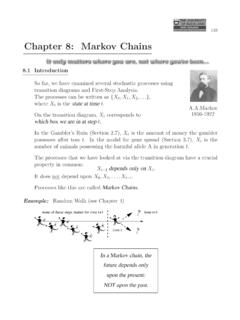
www.stat.auckland.ac.nzThe matrix describing the Markov chain is called the transition matrix. It is the most important tool for analysing Markov chains. Transition Matrix list all states X t list all states z }| {X t+1 insert probabilities p ij rows add to 1 rows add to 1 The transition matrix is …
Chapter 3: Expectation and Variance
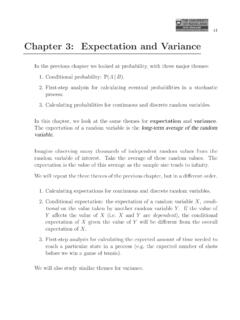
www.stat.auckland.ac.nz3. Calculating probabilities for continuous and discrete random variables. In this chapter, we look at the same themes for expectation and variance. The expectation of a random variable is the long-term average of the random variable. Imagine observing many thousands of independent random values from the random variable of interest.
Chapter 1: What is Statistics? D - Auckland
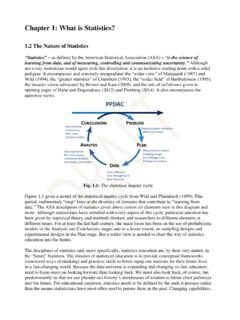
www.stat.auckland.ac.nzChapter 1: What is Statistics? 1.2 The Nature of Statistics “Statistics” as defined by the American Statistical Association (ASA) “is the science of learning from data, and of measuring, controlling and communicating uncertainty.

Chapter 3: Expectation and Variance
www.stat.auckland.ac.nzexpectation is the value of this average as the sample size tends to infinity. We will repeat the three themes of the previous chapter, but in a different order. 1. Calculating expectations for continuous and discrete random variables. 2. Conditional expectation: the expectation of a random variable X, condi-
Related documents
CONTINUOUS-TIME MARKOV CHAINS - Columbia University
www.columbia.eduHere is how the chapter is organized: We start in §2 by discussing transition probabilities and the way they can be used to specify the finite-dimensional distributions, which in turn specify the probability law of the CTMC.
Random Processes for Engineers 1 - University of Illinois ...
www.ifp.illinois.edu4.2 Random walks and gambler’s ruin 112 4.3 Processes with independent increments and martingales 115 4.4 Brownian motion 116 4.5 Counting processes and the Poisson process 118 4.6 Stationarity 121 4.7 Joint properties of random processes 124 4.8 Conditional independence and Markov processes 125 4.9 Discrete-state Markov processes 129

An Introduction To Stochastic Modeling
appliedmath.arizona.eduV Poisson Processes 267 1. The Poisson Distribution and the Poisson Process 267 2. The Law of Rare Events 279 3. Distributions Associated with the Poisson Process 290 4. The Uniform Distribution and Poisson Processes 297 5. Spatial Poisson Processes 311 6. Compound and Marked Poisson Processes 318 VI Continuous Time Markov Chains 333 1. Pure ...
Chapter 1 Poisson Processes - NYU Courant
www.math.nyu.eduChapter 2 Continuous time Markov Processes 2.1 Jump Markov Processes. If we have a Markov Chain {Xn} on a state space X, with transition probabil-ities Π(x,dy), and a Poisson Process N(t) with intensity λ, we can combine the two to define a continuous time Markov process x(t) with X as state space by the formula x(t) = XN(t)
Stochastic Calculus: An Introduction with Applications
www.math.uchicago.eduIntroductory comments This is an introduction to stochastic calculus. I will assume that the reader has had a post-calculus course in probability or statistics.

Introduction to Simulation Using R
www.probabilitycourse.comExample 7. (Poisson) Generate a Poisson random variable. Hint: In this example, use the fact that the number of events in the interval [0;t] has Poisson distribution when the elapsed times between the events are Exponential. Solution: We want to employ the de nition of Poisson processes. Assume Nrepresents the number of events (arrivals) in [0,t].
GAUSSIAN RANDOM VECTORS AND PROCESSES
www.rle.mit.eduThis chapter is aimed primarily at Gaussian processes, but starts with a study of Gaussian (normal1) random variables and vectors, These initial topics are both important in their own right and also essential to an understanding of Gaussian processes. The material here is essentially independent of that on Poisson processes in Chapter 2.