
Chapter 4: Generating Functions - Auckland
a sum using the traditional probability function. The PGF transforms a sum into a product and enables it to be handled much more easily. Sums of random variables are particularly important in the study of stochastic processes, because many …
Download Chapter 4: Generating Functions - Auckland

Information
Domain:
Source:
Link to this page:
Documents from same domain

Computer Organisation and Architecture
www.stat.auckland.ac.nzComputer Organisation and Architecture David J. Scott Department of Statistics, University of Auckland Computer Organisation and Architecture – p.1/
Chapter 1: Stochastic Processes - The University of …
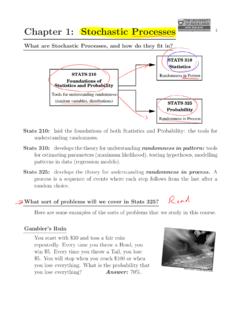
www.stat.auckland.ac.nzChapter 1: Stochastic Processes 4 What are Stochastic Processes, and how do they fit in? STATS 310 Statistics STATS 325 Probability Randomness in Pattern

Time Series Analysis - The University of Auckland
www.stat.auckland.ac.nztime series are related in simple ways to series which are stationary. Two im- ... time spans for stationary series.) ... The theory which underlies time series analysis is quite technical in nature. In spite of this, a good deal of intuition can …
Statistics 120 Good and Bad Graphs - Department of Statistics
www.stat.auckland.ac.nzStatistics 120 Good and Bad Graphs •First •Prev •Next •Last •Go Back •Full Screen •Close •Quit The Plan • In this lecture we will try to set down some basic rules for drawing good graphs. • We will do this by showing that violating the rules produces bad graphs.

SUBJECT MATTER KNOWLEDGE FOR TEACHING
www.stat.auckland.ac.nzupon teachers’ subject matter knowledge involved in the practice of teaching. Findings regarding the knowledge required for teaching correlation coefficient are highlighted, including its computation, interpretation, sensitivity, estimation, and

The Wilcoxon Rank-Sum Test - Department of Statistics
www.stat.auckland.ac.nz1 The Wilcoxon Rank-Sum Test The Wilcoxon rank-sum test is a nonparametric alternative to the two-sample t-test which is based solely on the order in which the observations from the two samples fall. We will use the following as a running example.
Chapter 8: Markov Chains - Auckland
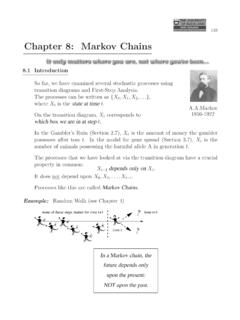
www.stat.auckland.ac.nzThe matrix describing the Markov chain is called the transition matrix. It is the most important tool for analysing Markov chains. Transition Matrix list all states X t list all states z }| {X t+1 insert probabilities p ij rows add to 1 rows add to 1 The transition matrix is …
Chapter 3: Expectation and Variance
www.stat.auckland.ac.nz3. Calculating probabilities for continuous and discrete random variables. In this chapter, we look at the same themes for expectation and variance. The expectation of a random variable is the long-term average of the random variable. Imagine observing many thousands of independent random values from the random variable of interest.
Chapter 1: What is Statistics? D - Auckland
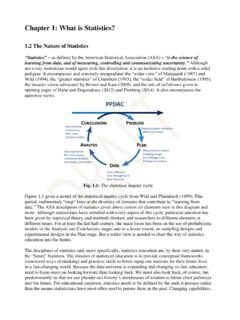
www.stat.auckland.ac.nzChapter 1: What is Statistics? 1.2 The Nature of Statistics “Statistics” as defined by the American Statistical Association (ASA) “is the science of learning from data, and of measuring, controlling and communicating uncertainty.

Chapter 3: Expectation and Variance
www.stat.auckland.ac.nzexpectation is the value of this average as the sample size tends to infinity. We will repeat the three themes of the previous chapter, but in a different order. 1. Calculating expectations for continuous and discrete random variables. 2. Conditional expectation: the expectation of a random variable X, condi-
Related documents

Probability and Stochastic Processes - WINLAB
www.winlab.rutgers.eduProbability and Stochastic Processes A Friendly Introduction for Electrical and Computer Engineers Third Edition STUDENT’S SOLUTION MANUAL (Solutions to the odd-numbered problems) Roy D. Yates, David J. Goodman, David Famolari August 27, 2014 1
One Hundred Solved Exercises for the subject: Stochastic ...
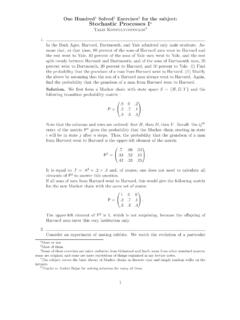
www.stat.berkeley.edufollowing transition probability matrix : P = .8 0 .2.2 .7 .1.3 .3 .4 . Note that the columns and rows are ordered: first H, then D, then Y. Recall: the ijth entry of the matrix Pn gives the probability that the Markov chain starting in state iwill be in state jafter nsteps. Thus, the probability that the grandson of a man

Operations Research: An Introduction to Models and ...
catalog.extension.oregonstate.eduProbability theory The relationship between models and probability Models can be deterministic or stochastic. A deterministic model contains no random (probabilistic) components. The output is determined once the set of input quantities and relationships in the model have been specified. Stochastic models, on the other hand,
Markov Processes - Ohio State University
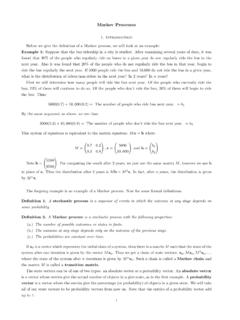
people.math.osu.eduDefinition 1. A stochastic process is a sequence of events in which the outcome at any stage depends on some probability. Definition 2. A Markov process is a stochastic process with the following properties: (a.) The number of possible outcomes or states is finite. (b.) The outcome at any stage depends only on the outcome of the previous ...
Radiation Dose and Radiation Risk
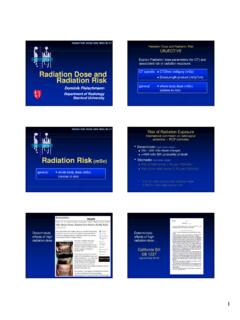
med.stanford.eduJul 14, 2012 · >4000 mSv 50% probability of death • Stochastic(low dose range) Risk of fatal cancer (~5% per 1000mSv) Risk of non-fatal cancer (1.2% per 1000mSv) ~ 0.01 % /mSv Cancer risk (incl.non-fatal) ~ 0.005 % /mSv fatal Cancer risk Deterministic effects of high radiation dose .. California Bill SB 1237 (signed Sept 2010) Deterministic effects of high
Mixture Models - Carnegie Mellon University
www.stat.cmu.edustochastic model, so it gives us a recipe for generating new data points: first pick a distribution, with probabilities given by the mixing weights, and then generate one ... Remember that the likelihood is the probability (or probability density) of …

Deterministic and Stochastic Effects of Radiation
juniperpublishers.comStochastic effect Stochastic effect is those effect which occur when a person receives a high dose of radiation. These effects have an increase probability of occurrence with increase dose. There is no threshold dose below which is creatively certain that a stochastic effect cannot occur. Severity does not depend on magnitude of