
Chapter 4: Generating Functions - Auckland
sequence of repeating steps: for example, the Gambler’s Ruin from Section 2.7. The name probability generating function also gives us another clue to the role of the PGF. The PGF can be used to generate all the probabilities of the distribution. This is generally tedious and is not often an efficient way of calculating probabilities.
Download Chapter 4: Generating Functions - Auckland

Information
Domain:
Source:
Link to this page:
Documents from same domain

Computer Organisation and Architecture
www.stat.auckland.ac.nzComputer Organisation and Architecture David J. Scott Department of Statistics, University of Auckland Computer Organisation and Architecture – p.1/
Chapter 1: Stochastic Processes - The University of …
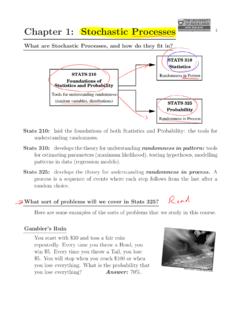
www.stat.auckland.ac.nzChapter 1: Stochastic Processes 4 What are Stochastic Processes, and how do they fit in? STATS 310 Statistics STATS 325 Probability Randomness in Pattern

Time Series Analysis - The University of Auckland
www.stat.auckland.ac.nztime series are related in simple ways to series which are stationary. Two im- ... time spans for stationary series.) ... The theory which underlies time series analysis is quite technical in nature. In spite of this, a good deal of intuition can …
Statistics 120 Good and Bad Graphs - Department of Statistics
www.stat.auckland.ac.nzStatistics 120 Good and Bad Graphs •First •Prev •Next •Last •Go Back •Full Screen •Close •Quit The Plan • In this lecture we will try to set down some basic rules for drawing good graphs. • We will do this by showing that violating the rules produces bad graphs.

SUBJECT MATTER KNOWLEDGE FOR TEACHING
www.stat.auckland.ac.nzupon teachers’ subject matter knowledge involved in the practice of teaching. Findings regarding the knowledge required for teaching correlation coefficient are highlighted, including its computation, interpretation, sensitivity, estimation, and

The Wilcoxon Rank-Sum Test - Department of Statistics
www.stat.auckland.ac.nz1 The Wilcoxon Rank-Sum Test The Wilcoxon rank-sum test is a nonparametric alternative to the two-sample t-test which is based solely on the order in which the observations from the two samples fall. We will use the following as a running example.
Chapter 8: Markov Chains - Auckland
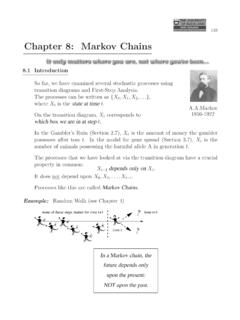
www.stat.auckland.ac.nzThe matrix describing the Markov chain is called the transition matrix. It is the most important tool for analysing Markov chains. Transition Matrix list all states X t list all states z }| {X t+1 insert probabilities p ij rows add to 1 rows add to 1 The transition matrix is …
Chapter 3: Expectation and Variance
www.stat.auckland.ac.nz3. Calculating probabilities for continuous and discrete random variables. In this chapter, we look at the same themes for expectation and variance. The expectation of a random variable is the long-term average of the random variable. Imagine observing many thousands of independent random values from the random variable of interest.
Chapter 1: What is Statistics? D - Auckland
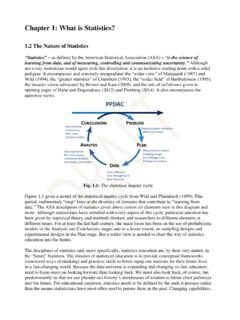
www.stat.auckland.ac.nzChapter 1: What is Statistics? 1.2 The Nature of Statistics “Statistics” as defined by the American Statistical Association (ASA) “is the science of learning from data, and of measuring, controlling and communicating uncertainty.

Chapter 3: Expectation and Variance
www.stat.auckland.ac.nzexpectation is the value of this average as the sample size tends to infinity. We will repeat the three themes of the previous chapter, but in a different order. 1. Calculating expectations for continuous and discrete random variables. 2. Conditional expectation: the expectation of a random variable X, condi-
Related documents

1 Stopping Times - Columbia University
www.columbia.edu1. (First passage/hitting times/Gambler’s ruin problem:) Suppose that X has a discrete state space and let ibe a xed state. Let ˝= minfn 0 : X n= ig: This is called the rst passage time of the process into state i. Also called the hitting time of the process to state i. More generally we can let Abe a collection of states such

Markov Chains - University of Cambridge
www.statslab.cam.ac.ukMarkov Chains These notes contain material prepared by colleagues who have also presented this course at Cambridge, especially James Norris. The material mainly comes from books of

Introduction to Probability Models - University of North ...
mitran-lab.amath.unc.eduwhich can be used to model the fortunes of an investor (or gambler) who always invests 1 and then receives a nonnegative integral return. Section 4.2 has additional material on Markov chains that shows how to modify a given chain when trying to determine such things as the probability that the chain ever enters a given class of
Random Walk: A Modern Introduction - University of Chicago
www.math.uchicago.edu5.1 Gambler’s ruin estimate 103 5.1.1 General case 106 5.2 One-dimensional killed walks 112 5.3 Hitting a half-line 115 6 Potential Theory 119 6.1 Introduction 119 6.2 Dirichlet problem 121 6.3 Difference estimates and Harnack inequality 125 6.4 Further estimates 132 6.5 Capacity, transient case 136 6.6 Capacity in two dimensions 144
Practice with Expected Value and Fair Games Answers
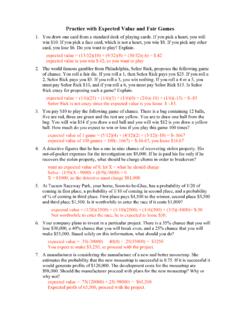
www.danielsroar.weebly.com2. The world famous gambler from Philadelphia, Señor Rick, proposes the following game of chance. You roll a fair die. If you roll a 1, then Señor Rick pays you $25. If you roll a 2, Señor Rick pays you $5. If you roll a 3, you win nothing. If you roll a 4 or a 5, you must pay Señor Rick $10, and if you roll a 6, you must pay Señor Rick $15.

Monte Carlo Method: Probability - Department of Scientific ...
people.sc.fsu.eduHistorically, the birth of probability arose when a gambler wrote to Fermat, asking him whether it was possible to settle up the bets in a particular dice game that had gotten interrupted. Fermat had some ideas, but he wrote to Pascal and between them they worked out methods that are still in use today. Burkardt Monte Carlo Method: Probability

The 12 cognitive biases that prevent you from being rational
www.kellogg.northwestern.eduGambler's Fallacy . It's called a fallacy, but it's more a glitch in our thinking. We tend to put a tremendous amount of weight on previous events, believing that they'll somehow influence future outcomes. The classic example is coin-tossing. After flipping heads, say, five consecutive times, our inclination is to predict an increase in