
Chapter 4 Normalization - Villanova
Chapter 4 Normalization 2 Data Normalization • Formal process of decomposing relations with anomalies to produce smaller, well-structured and stable relations • Primarily a tool to validate and improve a logical design so that it satisfies certain constraints that avoid unnecessary duplication of …
Download Chapter 4 Normalization - Villanova

Information
Domain:
Source:
Link to this page:
Documents from same domain

PowerPoint Presentation
www.csc.villanova.eduGood UIs are critical to success UI programming is ... advanced too busy

Python: Working with pixels - Villanova University
www.csc.villanova.eduWe can also get, set, and modify Colors • getColor(p) takes a pixel as input and returns a Color object with the color at that pixel • setColor(p, c) sets the color of pixel (p) as input and a color (c), then sets the pixel to that color. • We also have functions that can makeLighter(c) and makeDarker(c) an input color • Last time we saw that we can also create colors:

Encryption: Strengths and Weaknesses of Public-key ...
www.csc.villanova.eduthe encryption of data, while the private keys serve a necessary purpose in the decryption ... Digital signatures act as a verifiable seal or signature to confirm the authenticity of the sender and the integrity of the message. Users who wish to verify their identity ... Certificate Authorities Certificate authorities act as trusted third ...

Chapter 4 Logical Database Design and the Relational Model
www.csc.villanova.edu• Relational model is more concrete, lower level – Usually many more tables than entities – Harder to understand by non-technical people – Directly implementable 24 Six Cases of Transforming E-R Diagrams into Relations 1. Map Regular Entities 2. Map Binary Relationships 3. Map Weak Entities 4. Map Associative Entities 5.

Fourth Amendment to the United States Constitution
www.csc.villanova.eduFourth Amendment to the United States Constitution 6 Proposal and ratification After several years of comparatively weak government under the Articles of Confederation, a Constitutional Convention in Philadelphia proposed a new constitution on September 17, 1787, featuring a stronger chief executive and other changes.
Related documents
Chapter 4 Logical Database Design and the Relational Model
www.csc.villanova.eduChapter 4 Logical Database Design and the Relational Model 2 Objectives • Define terms for the relational data model • Transform EE-R diagrams to relations • Create tables with entity and relational integrity constraints

Entity Relationship Model - WBUTHELP.COM
www.wbuthelp.comThis chapter introduces the entity-relationship model in detail. The chapter covers numerous features of the model, several of which can be omitted depending on the planned coverage of the course. Weak entity sets (Section 2.6), design constraints (Section 2.7.4) and aggregation (Section 2.7.5), and the corresponding subsections of
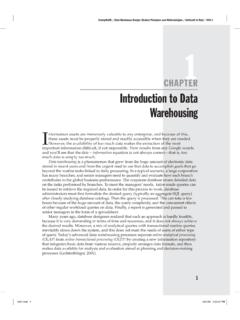
CHAPTER Introduction to Data Warehousing
cdn.ttgtmedia.comdatabase management system (DBMS) technologies, because there is no need for advanced transaction management techniques required by operational applications. Second, data warehouses operate in read-only mode, so data warehouse–specific logical design solutions are completely different from those used for operational databases.

A Suite of Case Studies in Relational Database Design
macsphere.mcmaster.caAlthough the development of relational database system theory and practice can be traced to the 1970 seminal paper A Relational Model of Data for Large Shared Data Banks by E.F. Codd [1], the explosive growth of the use of relational database management systems came with the advent of Internet. Databases not only represent significant ...

Database Design - 2nd Edition - Saylor Academy
resources.saylor.orgChapter 7 The Relational Data Model Adrienne Watt 24 Chapter 8 The Entity Relationship Data Model ... This chapter ofDatabase Design (including its images, unless otherwise noted) ... • A database is logical, coherent and internally consistent.
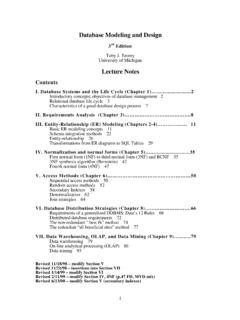
Database Modeling and Design
web.eecs.umich.edu2. Logical database design 2.1 ER modeling (conceptual design) 2.2 View integration of multiple ER models 2.3 Transformation of the ER model to SQL tables 2.4 Normalization of SQL tables (up to 3NF or BCNF) *result: global database schema, transformed to table definitions 3. Physical database design * index selection (access methods ...

DATABASE MANAGEMENT SYSTEMS SOLUTIONS MANUAL …
webpages.charlotte.educontents preface iii 1 introduction to database systems 1 2 introduction to database design 7 3therelationalmodel22 4 relational algebra and calculus 42 5 sql: queries, constraints, triggers 59 6 database application development 90 7 internet applications 94 8 overview of storage and indexing 102 9 storing data: disks and files 113 10 tree-structured indexing 122 11 hash-based …

Data Structures for Databases
www.cise.ufl.eduunderlying techniques and algorithms exceeds the scope of this chapter. More details on this topic can be found in any of the database textbooks (e.g., [3, 4, 9]). For an advanced treatment of this subject, the reader is also referred to [8, 7] as well as to some of the excellent surveys that have been published (see, for example, [6, 5]).