Chapter 4 Oscillatory Motion
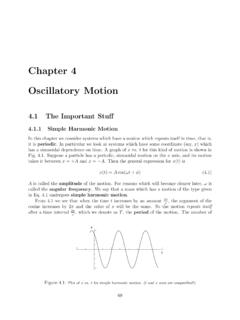
Oscillatory Motion 4.1 The Important Stuff 4.1.1 Simple Harmonic Motion In this chapter we consider systems which have a motion which repeats itself in time, that is, it is periodic. In particular we look at systems which have some coordinate (say, x) which has a sinusoidal dependence on time. A graph of x vs. t for this kind of motion is shown in
Download Chapter 4 Oscillatory Motion

Information
Domain:
Source:
Link to this page:
Documents from same domain
Chapter 6 Work, Kinetic Energy and Potential Energy
www2.tntech.eduThe potential energy U(r) also has units of joules in the SI system. When our physics problems involve forces for which we can have a potential energy function, we usually think about the change in potential energy of the objects rather than the work done by these forces. However for non–conservative forces, we must directly calculate

Worked Examples from Introductory Physics (Algebra–Based ...
www2.tntech.edu• A summary of the material in the first semester of the non–calculus physics course as I teach it at Tennessee Tech. • A set of example problems typical of those given in non–calculus physics courses solved and explained as well as I know how. It is not intended as a substitute for any textbook suggested by a professor...at least not yet!

Chapter 1 Units and Vectors: Tools for Physics
www2.tntech.eduIf two vectors are perpendicular then their scalar product is zero. The vector product (or cross product) of vectors a and b is a vector c whose mag-nitude is given by c = absinφ (1.9) where φ is the smallest angle between a and b. The direction of c is perpendicular to the

Chapter 3 Static Equilibrium
www2.tntech.eduChapter 3 Static Equilibrium 3.1 The Important Stuff In this chapter we study a special case of the dynamics of rigid objects covered in the last two chapters. It is the (very important!) special case where the center of mass of the object has no motion and the object is not rotating. 3.1.1 Conditions for Equilibrium of a Rigid Object

Chapter 1 Electric Charge; Coulomb’s Law
www2.tntech.eduChapter 1 Electric Charge; Coulomb’s Law 1.1 The Important Stuff 1.1.1 Introduction During the second semester of your introductory year of physics you will study two special types of forces which occur in nature as a result of the fact that the constituents of matter have electric charge; these forces are the electric force and the magnetic ...

Chapter 2 Electric Fields
www2.tntech.edu20 CHAPTER 2. ELECTRIC FIELDS mg F elec = qE E q = 24 mC Figure 2.2: Forces acting on the charged mass in Example 1. 1. An object having a net charge of 24µC is placed in a uniform electric field of 610 N C directed vertically. What is the mass of this object if it “floats” in the field? [Ser4 23-16] The forces acting on the mass are ...

Chapter 4 Forces I
www2.tntech.eduChapter 4 Forces I 4.1 The Important Stuff 4.1.1 Newton’s First Law With Newton’s Laws we begin the study of how motion occurs in the real world. The study of the causes of motion is called dynamics, or mechanics. The relation between force and acceleration was given by Isaac Newton in his three laws of motion, which form the

Chapter 7 Linear Momentum and Collisions
www2.tntech.eduThe value of the average force depends on the time interval chosen. 7.1.3 Conservation of Linear Momentum Linear momentum is a useful quantity for cases where we have a few particles (objects) ... again moving freely. For such an event, the two particles have well-defined momenta p1i and p2i before the

Chapter 1 Rotation of an Object About a Fixed Axis
www2.tntech.eduRotation of an Object About a Fixed Axis ... 1.1.2 Angular Displacement As a rotating object moves through an angle θ from the starting position, a mass point on the object at radius r will move a distance s; s length of arc of a circle of radius r, subtended by the angle θ.
Chapter 3 Motion in Two and Three Dimensions
www2.tntech.eduChapter 3 Motion in Two and Three Dimensions ... a medium like air or water which itself is moving with respect to the stationary ground; we can then find the velocity of the plane or boat with respect to the ground from the vector sum in Eq. 3.24. 3.2 Worked Examples 3.2.1 Velocity 1.
Related documents
Chapter 15 Oscillations and Waves
www.austincc.edu• Repetitive motion through a central equilibrium point. • Symmetry of maximum displacement. • Period of each cycle is constant. • Force causing the motion is directed toward the equilibrium point (minus sign). • F directly proportional to the displacement from equilibrium. Acceleration = - ω2 x Displacement
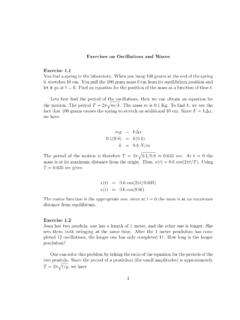
Exercises on Oscillations and Waves Exercise 1
www.cpp.eduThis speed of 4 m/s is the initial speed for the oscillatory motion. Since the spring obeys Hooke’s law, the motion is one of simple harmonic (i.e. sinusoidal) withq != k=m= q 16=4 = 2 s 1. The general expression for simple harmonic motion is: x(t) = x 0cos(!t) + v 0! sin(!t) (10) For our example, x 0 = 0 since the blocks are at x= 0 at t= 0 ...

Chapter 12 Oscillations - UC Santa Barbara
www.deepspace.ucsb.eduCharacteristics of periodic motion • The amplitude, A, is the maximum magnitude of displacement from equilibrium. • The period, T, is the time for one cycle. • The frequency, f, is the number of cycles per unit time. • The angular frequency, , is 2π times the frequency: = 2πf. • The frequency and period are reciprocals of each other:

Lecture 28 3D Rigid Body dynamics: Equations of Motion ...
ocw.mit.eduperturbation analysis. If the sign of A is negative, oscillatory motion of ω x (and ω y) will result, and the motion is stable. Examining A = (I y−I z)(I −I xx), we see that the condition for A to be positive is that I I zz is intermediate yy between I xx and I yy.That is I

LOW OR FAST - NCERT
ncert.nic.inmotion of a simple pendulum is an example of a periodic or an oscillatory motion. The pendulum is said to have completed one oscillation when its bob, starting from its mean position O, moves To set the pendulum in motion, gently hold the bob and move it slightly to one side. Make sure that the string

A pendulum with a moving support point
www.phys.lsu.edu• Vertical periodic motion: Y = Y 0 cos(Ωt), X = 0. 2Y 0 cosΩt)sinθ. The motion of the support adds an oscillating component to the gravitational acceleration. This is not a driven oscillator like the previous case, because the oscillatory driving force is vertical but the natural oscillatory pendulum motion is horizontal. If Y 0Ω2 ˝ g,

High Frequency Oscillatory Ventilation
med.stanford.eduand high-frequency oscillatory ventilation in severe, persistent pulmonary hypertension of the newborn” found that “treatment with HFOV plus iNO is often more successful than treatment with HFOV or iNO alone in severe

EXPERIMENT 2 Measurement of g: Use of a simple pendulum
www.kbcc.cuny.eduSuch oscillatory motion is called simple harmonic motion. It was Galileo who first observed that the time a pendulum takes to swing back and forth through small distances depends only on the length of the pendulum The time of this to and fro motion, called the period, does not