Chapter 4 - Student
In Chapter 4, the following problem modules explain the heat transfer processes involved in fuel cell vehicles and in the processes for producing fuel for fuel cells. 4.1-1 Heat Loss through a Stainless Steel Bipolar Plate
Download Chapter 4 - Student

Information
Domain:
Source:
Link to this page:
Documents from same domain
CM3215 Fundamentals of Chemical Engineering …
pages.mtu.eduControl Valve Lecture, CM3215 Morrison 2/17/2016 1 CM3215 Fundamentals of Chemical Engineering Laboratory Professor Faith Morrison Department of Chemical Engineering

Basic Concepts of Human Genetics - pages.mtu.edu
pages.mtu.edu1 Basic Concepts of Human Genetics • The genetic information of an individual is contained in 23 pairs of chromosomes. Every human cell contains the 23 pair of chromosomes. • One pair is called sex chromosomes Male: XY Female: XX • Other 22 pairs of homologous chromosomes are called autosomes. • The autosome …

Pumping System Curves - Michigan Technological …
pages.mtu.eduPumping System Head CM3215 FAM 3Mar2014 1 CM3215 Fundamentals of Chemical Engineering Laboratory Professor Faith Morrison Department of Chemical Engineering
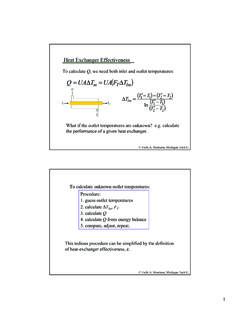
Heat Exchanger Effectiveness
pages.mtu.eduHeat Exchanger Effectiveness ... Double-pipe or 1-1 Shell-and-Tube Heat Exchangers ©Faith A. Morrison, Michigan Tech U. 8 Final Exam CM 310 November 16, 1998 ... The heat capacity of the oil is 1.89 kJ/kg K, and the average heat capacity of water over the temperature range of interest is 4.192 kJ/kg K. The overall heat-transfer coefficient of ...

Introduction to Electromagnetic Theory
pages.mtu.edu1/19/18 1 Lecture topics • Laws of magnetism and electricity • Meaning of Maxwell’s equations • Solution of Maxwell’s equations Introduction to Electromagnetic Theory

Note: This document represents a draft of text that is ...
pages.mtu.edubalance equations we choose the boundaries and then note the quantities of mass, energy, or momentum that cross the boundaries (Figure 2). A closed system is a system that does not have any mass crossing its boundaries.

Compressibility Factor from Redlick-Kwong Equations
pages.mtu.eduCompressibility Factor from Redlick-Kwong Equations (Dr. Tom Co 9/2/08) Working Equations: (based on Cutlip and Shacham, 2008, pp. 101-103) Let be pressure in …

STEAM TABLES - Michigan Technological University
pages.mtu.eduSaturated Steam: TEMPERATURE Table STEAM TABLES ( from M. D. Koretsky, "Engineering and Chemical Thermodynamics", John Wiley & Sons, 2004)

ROBOT OPERATIONS - Michigan Technological University
pages.mtu.eduR-J3, R-J3iB and R-30iA Controller This training focuses on the FANUC Robotics R-J3, R-J3iB and R-30iA controller. The R-J3 series uses advanced technology packaged in a

Best Practices Handbook on Asphalt Pavement Maintenance
pages.mtu.eduCrack sealing Microsurfacing 1 I9 Security ('lass (this report) I 20 Security ('lass (this page) I 2 I. No. of so Pages 1 22. Price IJnclassified linclassified . Best Practices Handbook on ASPHALT PAVEMENT MAINTENANCE February 2000 PUBLISHEDBY Minnesota Technology Transfer (T2) Center / LTAI’ Program
Related documents
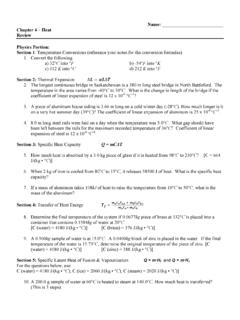
Chapter 4 Heat Review - Mr. Palmarin's Class Website
palmarin.weebly.com2H 2 + O 2 2H 2O 11. Calculate the quantity of heat required to change 50g of ice at -10°C into steam at 120°C.(This is 5 steps). 12. Calculate the quantity of heat required to change 100g of steam at 130°C into ice at -10°C? (This is 5 steps).
Chapter 4 Convection - MIT PAOC
paoc.mit.edu74 CHAPTER 4. CONVECTION Figure 4.1: Solar radiation warms the earth’s surface, triggering convection which carries heat vertically to the emission level from which, because the atmosphere above this level is transparent in …
Chapter 10 Temperature and Heat - Doane College
physics.doane.eduChapter 10 Temperature and Heat OVERVIEW Heat is a form of energy. As this energy moves from one object to another, we may detect physical changes in both the object losing heat energy and the object gaining heat energy. This chapter deals with many of these basic changes and the rules used to describe them.
Chapter 10 Temperature And Heat - Doane College
physics.doane.eduPhysics Including Human Applications 217 Chapter 10 Temperature And Heat GOALS When you have mastered the contents of this chapter, you will be able to achieve the
CHAPTER 4 THERMAL EFFECTIVENESS OF A …
shodhganga.inflibnet.ac.in55 CHAPTER 4 THERMAL EFFECTIVENESS OF A SPIRAL PLATE HEAT EXCHANGER 4.1 INTRODUCTION This chapter discusses the study of thermal effectiveness of the
CHAPTER 4 DESIGN FUNDAMENTALS OF SHELL …
web.iitd.ac.inCHAPTER 4 DESIGN FUNDAMENTALS OF SHELL-AND-TUBE HEAT EXCHANGERS 4.1 INTRODUCTION The thermal design of heat exchangers is directed to …
Chapter 4: Energy from Combustion The primary …
web.mnstate.eduChapter 4: Energy from Combustion The primary means of generating energy for human endeavors is the combustion of fuels. Fuels: Coal -burned in power plants ... 4.1 Heat is a consequence of motion at the molecular level; temperature is a measure of the average speed of that motion.
Chapter 4
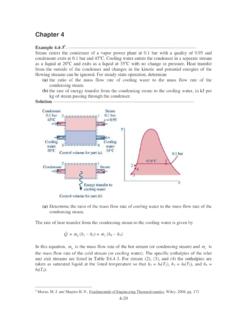
www.cpp.edu4-29 Chapter 4 Example 4.4-36. Steam enters the condenser of a vapor power plant at 0.1 bar with a quality of 0.95 and condensate exits at 0.1 bar and 45oC. Cooling water enters the condenser in a separate stream as a liquid at 20oC and exits as a liquid at 35oC with no change in pressure.Heat transfer
Chapter 5
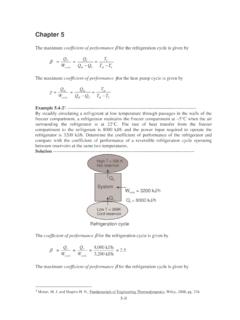
www.cpp.edu5-9 Chapter 5 The maximum coefficient of performance b for the refrigeration cycle is given by b C= CC cycle Q W = H C Q Q-Q H C T T-T The maximum coefficient of performance gfor the heat pump cycle is given by g = H H cycle Q W = H C Q Q-Q H C T T-T Example 5.4-23. By steadily circulating a refrigerant at low temperature through …

Chapter 4
www.delmarlearning.comChapter 4 Shielded Metal Arc Welding of Plate 67 not touch the electrode without gloves, because it will still be hot. If the flux breaks away from the end of the elec-trode, throw out the electrode because restarting the arc
Related search queries
Chapter 4 Heat Review, Heat, Chapter 4 Convection, CHAPTER 4. CONVECTION, Chapter 10 Temperature And Heat, Chapter, CHAPTER 4 THERMAL EFFECTIVENESS OF A, CHAPTER 4 THERMAL EFFECTIVENESS OF A SPIRAL, CHAPTER 4 DESIGN FUNDAMENTALS OF SHELL, CHAPTER 4 DESIGN FUNDAMENTALS OF SHELL-AND, Chapter 4: Energy from Combustion The primary, Chapter 4