
Chapter 5: Interpersonal Communication
Chapter 5: Interpersonal Communication Why do we Need to Communicate? Why is Communication Difficult? What is Involved in The Communication Process? Ł Step one: The idea ... Nonverbal Communication Facial expressions and eye contact Vocal qualities Gestures and other body movements Touching
Download Chapter 5: Interpersonal Communication

Information
Domain:
Source:
Link to this page:
Documents from same domain

Berg Balance Scale - Lane Community College
media.lanecc.eduPage 1 of 4 Berg Balance Scale Description: 14-item scale designed to measure balance of the older adult in a clinical setting. Equipment needed: Ruler, 2 standard chairs (one with arm rests, one without)

Development over the Lifespan Attachment and …
media.lanecc.eduLP 10A Teratogens 1 03/23/09 Development over the Lifespan • Teratogens o Description o Examples Alcohol Radiation Others o Sources of teratogens

Modified Clinical Test of Sensory Interaction in Balance ...
media.lanecc.eduFALL PROOF PROGRAM: CENTER FOR SUCCESSFUL AGING, CAL STATE FULLERTON Modified Clinical Test of Sensory Interaction in Balance (CTSIB-M) *Administer only one trial per condition if participant able to complete first trial without loss of balance .

MENU GUIDE - Lane Community College
media.lanecc.eduThis Menu Guide is designed as a resource to implement and manage the IMPAC Program. It is updated periodically based on current literature and program ... Finger Food (FGRFD) This diet follows the Regular Diet. Foods that may be eaten with minimal utensil involvement are included.

What is Abnormal? - Lane Community College
media.lanecc.eduWhat is Abnormal? Abnormal behavior is defined as behavior that is deviant, ... • Deviant: Behavior that is a serious deviation from social norms of that culture. o For example, washing your hands 4 times an hour, taking 7 showers a day, and cleaning your apartment twice a day is considered deviant. LP Psy Disorders BA:Psydisorder 2

Moral Reasoning: Lawrence Kohlberg
media.lanecc.eduThe Porcupine and the Moles Seeking refuge from the cold, a porcupine asked to share a cave for the winter with a family of moles. The moles agreed. But because the cave was small, they soon found they were being scratched each time the porcupine moved about. Finally, they asked the porcupine to leave. But the porcupine refused, saying,
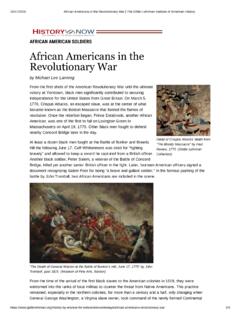
African Americans in the Revolutionary War
media.lanecc.eduGeneral George Washington, a Virginia slave owner, took command of the newly formed Continental ... 10/17/2016 African Americans in the Revolutionary War | The Gilder Lehrman Institute of American History ... Primary Source: Calling out the militia after Lexington and Concord, 1775 Multimedia: Washington, Grant, Marshall: Three Soldiers and ...

Chapter 1 Introduction
media.lanecc.edu• Database access languages and application programming interfaces – DBMS provides access through a query language – Query language is a nonprocedural language – Structured Query Language (SQL) is the de facto query language for relational databases • ANSII standard supported by majority of DBMS vendors CS275 Fall 2010 31 DBMS Functions
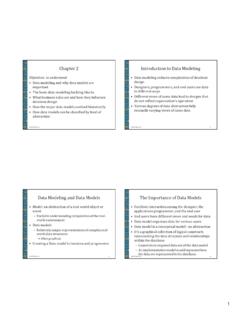
Data Modeling and Data Models The Importance of Data …
media.lanecc.edu(XML) emerged as the de facto standard • Current databases support XML –XML: the standard protocol for data exchange among systems and Internet services CS275 Fall 2010 35 The Future of Data Models • Hybrid DBMSs –Retain advantages of relational model –Provide object-oriented view of the underlying data

Chapter 6 Database Tables & Normalization
media.lanecc.edutables: – Evaluate PK Assignments – Evaluate Naming Conventions – Refine Attribute Atomicity – Identify New Attributes – Identify New Relationships – Refine Primary Keys as Required for Data Granularity – Maintain Historical Accuracy – Evaluate Using Derived Attributes CS275 Fall 201023 Surrogate Key Considerations
Related documents

eleventh edition Communicating in Small Groups - Pearson
catalogue.pearsoned.caeleventh edition Communicating in Small Groups Steven A. Beebe Texas State University ... Communication 3 A Small Group of People 5 Meeting with a Common Purpose 5 ... Applications of Nonverbal Communication Research to Groups 157 Posture, Movement, and Gestures 157

CHAPTER 3: INTERPERSONAL COMMUNICATIONS
cwarden.orgA. Modes of Transmission of Nonverbal Communication Seven categories of nonverbal messages are (1) environment, (2) interpersonal distance, (3) posture, (4) gestures, (5…
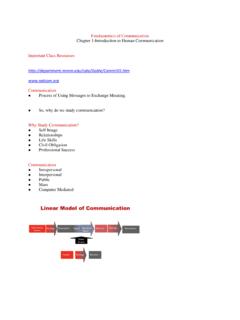
Fundamentals of Communication Chapter 1-Introduction to ...
department.monm.eduFundamentals of Communication Chapter 1-Introduction to Human Communication ... Use verbal communication effectively Use nonverbal communication effectively Listening in the Workplace ... Fundamentals of Communication Chapter 5- Non-verbal Communication

Communication Ch. 5 - ftc-drthorson.weebly.com
ftc-drthorson.weebly.comCommunication Ch. 5 Dr. Thorson. Lesson Objectives Lesson Objectives Upon completion of this lesson, students should be able to: 1. ... Compare and contrast verbal and nonverbal communication. 5.List five examples of nonverbal communication conveying impatience. Critical Thinking Question 1.

Chapter 5 Outline - Oxford University Press
global.oup.comChapter 5 Outline (Italicized words are key words) I. Nonverbal communication, commonly used to describe all human communication events that transcend spoken or written words, has many characteristics and functions. A.
Workplace Communication - jblearning.com
healthadmin.jbpub.comWorkplace Communication Kristina L. Guo, PhD and Yesenia Sanchez, MPH Learning Outcomes After completing this chapter, the student should be able to: 1. Describe the communication process. ... Understand various verbal and nonverbal methods of communication. 4. Understand the common barriers to communication. 5.

COURSE TITLE: PUBLIC SPEAKING SEMESTER CREDIT HOURS ...
labette.edu10-12) – Reading assignment Ch. 4 (Nonverbal Communication) and Ch. 5 (Listening and Critical Thinking) Week 10: SPRING BREAK – No Classes – Have a Fun, Safe Break! Week 11: Nonverbal communication assignment – Discuss and quiz over Ch. 4 – Listening activity to introduce
THE NATURE OF COMMUNICATION IN ORGANIZATIONS
my.ilstu.eduTHE NATURE OF COMMUNICATION IN ORGANIZATIONS Regardless of the type of organization, communication is the element that maintains and ... nonverbal aspect of communication. Yet much of communication is nonverbal. In fact, when we talk to someone, our verbal communication is always accompanied by nonverbal messages as well.

Introduction to Human Communication and Culture
steinhardt.nyu.edu• Trenholm Chapter 5, pp. 107-118 (“What is Nonverbal Communication” & first sections of “The Nonverbal Codes”) • Hebdige, “The Meaning of Style” • Gladwell, “The Theory of Thin Slices: How a Little Bit of Knowledge Goes a Long Way”
Communicating in Teams and Mastering Listening and ...
wps.pearsoncustom.comChapter 2 Communicating in Teams and Mastering Listening and Nonverbal Communication Skills 41 Effective teams can pool knowledge, take advantage of diverse viewpoints,
Related search queries
Eleventh edition Communicating in Small Groups, Communication, Nonverbal Communication, CHAPTER 3: INTERPERSONAL COMMUNICATIONS, Nonverbal, Fundamentals of Communication Chapter 1, Fundamentals of Communication Chapter 5, Non-verbal Communication, Communication Ch, Chapter 5 Outline, Oxford University Press, Workplace Communication, NATURE OF COMMUNICATION IN ORGANIZATIONS, Introduction to Human Communication and, Communicating in Teams and Mastering Listening and, Communicating in Teams and Mastering Listening and Nonverbal Communication