Chapter 6. Compression Reinforcement - Flexural Members
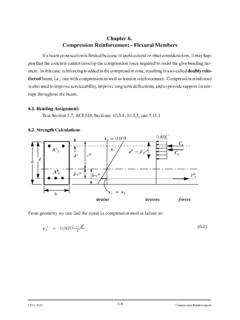
6.4. Compression Steel below Yield Stress (strain compatibility check). Whether or not the compression steel will have yieldedat failure can be determined as fol-lows: From geometry: Á u Á′ s = c c −d ′ if compression steel yield Á′ s = Á y then: Á u Á y = c c −d ′ → c = Á u Á u −Á y d ′ Equilibrium for case II: (Alim ...
Download Chapter 6. Compression Reinforcement - Flexural Members

Information
Domain:
Source:
Link to this page:
Documents from same domain
Chapter 11 SEISMIC DESIGN CRITERIA - Civil …
www.ce.memphis.eduP1: JsY ASCE003-11.tex ASCE003/SIE-v1.cls September 29, 2005 17:5 Chapter 11 SEISMIC DESIGN CRITERIA 11.1 GENERAL 11.1.1 Purpose. Chapter 11 presents criteria for the design and

Review of Engineering Fundamentals - University …
www.ce.memphis.eduReview of Engineering Fundamentals CIVL 4197. Course Format ... FE Chemical 853 77% FE Civil 4,874 70% FE Electrical & Computer 1,217 …

ASCE Requirements for Citations f13 - Civil …
www.ce.memphis.eduASCE Requirements for Citations Books Feld, J. and Carper, K. (1997). Construction Failure, 2nd Ed., Wiley, New York. Book references must include author, book title, publisher, and the publisher’s

2 - Aggregate Gradation and Sampling - Civil …
www.ce.memphis.eduCIVL 3137 3 Gradation Analysis percent coarser or percent retained percent finer or percent passing
BEAM DESIGN - University of Memphis
www.ce.memphis.edu6 2. SHEAR DESIGN IN FLAT PLATES AND FLAT SLABS When two-way slabs are supported directly by columns, as in flat slabs and flat plates, or when slabs carry concentrated loads, as in footings, shear near the columns is of critical

Topic 14 - Foundation Design - Civil Engineering
www.ce.memphis.eduInstructional Materials Complementing FEMA 451, Design Examples Foundation Design 14-7 Reinforced Concrete Footings: Basic Design Criteria (concentrically loaded) d/2 …
Curing Concrete, Chapter 12 - The University of …
www.ce.memphis.edu221 Chapter 12 Curing Concrete 3. Methods that accelerate strength gain by supplying heat and additional moisture to the concrete. This is usually accomplished with live steam, heating coils,
AAA CE4135 ver2 - Civil Engineering
www.ce.memphis.eduCIVL 4135 Chapter 1. Introduction • 2 A problem unique to the design of reinforced concrete structures is the need to detail each member throughout.
Aggregates for Concrete - Department of Civil …
www.ce.memphis.eduT 27). The range of particle sizes in aggregate is illustrated in Fig. 5-4. The aggregate particle size is determined by using wire-mesh sieves with square openings.

Aggregate Specifications - The University of …
www.ce.memphis.eduCIVL 3137 125 Specifications TDOT Specs for Concrete Fine Aggregate Percent Passing by Weight 3/8 in. (9.5 mm) 100 No. 4 (4.75 mm) 95 ‐ 100
Related documents
WisDOT Bridge Manual Chapter 24 – Steel Girder Structures
wisconsindot.govSteel girders are recommended due to depth of section considerations for short span structures and due to their economy in comparison with other materials or structure types for longer span structures. 24.1.1 Types of Steel Girder Structures . This chapter considers the following common types of steel girder structures: • Plate girder
Chapter 2 Thermal Expansion - Rice University
www.owlnet.rice.eduChapter 2 Thermal Expansion. to 600 °C (–185 to 1110 °F), but the temperature range may be extended depending on instrumen- ... with mild steel shells and austenitic grade tubes. Welding. The coefficient of thermal expan-sion is an important factor when welding two dissimilar base metals. Large differences in the
Chapter 07 REINFORCING STEEL (REBAR)
www.roads.maryland.govReinforcing Steel Design, fy = 60 ksi, the General Notes indicate These bar laps only apply where psi lightweight concrete. These bar laps only apply to 4500 shall be used. the Plans, the above dimensions When bar lap is not specified on Note: 5. 4. 03/21/2017 1.0 REBAR-BL-102 R E B A R-B A R L A P 1 1 LIGHTWEIGHT CONCRETE REINFORCING STEEL IN ...

An Introduction to Nitriding - ASM International
www.asminternational.orging potential of both the gas and steel, which in turn controlled the final surface metallurgy. • The Germans manipulated the process through alloying and improved on such aspects as core hardness and tensile strength. Chapter 1: An Introduction to Nitriding / 5 Table 1 British standard nitriding steels Composition, %

Chapter 8 Multiview Drawings - McGraw Hill
www.mhhe.comChapter 8 introduces the theory, techniques, and standards of multiview drawings, which are a standard method for representing engineering designs. The chapter describes ... Existing valves from the company feature an all-steel sleeve, consisting of a flange nut, tube, and end stop, all of which are staked together for welding. A weld bead se-
6 INTRODUCTION TO COLUMN BUCKLING - steel-insdag.org
www.steel-insdag.orgBuckling is of particular interest while employing steel members, which tend to be slender, compared with reinforced concrete or prestressed concrete compression members. Members fabricated from steel plating or sheeting and subjected to compressive stresses also experience local buckling of the plate elements. This chapter
COMPANION TO THE AISC STEEL CONSTRUCTION MANUAL
www.aisc.org1. The 2016 AISC Specification for Structural Steel Buildings is referred to as the AISC Specification and the 15th Edition AISC Steel Construction Manual, is referred to as the AISC Manual. 2. The source of equations or tabulated values taken from the AISC Specification or AISC Manual is noted along the right-hand edge of the page. 3.
25 STEEL-CONCRETE COMPOSITE COLUMNS-I
www.steel-insdag.orgNote: This chapter is confined to steel concrete composite columns made up of hot rolled steel sections having yield strengths within the range 250 N/mm2 to 350 N/mm2 and reinforcement with steel rods of 415 or 500 N/mm2. This limitation is considered necessary at the present time on account of the lower ductility of steels having higher