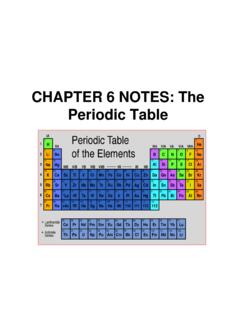
CHAPTER 6 NOTES: The Periodic Table
Soft solids Readily combine with halogens Tendency to lose one electron examples: sodium, potassium, cesium. Alkaline Earth Metals ... 2 to form salts (ionic bonds) examples: fluorine, bromine, iodine. Noble Gases Group 18 on periodic table Relatively inert, or nonreactive
Download CHAPTER 6 NOTES: The Periodic Table

Information
Domain:
Source:
Link to this page:
Documents from same domain
To Kill a Mockingbird Comprehension Questions Name
www.wlwv.k12.or.us1 To Kill a Mockingbird Comprehension Questions Name_____ Read the questions for each chapter to set a purpose before reading. Answer the questions after reading each chapter.

ACTIVITY - Webquest Nutrient Cycles - West Linn
www.wlwv.k12.or.us3 5. What is the process of transpiration? 6. What is the process of condensation? 7. How do clouds become precipitation? 8. What does precipitation become a part of after it falls?
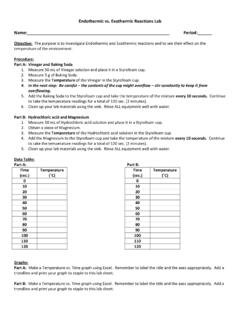
Endothermic vs. Exothermic Reactions Lab Name: Period
www.wlwv.k12.or.us80 . 90 . 100 . 110 . 120 . Graphs: Part A: Make a Temperature vs. Time graph using Excel.Remember to label the title and the axes appropriately. Add a trendline and print your graph to staple to this lab sheet.
Prime Time Practice Answers - West Linn
www.wlwv.k12.or.usPrime Time Practice Answers. Title: 6CMP06_tgpw_eng_001-013.qxd Author: Station 01 Created Date: 1/19/2005 7:11:53 PM ...
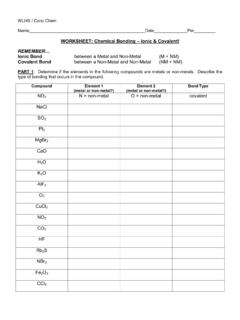
WORKSHEET: Chemical Bonding Ionic & Covalent!
www.wlwv.k12.or.usWLHS / Conc Chem Name Date Per WORKSHEET: Chemical Bonding – Ionic & Covalent! REMEMBER… Ionic Bond between a Metal and Non-Metal (M + NM) Covalent Bond between a Non-Metal and Non-Metal (NM + NM) PART 1: Determine if the elements in the following compounds are metals or non-metals.Describe the type of bonding that occurs in the compound.
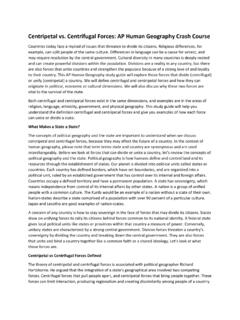
Centripetal vs. Centrifugal Forces: AP Human Geography ...
www.wlwv.k12.or.usdraw on unifying forces to rally its citizens behind forces common to its national identity. A federal state gives local political units like states or provinces within that country a measure of power. Conversely, unitary states are characterized by a strong central government. Divisive forces threaten a country’s
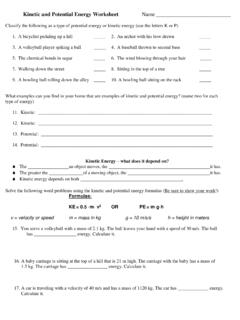
Kinetic and Potential Energy Worksheet Name
www.wlwv.k12.or.usThe potential energy of a 40-kg cannon ball is 14000 J. How high was the cannon ball to have this much potential energy? IF most of the energy we use on earth comes from the sun – how does that energy (light and thermal) end up As energy in our food As energy of …
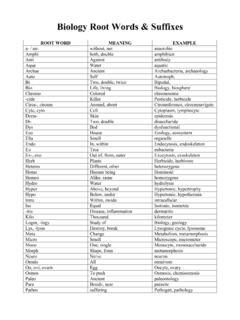
Biology Root Words & Suffixes
www.wlwv.k12.or.usBiology Root Words & Suffixes ROOT WORD MEANING EXAMPLE a- / an- without, not anaerobic Amphi both, double amphibian Anti Against antibody Aqua Water aquatic Archae Ancient Archaebacteria, archaeology Auto Self Autotroph, Bi Two, double, twice Bipedal, Bio Life, living Biology, biosphere Chromo Colored chromosome
The Skeletal System - West Linn-Wilsonville School District
www.wlwv.k12.or.us• New cartilage is continuously formed • Older cartilage becomes ossified • Cartilage is broken down • Bone replaces cartilage . Bone Growth • Bones are remodeled and lengthened until growth stops ... collarbone • Scapula – shoulder blade • These bones allow the upper limb to
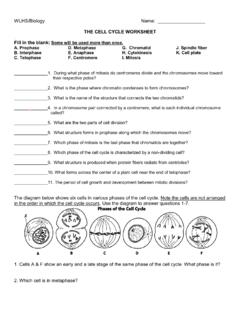
THE CELL CYCLE WORKSHEET - West Linn
www.wlwv.k12.or.usThe period of cell growth and development between mitotic divisions? The diagram below shows six cells in various phases of the cell cycle. Note the cells are not arranged in the order in which the cell cycle occurs. Use the diagram to answer questions 1-7. 1. Cells A & F show an early and a late stage of the same phase of the cell cycle.
Related documents
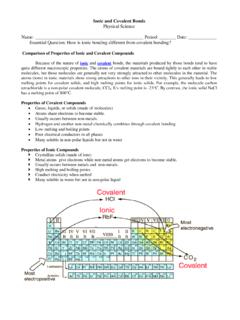
Covalent Compounds Worksheet - Winston-Salem/Forsyth ...
www.wsfcs.k12.nc.usatoms (ions) in ionic materials show strong attractions to other ions in their vicinity. This generally leads to low melting points for covalent solids, and high melting points for ionic solids. For example, the molecule carbon tetrachloride is a non-polar covalent molecule, CCl 4. It's melting point is -23°C. By contrast, the ionic solid NaCl

Benha University 3 Faculty of Engineering at Shoubra ... - BU
www.bu.edu.egsolids, and varies depending on the time of application of voltage as shown in Fig. 4. 1. The various breakdown mechanisms can be classified as follows: a) Intrinsic or ionic breakdown, b) electromechanical breakdown, c) failure due to treeing and tracking, Intrinsic, Electromechanical Streamer Thermal Erosion and Electrochemical Log Time Breakdown

Chapter 11 Substance Mass (amu) Moment (D) Acetonitrile ...
alpha.chem.umb.edu27)_____ solids consist of atoms or molecules held together by dipole-dipole forces, London disperson forces, and/or hydrogen bonds. A)Molecular B)Covalent-network C)Metallic and covalent-network D)Metallic E)Ionic 27) 8
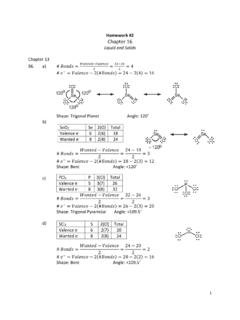
Homework #2 Chapter 16 - UC Santa Barbara
people.chem.ucsb.educ) LiCl is an ionic compound, which is ionic bonds which are stronger than any type of intermolecular forces. Therefore, LiCl has a higher boiling point than HCl. d) The larger the molecule the larger the London forces, therefore, n-hexane has a larger boiling point than n-pentane. 20. Benzene Naphthalene Carbon tetrachloride
BONDING AND PROPERTIES - University of Washington
courses.washington.eduIonic Bonding • Energy – minimum energy most stable – Energy balance of attractive and repulsive terms ... The Structure of Crystalline Solids. Chapter 3 - 19 • Non dense, random packing • Dense, ordered packing. Dense, ordered packed structures tend to have. lower energies. Energy and Packing.