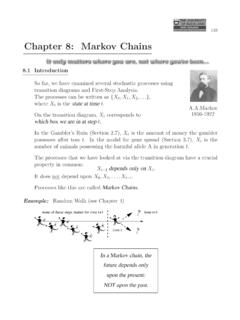
Chapter 8: Markov Chains - Auckland
The matrix describing the Markov chain is called the transition matrix. It is the most important tool for analysing Markov chains. Transition Matrix list all states X t list all states z }| {X t+1 insert probabilities p ij rows add to 1 rows add to 1 The transition matrix is …
Download Chapter 8: Markov Chains - Auckland

Information
Domain:
Source:
Link to this page:
Documents from same domain

Computer Organisation and Architecture
www.stat.auckland.ac.nzComputer Organisation and Architecture David J. Scott Department of Statistics, University of Auckland Computer Organisation and Architecture – p.1/
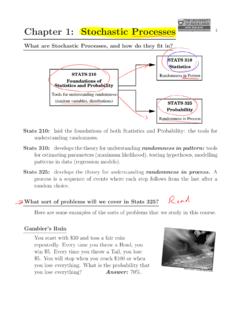
Chapter 1: Stochastic Processes - The University of …
www.stat.auckland.ac.nzChapter 1: Stochastic Processes 4 What are Stochastic Processes, and how do they fit in? STATS 310 Statistics STATS 325 Probability Randomness in Pattern

Time Series Analysis - The University of Auckland
www.stat.auckland.ac.nztime series are related in simple ways to series which are stationary. Two im- ... time spans for stationary series.) ... The theory which underlies time series analysis is quite technical in nature. In spite of this, a good deal of intuition can …
Statistics 120 Good and Bad Graphs - Department of Statistics
www.stat.auckland.ac.nzStatistics 120 Good and Bad Graphs •First •Prev •Next •Last •Go Back •Full Screen •Close •Quit The Plan • In this lecture we will try to set down some basic rules for drawing good graphs. • We will do this by showing that violating the rules produces bad graphs.

SUBJECT MATTER KNOWLEDGE FOR TEACHING
www.stat.auckland.ac.nzupon teachers’ subject matter knowledge involved in the practice of teaching. Findings regarding the knowledge required for teaching correlation coefficient are highlighted, including its computation, interpretation, sensitivity, estimation, and

The Wilcoxon Rank-Sum Test - Department of Statistics
www.stat.auckland.ac.nz1 The Wilcoxon Rank-Sum Test The Wilcoxon rank-sum test is a nonparametric alternative to the two-sample t-test which is based solely on the order in which the observations from the two samples fall. We will use the following as a running example.
Chapter 3: Expectation and Variance
www.stat.auckland.ac.nz3. Calculating probabilities for continuous and discrete random variables. In this chapter, we look at the same themes for expectation and variance. The expectation of a random variable is the long-term average of the random variable. Imagine observing many thousands of independent random values from the random variable of interest.
Chapter 1: What is Statistics? D - Auckland
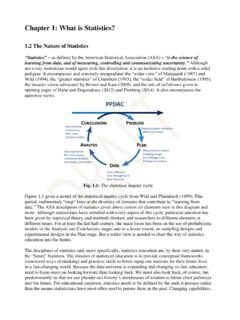
www.stat.auckland.ac.nzChapter 1: What is Statistics? 1.2 The Nature of Statistics “Statistics” as defined by the American Statistical Association (ASA) “is the science of learning from data, and of measuring, controlling and communicating uncertainty.

Chapter 3: Expectation and Variance
www.stat.auckland.ac.nzexpectation is the value of this average as the sample size tends to infinity. We will repeat the three themes of the previous chapter, but in a different order. 1. Calculating expectations for continuous and discrete random variables. 2. Conditional expectation: the expectation of a random variable X, condi-

Chapter 4: Generating Functions - Auckland
www.stat.auckland.ac.nzThe probability generating function gets its name because the power series can be expanded and differentiated to reveal the individual probabilities. Thus, given only the PGFGX(s) = E(sX), we can recover all probabilitiesP(X = x). For shorthand, write px = P(X = x). Then GX(s) = E(sX) = X∞ x=0 pxs x = p 0+ p1s + p2s 2+p 3s 3+ p 4s 4+ ...
Related documents

Chapter 1 Markov Chains - Yale University
www.stat.yale.edu2 1MarkovChains 1.1 Introduction This section introduces Markov chains and describes a few examples. A discrete-time stochastic process {X n: n ≥ 0} on a countable set S is a collection of S-valued random variables defined on a probability space (Ω,F,P).The Pis a probability measure on a family of events F (a σ-field) in an event-space Ω.1 The set Sis the state space of the …
MARKOV CHAINS: BASIC THEORY - University of Chicago
galton.uchicago.eduIrreducible Markov chains. If the state space is finite and all states communicate (that is, the Markov chain is irreducible) then in the long run, regardless of the initial condition, the Markov chain must settle into a steady state. Formally, Theorem 3. An irreducible Markov chain Xn on a finite state space n!1 n = g=ˇ( T T

An introduction to Markov chains - ku
web.math.ku.dkample of a Markov chain on a countably infinite state space, but first we want to discuss what kind of restrictions are put on a model by assuming that it is a Markov chain. Within the class of stochastic processes one could say that Markov chains are characterised by the dynamical property that they never look back.

1. Markov chains - Yale University
www.stat.yale.eduMarkov chains illustrate many of the important ideas of stochastic processes in an elementary setting. This classical subject is still very much alive, with important developments in both theory and applications coming at an accelerating pace in recent decades.

Markov Chains - University of Cambridge
www.statslab.cam.ac.ukA Markov process is a random process for which the future (the next step) depends only on the present state; it has no memory of how the present state was reached. A typical example is a random walk (in two dimensions, the drunkards walk). The course is concerned with Markov chains in discrete time, including periodicity and recurrence.
Markov Chains - Texas A&M University
people.engr.tamu.eduIrreducible Markov Chains Proposition The communication relation is an equivalence relation. By de nition, the communication relation is re exive and symmetric. Transitivity follows by composing paths. De nition A Markov chain is called irreducible if and only if all states belong to one communication class. A Markov chain is called reducible if

Markov Chains Exercise Sheet - Solutions
vknight.orgOct 17, 2012 · Markov Chains Exercise Sheet - Solutions Last updated: October 17, 2012. 1.Assume that a student can be in 1 of 4 states: Rich Average Poor In Debt Assume the following transition probabilities: If a student is Rich, in the next time step the student will be: { Average: .75 { Poor: .2 { In Debt: .05
Markov Chains and Transition Matrices: Applications to ...
www2.kenyon.eduRegular Markov Chains and Steady States: Another special property of Markov chains concerns only so-called regular Markov chains. A Regular chain is defined below: Definition 2: A Regular Transition Matrix and Markov Chain A transition matrix, T, is a regular transition matrix if for some k, if k T has no zero entries.
Linear Algebra Application~ Markov Chains
www2.kenyon.eduMarkov chains are named after Russian mathematician Andrei Markov and provide a way of dealing with a sequence of events based on the probabilities dictating the motion of a population among various states (Fraleigh 105). Consider a situation where a population can cxist in two oc mocc states. A Ma7hain is a sccies of discccte time inte,vais ove,