
Chapter 9: Atomic Absorption Spectrometry
Chapter 9: Atomic Absorption Spectrometry. Read: pp. 230 – 249 Problems: 9-1,3,5,6,8. Figure 9-13a. A(λ)= ε(λ)bC = log P. o /P
Download Chapter 9: Atomic Absorption Spectrometry

Information
Domain:
Source:
Link to this page:
Documents from same domain

Standard Operating Procedure: Pumps
www2.chemistry.msu.eduStandard Operating Procedure: Pumps Last Updated: ... operation of ports and evacuation procedures are covered in the glove box SOP document. As a general
Radiation Detection & Measurement Dept. of …
www2.chemistry.msu.eduRadiation Detection & Measurement Dept. of Chemistry --- Michigan State Univ. National Superconducting Cyclotron Lab DJMorrissey Spring/2oo9

Chemistry 151 - Michigan State University
www2.chemistry.msu.eduChemistry 151 • Professor James H. Geiger • Office: Chemistry Building, Room 9 ... Chemistry, the Central Science, 10th edition, Prentice-Hall, 2005. ISBN: 0-13-109686-9. ... Registering for Mastering Chemistry, What You Need: A valid email address

Chapter 3 Stoichiometry - Michigan State University
www2.chemistry.msu.eduChapter 3! Stoichiometry: Calculations with Chemical Formulas and Equations. Stoichiometry Anatomy of a Chemical Equation CH 4 (g) + 2O 2 (g) CO 2 (g) + 2 H 2 O (g) Stoichiometry Anatomy of a Chemical Equation Reactants appear on the left side of the equation. CH 4 (g) + …

Bond Dissociation Energies of Organic Molecules
www2.chemistry.msu.eduBond Dissociation Energies of Organic Molecules STEPHEN J. BLANKSBY*,† AND G. BARNEY ELLISON*,‡ Department of Chemistry, University of Wollongong, NSW, 2522, Australia, and Department of Chemistry &

Chapter 1 Structure and Bonding - Chemistry
www2.chemistry.msu.eduThe atomic mass (atomic weight) of an element is weighted average mass in atomic mass units (amu) of an element’s naturally occurring isotopes. Carbon: Atomic Number and Atomic Mass 12C 6 AC Z 13C 6 (98.9 12.000) (1.1 13.000) 12.011 100 × +× =

Chapter 24 Chemistry of Coordination Compounds
www2.chemistry.msu.edu6 3+ • Co3+ electron configuration: • 4s23d4----" 4s03d6 • Need six orbitals for six ligands so: !Hybridize 1 4s, 3 4p and 2 3d to give: !Sp3d2 orbitals. The 6 …
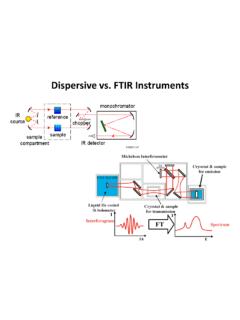
Dispersive vs. FTIR Instruments - Chemistry
www2.chemistry.msu.eduA spectroscopic technique used to observe vibrational, rotational, and other low-frequency [modes in a system. 1] It relies on inelastic scattering, or Raman scattering, of monochromatic light, usually from a laser in the visible, near infrared, or near ultraviolet range.

Principles of FTIR Spectroscopy - Chemistry
www2.chemistry.msu.eduPrinciples of Diffuse Reflectance Method K is the absorption coefficient, and S is the scattering coefficient. In practice, the comparative reflectance r∞ with respect to a standard powder such as KBr or KCl, of which K is near zero (0) in the actual measurement range Spectrum of solid caffeine Measurement of chemicals adhering to a surface ...

Chapter 5 Signals and Noise - Michigan State University
www2.chemistry.msu.eduNoise pick-up and possible amplification by the instrument circuit can be minimized. Difference Amplifiers →Analyte signal and reference signals are fed into the inputs of an operational amplifier is a scaler-type configuration. Common mode noise rejection. V o = R. k. R. i (V. 2 - V. 1)
Related documents
ATOMIC STRUCTURE Notes
nios.ac.inAtomic Structure MODULE - 2 Notes Atomic Structure and Chemical Bonding called a photon. The energy of the quantum ( or photon) is proportional to the frequency of the radiation. The two are related as E = hv The energy of the quantum can also be …
Atomic Structure & Chemical Bonding - Harvard University
projects.iq.harvard.eduChapter 1 Atomic Structure & Chemical Bonding 4 biological matter, about 99%, is made of just six elements: carbon, hydrogen, nitrogen, oxygen, sulfur, and phosphorus. Most biological molecules, such as proteins, carbohydrates, lipids, and nucleic acids, are exclusively composed of these elements. A few other atoms also play roles in biology;

CHAPTER 4: Structure of the Atom - Texas A&M University
sibor.physics.tamu.edu4.1 The Atomic Models of Thomson and Rutherford 4.2 Rutherford Scattering 4.3 The Classic Atomic Model 4.4 The Bohr Model of the Hydrogen Atom 4.5 Successes and Failures of the Bohr Model 4.6 Characteristic X-Ray Spectra and Atomic Number 4.7 Atomic Excitation by Electrons CHAPTER 4 Structure of the Atom

Chapter 2. Atomic Structure and Interatomic Bonding
web.eng.fiu.eduChapter 2. Atomic Structure and Interatomic Bonding Interatomic Bonding –Bonding forces and energies –Primary interatomic bonds –Secondary bonding –Molecules Bonding Forces and Energies • Considering the interaction between two isolated atoms as they are brought into close proximity from an infinite separation. • At larger distances ...

CHAPTER 4 TEST: Atoms, Atomic Theory and Atomic …
www.brooklyn.k12.oh.usCHAPTER 4 TEST: Atoms, Atomic Theory and Atomic Structure Matching. A. Bohr B. Democritus C. Rutherford D. Dalton E. Thomson F. Schrodinger _____ 1. Greek thinker; called nature’s basic particle an atom, based on the Greek word “atomos” which means “indivisible”. Did not have evidence that atoms existed. _____2.

SSSTRUCTURE OFOFOF THETHETHE A A ATOMTOMTOM
www.ncert.nic.in4.2 The Structure of an Atom We have learnt Dalton’s atomic theory in Chapter 3, which suggested that the atom was indivisible and indestructible. But the discovery of two fundamental particles (electrons and protons) inside the atom, led to the failur e of this aspect of Dalton’s atomic theory. It was then considered necessary to
Chapter 1 Structure and Bonding - Chemistry
www2.chemistry.msu.eduThe atomic mass (atomic weight) of an element is weighted average mass in atomic mass units (amu) of an element’s naturally occurring isotopes. Carbon: Atomic Number and Atomic Mass 12C 6 AC Z 13C 6 (98.9 12.000) (1.1 13.000) 12.011 100 × +× =
CHAPTER 4: IMPERFECTIONS IN SOLIDS
www3.nd.edu1. Atomic Sizes: should not differ by more than 14%; 2. Crystal structures: same for “pure” metals; 3. Electronegativity: The atoms should have similar electronegativity, or compounds will form; 4. Valences: If (1) -(3) are favorable, then the metal of lower valence will dissolve more in crystal structure of the higher valence metal than vice