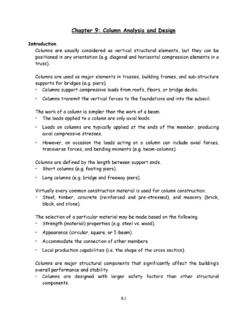
Chapter 9: Column Analysis and Design
= allowable compressive stress per code (psi or ksi) • This stress equation can be rewritten into a design form to determine the required short column size when the load and allowable material strength are known. A required = P actual /F a where A required = minimum cross-sectional area of the column Long Columns – Euler Buckling
Download Chapter 9: Column Analysis and Design

Information
Domain:
Source:
Link to this page:
Documents from same domain
EMBEDDED SYSTEMS PROGRAMMING WITH THE …
academic.csuohio.edu5 Preface This book is intended for use by Junior-level undergraduates, Senior-level undergraduates, and Graduate students in electrical engineering as well as practicing
THEORIES OF ACCIDENT CAUSATION - Cleveland …
academic.csuohio.eduCleveland State University Work Zone Safety and Efficiency Transportation Center Section 3 Accident Theories THEORIES OF ACCIDENT CAUSATION
The Content Analysis Guidebook - Cleveland State …
academic.csuohio.edu202 The CoNTeNT ANALySIS GUIDeBooK of the Japanese earthquake of 2011, for example, the social media of the world followed and documented the crisis, aided in recovery efforts through

OSHA Subpart R: Steel Erection
academic.csuohio.eduSection 17 1926 Subparts R Cleveland State University Work Zone Safety and Efficiency Transportation Center OSHA Subpart R: Steel Erection
THEORIES OF ACCIDENT CAUSATION - …
academic.csuohio.eduCleveland State University Work Zone Safety and Efficiency Transportation Center Section 3 Accident Theories THEORIES OF ACCIDENT CAUSATION
OSHA 1926 Subpart D Occupational Health & …
academic.csuohio.eduSection 9 1926 Subparts D & E Cleveland State University Work Zone Safety and Efficiency Transportation Center 1926.50 Medical Services and First Aid
OSHA Subpart R: Steel Erection - …
academic.csuohio.eduSection 17 1926 Subparts R Cleveland State University Work Zone Safety and Efficiency Transportation Center Before Authorizing The Start Of Steel
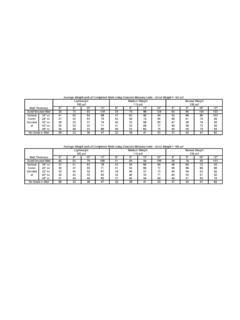
Average Weight (psf) of Completed Walls Using …
academic.csuohio.edu6" 8" 10" 12" 6" 8" 10" 12" 6" 8" 10" 12" 52 75 93 118 58 78 98 124 63 84 104 133 Vertical 16" oc 41 60 69 88 47 63 80 94 52 66 86 103 …
Preliminaries: Beam Deflections Virtual Work
academic.csuohio.eduSection 6: The Flexibility Method - Beams Washkewicz College of Engineering 1 Preliminaries: Beam Deflections –Virtual Work There are several methods available to calculate deformations (displacements and rotations)
OSHA Subpart L: Scaffolds - Cleveland State …
academic.csuohio.eduSection 12 1926 Subparts I Cleveland State University Work Zone Safety and Efficiency Transportation Center OSHA Subpart L: Scaffolds
Related documents
Designing and Proportioning Normal Concrete Mixtures ...
www.ce.memphis.eduStrength The specified compressive strength, ˘, at 28 days is the strength that is expected to be equal to or exceeded by the average of any set of three consecutive strength tests. ACI 318 requires for ø to be at least 17.5 MPa (2500 psi). No individual test (average of two cylinders) can be more than 3.5 MPa (500 psi) below the specified ...
Wood: Strength and Stiffness - Forest Products Laboratory
www.fpl.fs.fed.usobtained from elastic theory. Strength properties in directions other than parallel (P) or perpendicular (Q) to the grain can be approximated using a Hankinson type formula: where q is the angle to the grain. For bending and tensile strength, N ranges from 1.5 to 2, and for compressive strength from 1.5 to 2.0. For the modulus wood.a

IS 516 (1959): Method of Tests for Strength of Concrete
www.iitk.ac.indetermination of compressive strength, flexural strength and modulus of elasticity of concrete. Sampling and analysis of concrete have been covered separately in IS: 1199-1959Methods of Sampling and Analysis of Concrete. 0.3 The Sectional …
Guide to Evaluation of Strength Test Results of Concrete
dl.mycivil.irstrength) is the compressive strength of a single cylinder (ASTM C39/C39M); a single cylinder strength is part of, but individually does not constitute, a test result. normal distribution—a frequently occurring natural distribution that has predictable properties. The analysis of strength test results presented in this guide assumes that the

IS 3495-1 to 4 (1992): Methods of tests of burnt clay ...
www.iitk.ac.inCompressive strength in N/mm2 ( kgf,cm2) = Maximum load at failure in N(kgf) Average area of the bed faces in mm2 ( cm2 ) 4.1.4.1 The average of results shall be reported. 4.2 For Perforated Bricks 4.2.1 Apparatus See 4.1.1. 4.2.2 Preconditioning Immerse the specimen in water at room tempe- rature for 24 hours.

Simpson Strong-Tie SET-XP High-Strength Epoxy Adhesive
www.buildsite.comBond strength (moist cure) ASTM C882 2,916 psi at 2 days Water absorption ASTM D570 0.10% Compressive yield strength ASTM D695 14,110 psi Compressive modulus ASTM D695 612,970 psi Shore D Durometer ASTM D2240 84 Gel time ASTM C881 60 minutes Volatile Organic Compound (VOC) — 3 g/L

COMPRESSIVE STRENGTH OF CONCRETE
iricen.gov.inThe measured compressive strength of the cubes shall be calculated by divid ing the maximum load applied to the cubes during the test by the cross-sectional area, calculated from the mean dimensions of the section and shall be expressed to the nearest 0.5 N/mm2. In determining the compressive strength, do