
CHAPTER A - Stanford University
A.1 Markov Chains Markov chain The HMM is based on augmenting the Markov chain. A Markov chain is a model that tells us something about the probabilities of sequences of random variables, states, each of which can take on values from some set. These sets can be words, or tags, or symbols representing anything, like the weather. A Markov chain ...
Download CHAPTER A - Stanford University

Information
Domain:
Source:
Link to this page:
Documents from same domain
Chemical Engineering 160/260 Important …
web.stanford.eduChemical Engineering 160/260 Important Concepts, Lecture 9-16 Lecture 9: Introduction to Thermodynamic Models for Polymer/Solvent (and Polymer/Polymer

Game Review | The Legend of Zelda
web.stanford.eduTech Specs: like nuthin' your mama has ever seen. Two chip technologies in particular are responsible for LoZ's technological prowess: MMC (Memory
Assignment 1: Game Review “The Legend of Zelda”
web.stanford.eduNitin Chopra Assignment 1: Game Review “The Legend of Zelda” 1. Identify the Game I have chosen to do my Game Review on “The Legend of Zelda” because I …
Lecture 12 Feedback control systems: static analysis
web.stanford.eduLecture 12 Feedback control systems: ... sensors: radar altimeter; ... Feedback control systems: static analysis 12{4. Example
Credit Risk Modeling with Affine Processes
web.stanford.educredit-risk modeling (emphasizing the valuation of corporate debt and credit derivatives) with an introduction to the analytical tractability and richness of affine state processes. This is not a general survey of either topic, but rather

OBIEE Upgrade from 11G Oracle Business …
web.stanford.eduOracle Business Intelligence 12c is a unique platform that enables customers to uncover new insights and make faster, ... Oracle BI Enterprise Edition ...
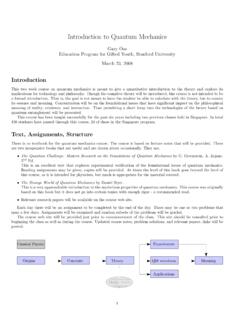
Introduction to Quantum Mechanics - Stanford …
web.stanford.eduIntroduction to Quantum Mechanics Gary Oas Education Program for Gifted Youth, Stanford University March 23, 2008 Introduction This two week course on quantum mechanics is meant to give a quantitative introduction to the theory and explore its
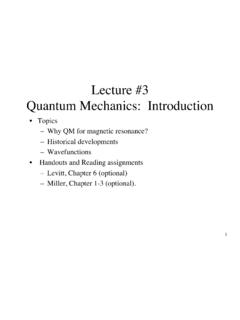
Lecture #3 Quantum Mechanics: Introduction
web.stanford.edu2 Classical versus Quantum NMR • QM is only theory that correctly predicts behavior of matter on the atomic scale, and QM effects are seen in vivo.
Reprogramming to a muscle fate by fusion …
web.stanford.eduResearch Article 1045 Introduction We have extended our earlier studies of nuclear reprogramming in heterokaryons to enhance our understanding of the mechanistic basis
Journal of Teacher Education, Vol. 51, No. 3, …
web.stanford.eduON THE NATURE OF TEACHING AND TEACHER EDUCATION ... isolation is to create a vision of learning to teach as a private ordeal (Lortie, 1975) and a vision of
Related documents

Chapter 1 Markov Chains - Yale University
www.stat.yale.edu2 1MarkovChains 1.1 Introduction This section introduces Markov chains and describes a few examples. A discrete-time stochastic process {X n: n ≥ 0} on a countable set S is a collection of S-valued random variables defined on a probability space (Ω,F,P).The Pis a probability measure on a family of events F (a σ-field) in an event-space Ω.1 The set Sis the state space of the …

1. Markov chains - Yale University
www.stat.yale.eduMarkov chains illustrate many of the important ideas of stochastic processes in an elementary setting. This classical subject is still very much alive, with important developments in both theory and applications coming at an accelerating pace in recent decades.

Markov Chains - University of Cambridge
www.statslab.cam.ac.ukA Markov process is a random process for which the future (the next step) depends only on the present state; it has no memory of how the present state was reached. A typical example is a random walk (in two dimensions, the drunkards walk). The course is concerned with Markov chains in discrete time, including periodicity and recurrence.

Markov Chains (Part 4) - University of Washington
courses.washington.eduMarkov Chains - 3 Some Observations About the Limi • The behavior of this important limit depends on properties of states i and j and the Markov chain as a whole. – If i and j are recurrent and belong to different classes, then p(n) ij=0 for all n. – If j is transient, then for all i.Intuitively, the
Markov Chains - Texas A&M University
people.engr.tamu.eduIrreducible Markov Chains Proposition The communication relation is an equivalence relation. By de nition, the communication relation is re exive and symmetric. Transitivity follows by composing paths. De nition A Markov chain is called irreducible if and only if all states belong to one communication class. A Markov chain is called reducible if

5 Random Walks and Markov Chains - Carnegie Mellon …
www.cs.cmu.eduThe fundamental theorem of Markov chains asserts that the long-term probability distri-bution of a connected Markov chain converges to a unique limit probability vector, which we denote by π. Executing one more step, starting from this limit distribution, we get back the same distribution. In matrix notation, πP = πwhere P is the matrix of ...