CHAPTER EIGHT - ESCAP
Waste is an unavoidable by-product of most human activity. Economic development and rising living standards in the Asian and Pacific Region have led to increases in the quantity and complexity of generated waste, whilst industrial diversification and the provision of expanded health-care facilities have added substantial quantities of ...
Download CHAPTER EIGHT - ESCAP

Information
Domain:
Source:
Link to this page:
Documents from same domain
What is Good Governance? - United Nations ESCAP
www.unescap.orgUnited Nations Economic and Social Commission for Asia and the Pacific What is Good Governance? Introduction Recently the terms "governance" and "good
Data Collection Methods and Instruments - …
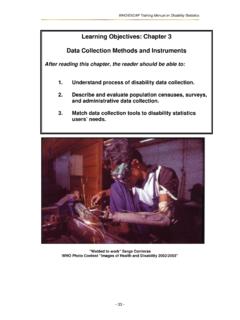
www.unescap.orgWHO/ESCAP Training Manual on Disability Statistics - 36 - There are also issues of practicality and efficiency. Having the household as the selection unit means that the survey or interview can be conducted in a
II. MAPPING OF LOGISTICS SERVICES A. Scope ... - …
www.unescap.org- 8 - II. MAPPING OF LOGISTICS SERVICES A. Scope of Logistics Service Provision There is no universally agreed definition for logistics services, and the role may
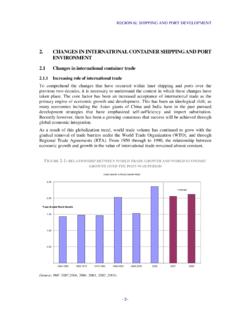
2. CHANGES IN INTERNATIONAL CONTAINER …
www.unescap.orgThe period between 2004 and 2005 was a strong one for the liner shipping operators, with container volume in excess of ship capacity for the majority of …
OECD-UNESCAP Multi-Dimensional Review of …
www.unescap.org4,808 4.6% MOI Burma Companies Act (1914); Private Industrial Enterprise Law (1990); Special Company Act (1950)
Resolutions - unescap.org
www.unescap.org69/277 Political declaration on strengthening cooperation between the United Nations and regional and subregional organizations 69/317 Cooperation between the United Nations and the Organization of Islamic
Enabling Entrepreneurship for Women’s Economic …
www.unescap.orgconducted the country studies and primary surveys: ... (Malaysia). This publication was ... OECD Organization for Economic Cooperation and Development
India and the MDGs - unescap.org
www.unescap.orgdignity to all. India and the MDGs: ... and is likely to reach parity in secondary and tertiary education also by 2015. India is set to achieve reducing hunger by ...
Statement Global Energy Interconnection …
www.unescap.org1 The statement delivered at the Second Asian and Pacific Energy Forum on 4 April 2018 Statement Global Energy Interconnection Development and Cooperation
Global Energy Interconnection and the Concept of …
www.unescap.org2 “China will propose discussions on estab-lishing global energy interconnection to facilitate efforts to meet the global power demand with clean and green alternatives”.
Related documents

UK Statistics on Waste
assets.publishing.service.gov.uk• It is estimated that the UK generated 43.9 million tonnes of commercial and industrial (C&I) waste in 2018, of which 37.2 million tonnes (85%) was generated in England.
WHAT A WASTE: A GLOBAL REVIEW OF SOLID WASTE …
documents1.worldbank.orgWaste generation projections for 2025 by region 10 5. Current waste generation per capita by income level 10 6. Waste generation projections for 2025 by income 11 ... residents who generated about 0.64 kg of MSW per person per day (0.68 billion tonnes per year). This report estimates that today these amounts have increased ...

NSW Waste and Sustainable Materials Strategy 2041
www.dpie.nsw.gov.auwith waste closer to where it is generated. Part 1. Context and background. The circular economy. A circular economy is an economic system aimed at minimising waste and promoting the continual reuse of resources. The circular economy aims to keep products, equipment and infrastructure in use

Improving Plastics Management: Trends, policy responses ...
www.oecd.org10. The proliferation of plastics use, in combination with poor endof-life waste - management, has resulted in widespread, persistent plastics pollution. Around 6 300 million tonnes of plastics waste are thought to have been generated between 1950 and 2015, of which only 9% were recycled, and 12% incinerated, leaving nearly 80% to accumulate
Handling, storage, and transportation of health-care waste ...
www.who.intsible to where the waste is generated, and should be maintained in storage areas and during transport. The same system of segregation should be in force throughout the country. The most appropriate way of identifying the categories of health-care waste is by sorting the waste into colour-coded plastic bags or containers.