CHAPTER Logistic Regression
4.An algorithm for optimizing the objective function. We introduce the stochas-tic gradient descent algorithm. Logistic regression has two phases: training: we train the system (specifically the weights w and b) using stochastic gradient descent and the cross-entropy loss. test: Given a test example x we compute p(yjx) and return the higher ...
Download CHAPTER Logistic Regression

Information
Domain:
Source:
Link to this page:
Documents from same domain
Information Mapping - Stanford University
www.web.stanford.eduInformation mapping is a methodology specifically designed to make technical communication in business and industry easier and quicker. It is currently emerging from
CHAPTER N-gram Language Models
www.web.stanford.edu2 CHAPTER 3•N-GRAM LANGUAGE MODELS A probabilistic model of word sequences could suggest that briefed reporters on is a more probable English phrase than briefed to reporters (which has an awkward to after briefed) or introduced …

The Egg and the Sperm: How Science Has Constructed a ...
www.web.stanford.edusets up between male and female: the male, who continuously produces fresh germ cells, and the female, who has stockpiled germ cells by birth and is faced with their degeneration. Nor are the female organs spared such vivid descriptions. One scientist writes in a newspaper article that a woman's ovaries

Economics of Energy - Stanford University
www.web.stanford.edu48 Economics of Energy Energy economics is the field that studies human utilization of energy resources and energy commodities and the consequences of that utilization. In physical science terminology, “energy” is the capacity for doing work, e.g., lifting, accelerating, or heating material. In
CHAPTER Regular Expressions, Text Normalization, Edit Distance
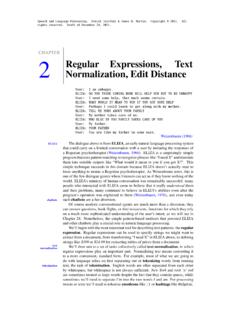
www.web.stanford.eduELIZA The dialogue above is from ELIZA, an early natural language processing system that could carry on a limited conversation with a user by imitating the responses of a Rogerian psychotherapist (Weizenbaum,1966). ELIZA is a surprisingly simple program that uses pattern matching to recognize phrases like “I need X” and translate
CHAPTER Logistic Regression - Stanford University
www.web.stanford.edulearning. Machine learning classifiers require a training corpus of m input/output pairs (x(i);y(i)). (We’ll use superscripts in parentheses to refer to individual instances in the training set—for sentiment classification each instance might be an individual document to be classified.) A machine learning system for classification then ...

Paul Romer:Ideas,Nonrivalry,and Endogenous Growth
www.web.stanford.edu860 Paul Romer: ideas, nonrivalry, and endogenous growth as the most important paper in the growth literature since Solow’s Nobel-recognized work. In this article, I review Romer’s prize-winning work, putting it into the context of the surrounding literature and providing a retrospective on how this research has led to the modern ...

Acids and Bases Edit - Stanford University
www.web.stanford.edu6. For baking soda, add 3 tablespoons of baking soda into 100 ml water. Example: 7. Pour 50 ml of cabbage juice into each of the cups. Do this one at a time and record the color change below: Liquid: Color Change/ pH Actual pH Hand Sanitizer Lemon Soda Apple Juice White Vinegar Baking Soda Shampoo Conditioner

An Introduction to Design Thinking PROCESS GUIDE
www.web.stanford.eduMentally it represents a process of Ògoing wideÓ in terms of concepts and outcomes. Ideation provides both the fuel and also the source material for building prototypes and getting innovative solutions into the hands of your users. WHY ideate You ideate in order to transition from identifying problems to creating solutions for your users.
Peer Pressure - Stanford University
www.web.stanford.eduthat both sorts of peer pressures are observed (e.g., see Brown (1982), Brown, Clasen, and Eicher (1986), and Santor, Messervey, and Kusumakar (2000)), and so it is important to understand both types of peer pressure. While one might be tempted to conclude that positive peer pressure will be beneficial and negative
Related documents

Rectified Linear Units Improve Restricted Boltzmann Machines
icml.ccRBMs were originally developed using binary stochas-tic units for both the visible and hidden layers (Hinton, 2002). To deal with real-valued data such as the pixel intensities in natural images, (Hinton & Salakhutdinov, 2006) replaced the binary visible units by linear units with independent Gaus-sian noise as first suggested by (Freund ...

High-Frequency Component Helps Explain the Generalization ...
openaccess.thecvf.comprogressively, including studying the properties of stochas-tic gradient descent [31], different complexity measures [46], generalization gaps [50], and many more from differ-ent model or algorithm perspectives [30, 43, 7, 51]. In this paper, inspired by previous understandings that convolutional neural networks (CNN) can learn from con-

1 Frank-Wolfe algorithm
people.csail.mit.eduThe paper [3] shows a Frank-Wolfe method for the structured SVM, and derive a stochas-tic block coordinate descent method. This can be related to a stochastic gradient method in the primal. 4.2 Herding Problem In the herding problem, we are are given a set of samples x 1;::;x nand are trying to ap-

Learning Structured Output Representation using Deep ...
proceedings.neurips.ccposterior inference. However, the parameters of the VAE can be estimated efficiently in the stochas-tic gradient variational Bayes (SGVB) [16] framework, where the variational lower bound of the log-likelihood is used as a surrogate objective function. The variational lower bound is written as: logp (x) = KL(q ˚(zjx)kp (zjx))+E q ˚(zjx) logq ...