
CHAPTER4 Carbon and its Compounds
(a) 5 covalent bonds (b) 12 covalent bonds (c) 16 covalent bonds (d) 17 covalent bonds 16. Structural for mula of benzene is (a) (b) (c) (d) 17. Ethanol reacts with sodium and for ms two products. These ar e (a) sodium ethanoate and hydr ogen (b) sodium ethanoate and oxygen (c) sodium ethoxide and hydr ogen (d) sodium ethoxide and oxygen 18.
Download CHAPTER4 Carbon and its Compounds

Information
Domain:
Source:
Link to this page:
Documents from same domain
ntse exam notification - National Council Of …
ncert.nic.inExamination: The tentative pattern of written examination will be as follows: Stage-I & Il : examination at the State/UT level will comprise of three papers i.e.
14 Effects Electric Current and Its - National …
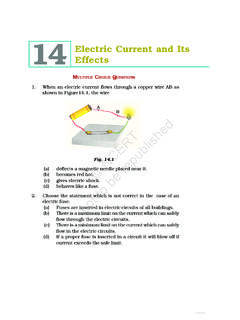
ncert.nic.in76 EXEMPLAR PROBLEMS 3. Three bulbs A, B, C are connected in a circuit as shown in Figure 14.2. When the switch is ‘ON’ (a) bulb C will glow first. (b) bulb B and C will glow simulaneously and bulb A will
SEMICONDUCTOR AND SIMPLE CIRCUITSnot to be …
ncert.nic.in469 Semiconductor Electronics: Materials, Devices and Simple Circuits semiconductors. However , after 1990, a few semiconductor devices using organic semiconductors and semiconducting polymers have been
ENVIRONMENTAL CHEMISTRY - National Council …
ncert.nic.in400 CHEMISTRY (c) Hydrocarbons: Hydrocarbons are composed of hydrogen and carbon only and are formed by incomplete combustion of fuel …
LAWS OF MOTION
ncert.nic.inLAWS OF MOTION 91 In practice, the ball does come to a stop after moving a finite distance on the horizontal plane, because of the opposing force of friction which
DESIGN OF THE QUESTION PAPER Mathematics …
ncert.nic.inDESIGN OF THE QUESTION PAPER, SET-I 207 (A) 18 5 (B) 17 5 (C) 17 8 (D) 1 7. In the adjoining figure, PA and PB are tangents from a point P to a circle with centre O.
CHAPTER 10
ncert.nic.in(A) Main Concepts and Results Circle, radius, diameter , chord, segment, cyclic quadrilateral. • Equal chords of a circle (or of congruent circles) subtend equal angles at the
INDIA : CLIMATE, VEGETATION AND WILDLIFE
ncert.nic.inINDIA : CLIMATE, VEGETATION AND WILDLIFE 59 year. Therefore, they always appear gr een and are called evergreen forest as you may notice in Figure
Objectives Polymers - National Council of …
ncert.nic.in427 Polymers C:\Chemistry-12\Unit-15.pmd 28.02.07 Polymers can also be classified on the basis of mode of polymerisation into two sub groups.
TEXTBOOK IN GEOGRAPHY FOR CLASS IX
ncert.nic.inFOREWORD The National Curriculum Framework, (NCF) 2005, recommends that children’s life at school must be linked to their life outside the school. This principle
Related documents

Oxidation Numbers: Rules
www.chem.tamu.edu9 The Continuous Range of Bonding Types Covalent and ionic bonding represent two extremes: In pure nonpolar covalent bonds electrons are equally shared by the atoms In pure electrostatic ionic bonds electrons are completely transferred from one atom to the other Most compounds fall somewhere between these two extremes

AP Chemistry- Practice Bonding Questions for Exam
www.quia.comcovalent bonds. e. the difference between the number of valence electrons in a free atom and the number of ... B PTS: 1 OBJ: 9.3 Bonding in Ionic Compounds. ANS:20. E PTS: 1 OBJ: 9.6 Exceptions to the Octet Rule. ANS:21. C PTS: 1 OBJ: 9.9 Molecular Polarity. ANS:22. B PTS: 1

Chapter 17: Amines and Amides
www.chem.latech.eduTwo types of organic nitrogen-containing compounds are the focus of this chapter amines and amides. Amines are carbon-hydrogen-nitrogen ... Nitrogen atoms forms three covalent bonds and has the following bonding ... 2.1 = 0.9) is less than that between O and H (3.5 - 2.1 = 1.4) ...

1331 – CHAPTER 11 QUESTIONS IGNORE QUESTIONS 3, 10, …
uh.edu9. When liquid bromine is cooled to form a solid, which of the following types of solid would it form? A. atomic B. metallic C. molecular D ionic E. covalent network 10. Which one of the following substances does not exist in the indicated solid type? A. graphite – network covalent B. Na – metallic C. SiO2 - molecular
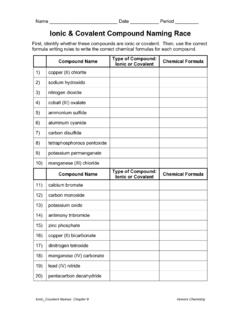
Ionic & Covalent Compound Naming Race
www.gardencity.k12.ny.usIonic_Covalent Names: Chapter 9 Honors Chemistry Ionic & Covalent Compound Naming First, identify whether these compounds are ionic or covalent. Then, use the correct naming rules to write the correct names for each compound. Chemical Formula Type of Compound: Ionic or Covalent Compound Name 21) CdBr 2 22) Cr(Cr 2O 7) 3 23) SBr 2 24) (NH 4) 2CrO 4

Chapter 1 Organic Compounds: Alkanes
www.angelo.eduChapter 1 Alkanes 6 11 What’s So Great About Carbon? • Carbon atoms can form stable bonds to many other elements (H, F, Cl, Br, I, O, N, S, P, etc.). Most organic compounds contain a few hydrogens, and sometimes oxygen, nitrogen, sulfur, phosphorus, etc.

I. Multiple Choice Questions (Type-I) - Byju's
cdn1.byjus.comNCERT Exemplar Solutions for Class 11 Chemistry Chapter 12 Organic Chemistry Some Basic Principles and Techniques. 4. Electronegativity of carbon atoms depends upon their state of hybridisation. In which of the following compounds, the carbon marked with an asterisk is . most electronegative? (i) CH3 – CH2 – *CH2 –CH3 (ii) CH3 – *CH ...