
Chemical Engineering Design - Elsevier.com
Butterworth-Heinemann is an imprint of Elsevier The Boulevard, Langford Lane, Kidlington, Oxford, OX5 1GB, UK 225 Wyman Street, Waltham, MA 02451, USA
Download Chemical Engineering Design - Elsevier.com

Information
Domain:
Source:
Link to this page:
Documents from same domain
Introduction to Corrosion - Elsevier
booksite.elsevier.comIntroduction to Corrosion 1.1 Historical Background ... Ideas on corrosion control started to be generated at the begin-ning of nineteenth century. Whitney (1903)
1.05 Basic Concepts of Corrosion - Elsevier
booksite.elsevier.commetalanditsanticipatedlife.Atoneextreme,corrosion control in certain environments may be effectedby the ... Basic Concepts of Corrosion 91. of species in solution, ...
1 Air-conditioning fundamentals - Elsevier
booksite.elsevier.com1 Air-conditioning fundamentals The aim of this chapter is to: Give an overview of the historical development of the heating and ventilation system and introduction of the air-conditioning (A/C) system. Provide the reader with a case study on the design and optimisation of an air-conditioning (A/C) system. Enable the reader to understand the fundamental principles and operation of the heating,

DIGITAL ELECTRONICS AND DESIGN WITH VHDL - Elsevier
booksite.elsevier.comDIGITAL ELECTRONICS AND DESIGN WITH VHDL ... 1.13 Circuit Synthesis and Simulation with VHDL 19 1.14 Circuit Simulation with SPICE 19 1.15 Gate-Level versus Transistor-Level Analysis 20 2 Binary Representations 21 2.1 Binary Code 21 2.2 Octal and Hexadecimal Codes 24

Chapter 4 - The First Law of Thermodynamics and …
booksite.elsevier.com100 CHAPTER 4: The First Law of Thermodynamics and Energy Transport Mechanisms In summary, Emmy Noether’s theorem shows us that (Table 4.1) Symmetry under translation produces the conservation of linear momentum.
An Introduction to Stochastic Modeling - booksite.elsevier.com
booksite.elsevier.comAn Introduction to Stochastic Modeling Fourth Edition Mark A. Pinsky Department of Mathematics Northwestern University Evanston, Illinois Samuel Karlin

A GRAPHICAL SYMBOLS FOR PIPING SYSTEMS AND PLANT
booksite.elsevier.comAPPENDIX A GRAPHICAL SYMBOLS FOR PIPING SYSTEMS AND PLANT A- 3. Upshot heater Where complex burners are employed the ‘‘burner block’’ may be detailed elsewhere on the drawing, thus ... Fluid contacting vessel (basic symbol) Fluid contacting vessel Support grids and distribution details may be shown Reaction or absorption vessel
4.18 Principles of Cathodic Protection - Elsevier
booksite.elsevier.com4.18 Principles of Cathodic Protection V. Ashworth This article is a revision of the Third Edition article 10.1 by V. Ashworth, volume 2, pp 10:3–10:28, 2010 Elsevier B.V. ... corrosion of a metal (since to be a cathodic reactant, anyparticular species mustsimplyact asanoxidizing O
CHAPTER ONE - Elsevier
booksite.elsevier.comCHAPTER ONE STRESSES AND STRAINS 1.1 Introduction The theory of plasticity is the branch of mechanics that deals with the calculation of stresses and strains in a body, made of ductile material, permanently deformed ... the stress–strain curve proceeds …
CHAPTER Utilities and Energy Efficient Design 3 - Elsevier
booksite.elsevier.comThe design of a network of heat exchangers for heat recovery can be a ... The design of fired heaters is described in Section 19.17. The cost of fired heat can be calculated from the price of the fuel fired. Most fired process heaters use natural gas as fuel, as ... 106 CHAPTER 3 Utilities and Energy Efficient Design.
Related documents

PHYSICS IGCSE 2012 EXAM REVISION NOTES
mrtremblaycambridge.weebly.com2.1 a. States of matter b. Molecular model c. Evaporation d. Pressure changes 2.2 Thermal properties a. Thermal expansion of solids, liquids and gases b. Measurement of temperature c. Thermal capactiy d. Melting and boiling 2.3 Transfer of thermal energy a. Conduction b. Convection c. Radiation d. Consequences of energy transfer 3.

IGCSE
chemistry-igcse1.weebly.comThere are 3 states of matter, solids, liquids and gases. Solids: The particles are packed closely together. The forces between particles are strong enough so that the particles cannot move freely but can only vibrate. As a result, a solid has a stable, definite shape, and a definite volume. Solids can only change
Section 9: Hazardous Materials - CDL Study
www.cdlstudy.comFlammable Gases Non-Flammable Gases Poisonous/Toxic Gases Propane Helium Fluorine, Compressed 3 --- Flammable Liquids Gasoline 4 4.1 4.2 4.3 Flammable Solids Spontaneously Combustible Spontaneously Combustible When Wet Ammonium Picrate, Wetted White Phosphorus Sodium 5 5.1 5.2 Oxidizers Organic Peroxides Ammonium Nitrate Methyl Ethyl …

Average Mark: 20.9 /30 42.2 /70 19.2 /30 - JABchem
jabchem.org.ukC Solids have lower entropy/disorder than liquids or gases. (sulphur m.pt. =115oC) D Liquid phosphorus (m.pt.=44oC) has higher entropy (disorder) than solid sulphur 11 B 70 Rate = k [A] [B]2 Reactant A is first order and Reactant B is second order
Cambridge International Examinations Cambridge ...
www.cambridgeinternational.orgA It is accelerating because its speed is changing. ... 19 Which line in the table shows the relative expansion of the three states of matter from the most expansion to the least expansion? ... gases gases > > > > liquids gases liquids solids > > > > gases liquids solids liquids 20 The diagram shows a liquid-in-glass thermometer. –10 0 10 20 ...
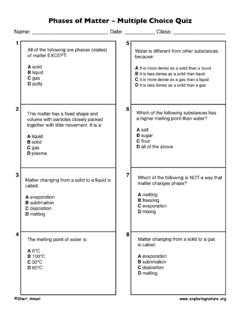
Phases of Matter – Multiple Choice Quiz - Exploring Nature
www.exploringnature.orgmodels of solids, liquids, and gases to show that adding or removing thermal energy increases or decreases kinetic energy of the particles until a change of state occurs. Examples of models could include drawing and diagrams. Examples of particles could include molecules or …