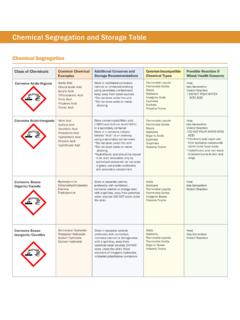
Chemical Segregation Table
Corrosive Acids-Organic Acid Glacial Acetic Acid Butyric Acid Trifluoroacetic Acid Picric Acid Propionic Acid Formic Acid Store in ventilated corrosives using secondary containment, keep away from water sources *Do not store under the sink *Do not store acids on metal shelving Flammable L Flammable Solids Bases Oxidizers Inorganic Acids Cyanides
Download Chemical Segregation Table

Information
Domain:
Source:
Link to this page:
Documents from same domain
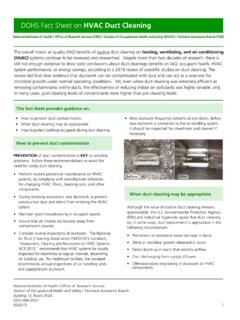
HVAC Duct Cleaning - National Institutes of Health
ors.od.nih.govDivision of Occupational Health and Safety . The dirty filter/vent above indicate a cleaning is needed and should be performed by a professional . DOHS Fact Sheet on . HVAC Duct Cleaning . National Institutes of Health • Office of Research Services (ORS) • Division of Occupational Health and Safety (DOHS) • Technical Assistance Branch (TAB)
Contractor Health and Safety Requirements
ors.od.nih.gova. Contractor Safety Program Assessment: The NIH is committed to providing a safe environment for its employees, guests, and patients. Safety, as demonstrated during previous contracts, may be used in the past performance evaluation of a Contractor. Contractors are required to enroll in the Contractor Safety Assessment Program (CSAP).
Guidance for the Selection of Laboratory Coats
ors.od.nih.govThis reference document provides a general overview for selection of laboratory coats. It does not alter or determine compliance responsibilities in OSHA standards or NIH’s Manual Chapter 1340. Because interpretations and policy may change over time, you should your consult with your Institute's Safety and Health Specialist.
Protocol for Use and Maintenance of Oxygen Monitoring …
ors.od.nih.govdisplacement of oxygen. At a minimum, the following factors should be used in determining if a device should be installed: manufacturer (e.g., magnet) guidance, volume of gas used, location of gas, and air changes/hour in the room/area. The 2008 NIH DRM notes that both ‘carbon dioxide manifold rooms…
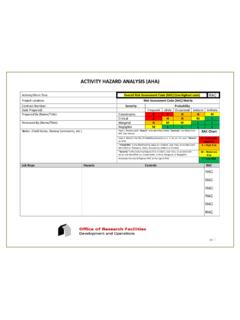
ACTIVITY HAZARD ANALYSIS (AHA)
ors.od.nih.govACTIVITY HAZARD ANALYSIS (AHA) Activity/Work Task: Overall Risk Assessment Code (RAC) (Use highest code) Project Location: Risk Assessment Code (RAC) Matrix . ... " is the likelihood to cause an incident, near miss, or accident and identified as: Frequent, Likely, Occasional, Seldom or Unlikely . H = High Risk "

Computer Workstation Ergonomics: Self-Assessment Checklist
ors.od.nih.govSelf Assessment Computer Workstation Ergonomics: Self-Assessment Checklist . The goal of this self-assessment is to help you set up your workstation for optimal comfort and performance. For more information, refer to the . National Institutes of Health, Office of Research Services, Division of Occupational Health and Safety website.
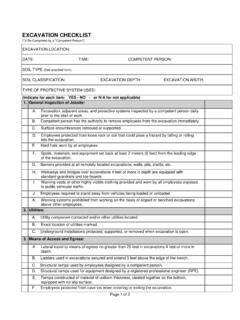
EXCAVATION CHK LST
ors.od.nih.govinto the excavation. rolling E. Hard hats worn by all employees. F. Spoils, materials, and equipment set back at least of the excavation. 2 meters (6 feet) from the leading edge G. Barriers provided at all remotely located excavations, wells, pits, shafts, etc. H. Walkways and bridges over excavations 4 feet or more in depth are equipped
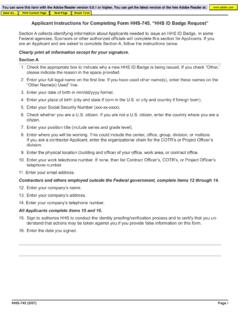
Applicant Instructions for Completing Form HHS-745, “HHS ...
ors.od.nih.govApplicant Instructions for Completing Form HHS-745, “HHS ID Badge Request” Section A collects identifying information about Applicants needed to issue an HHS ID Badge. In some Federal agencies, Sponsors or other authorized offi cials will complete this section for Applicants. If …
NIH Chemical Hygiene Plan
ors.od.nih.govBSC Biological Safety Cabinets CFH Chemical Fume Hood CFR Code of Federal Regulations CHO Chemical Hygiene Officer ... eyes, or mucus membranes. Physical hazards include, but are not limited to, chemicals which are explosive, flammable, or corrosive. (Definition listed in . Appendix F “Glossary of Terms.”) III.

Safety and Health Program Audit Tool
ors.od.nih.govImplemented Evidence of Implementation . A mechanism is established to exchange information about hazards present in the workplace and measures in place to prevent or control them. for all contractors to use to report injuries, hazards, and concerns. Host employers include any safety - related specifications and qualifications requirements for
Related documents
Nutrients: Phosphorus, Nitrogen Sources, Impact on Water ...
www.pca.state.mn.usPhosphorus occurs in dissolved organic and inorganic forms or attached to sediment particles. Phosphates, the inorganic form, are preferred for plant growth, but other forms can be used when phosphates are unavailable. Phosphorus builds up in the sediments of a lake. When it remains in the sediments it is generally

SOIL NUTRIENTS, SOURCES AND UPTAKE
www.agronomy.k-state.eduo Soil organic matter is approximately 5% N and 0.5% P or S. o Organic matter is also the primary reservoir for available forms of most of the micronutrients. o Potassium is an important exception and does not exist in organic forms. Even though plants are not able to utilize nutrients in organic matter directly,

Carbon and Nitrogen Cycles
faculty.weber.eduElements move from large sources to sinks " Reservoirs provide both ! Ocean important for carbon, nitrogen ! Land important for sulfur ! Oxidation state governs element reactivity " Nitrogen gas ... " Moves from organic to inorganic forms " Not often present in reduced form . Microbiology: An Evolving Science ...
Inherent Factors Affecting Soil Nitrogen
www.nrcs.usda.govBesides nitrogen (N2) gas within soil pore space, nitrogen is found in both organic and inorganic forms in soil. Organic forms occur in soil organic matter which consists of three primary parts including small (fresh) plant residues and small living soil organisms, decomposing (active) organic matter, and stable organic matter.
SOIL FERTILITY AND NUTRIENT MANAGEMENT
nmsp.cals.cornell.eduOct 26, 2016 · to inorganic N sources. This is accomplished by a wide variety of microorganisms. o Immobilization is the reverse of mineralization as this refers to the conversion of inorganic forms of nitrogen into organic forms, such as microbial cells and organic matter.
Compilation of Henry’s Law Constants for Inorganic and ...
www.ready.noaa.govCompilation of Henry’s Law Constants for Inorganic and Organic Species of Potential Importance in Environmental Chemistry http://www.mpch-mainz.mpg.de/~sander/res ...

ORGANIC CANNABIS GROWERS GUIDE - Dr Earth
drearth.comImportant for nitrogen fixation, chlorophyll synthesis and used in other enzymes and proteins. DEFICIENCY: more likely in alkaline soil. Causes yellowing between enlarged veins and short, skinny stems. Important for nitrogen metabolism and protein synthesis. Needed to convert inorganic phosphates to organic forms. DEFICIENCY: occurs mainly

NUTRIENT DEFICIENCY SYMPTOMS
www.mgofmc.orgNITROGEN (N) Nitrogen is mobile in plants. The mobility in soil is dependent on the chemical form of the element used. Organic N is not available to plants until it has been converted to an inorganic form by soil bacteria. Uptake inhibited by high phosphorus levels. N/K ratio is important: high N/low K favors vegetative growth; low

An Introduction to the Nitrogen Cycle
glaquarium.orgthe form of inorganic nitrate (NO 3-). Nitrogen is one of the limiting factors for plant growth. Animals get the nitrogen they need by consuming plants or other animals that contain organic molecules composed partially of nitrogen. When organisms die, …