Child Well-Being
strategies, as well as policy and program initiatives. These theories and themes underlie child development research and are critical for understanding the development of vulnerable young children. A whole-child perspective on child well-being. As noted, this paper takes a “whole child” perspective. Much research on children
Download Child Well-Being

Information
Domain:
Source:
Link to this page:
Documents from same domain

Evaluation 8 - Program Quality Assessment Tools
www.childtrends.orgrefer to the criteria, standards, or models that are used to assess program quality. These criteria, standards, or These criteria, standards, or models may be used to assess the different components that comprise “quality.”

Early Childhood Policy Focus: Healthy Eating and Physical ...
www.childtrends.orgHealthy Eating and Physical Activity By David Murphey, Bonnie Mackintosh and Marci McCoy-Roth ... Poor diet and lack of exercise contribute to obesity, which has been associated with higher rates of many diseases (e.g. diabetes ... (nutrition, physical activity, or …
Conceptualizing and Measuring “Healthy Marriage” For ...
www.childtrends.orgConceptualizing and Measuring “Healthy Marriages” For Empirical Research and Evaluation Studies: A Compendium of Measures- Part I (Task One)
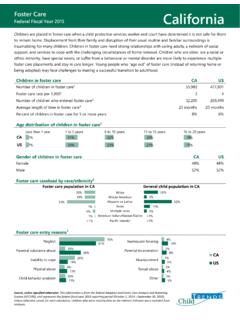
Foster Care California - Child Trends
www.childtrends.orgFoster Care California . Case plan goal for children in foster care8 Number of different foster care placements9 Foster care by placement type10 Outcomes of children exiting foster care11 Aging out of foster care CA US Of children who aged out of foster care, percent who had been in care since before age 13 24% 20%

Transition-Age Youth in Foster Care in California
www.childtrends.orgWho are the transition-age youth in foster care in CA? CA US Number of transition-age youth (16 to 21 year olds) in foster care in 20151 18,277 113,829 Number of transition-age youth who emancipated or aged out of foster care in 2015 4,261 20,698
Fact Sheet - Child Trends
www.childtrends.org2. Fact Sheet: Adverse Childhood Experiences and . the Well-Being of Adolescents. The relationship between adverse experiences and child well-being
Research Brief - Child Trends
www.childtrends.org2. Research Brief. Adverse Childhood Experiences: NATIONAL AND STATE-LEVEL PREVALENCE . Research Brief. MEASUREMENT OF ADVERSE CHILDHOOD EXPERIENCES. We measured the prevalence of eight adverse childhood experiences (ACEs), consisting of whether
DEFINING THE TERM “AT RISK” - Child Trends
www.childtrends.org1 DEFINING THE TERM “AT RISK” Kristin Anderson Moore, Ph.D WHAT DOES “AT RISK” MEAN? The term at risk is used frequently to describe children and youth and has a strong intuitive meaning. However, the term has no consistent definition and can be viewed as stigmatizing certain groups.

USING INCENTIVES TO INCREASE PARTICIPATION IN OUT-OF ...
www.childtrends.orgcomponents (e.g., skill-building, activities of interest, leadership opportunities, and supportive adult program leadership) retains their interest and involvement.51, 52, 53 REMEMBER THE 4 TIPS FOR CHOOSING AND OBTAINING INCENTIVES 1: Ask program participants for ideas about incentives. 2: Introduce incentives immediately after goals are reached.

Reaching and Engaging with Hispanic Communities
www.childtrends.orgThe Crimsonbridge Foundation is honored to present Reaching and Engaging with the Hispanic Community: A Research-Informed Communication Guide for Nonprofits, Policymakers and Funders. This guide is designed to help service providers and educators build communication strategies to more easily and effectively reach out to Latino children and ...
Related documents
Placement of Children With Relatives - Child Welfare
www.childwelfare.govan Indian child’s tribe to be considered “extended family members” for placement purposes. 9. In 28 states, the District of Columbia, and Guam, when a suitable relative cannot be found, the agency may consider placing the child with “fictive kin.” 10. The term “fictive kin” refers to a person who is not related to the
Child Care Staff Certification Guide - Alberta
www.humanservices.alberta.cathe three levels of certification in accordance with the Alberta Child Care Licensing Regulation. Early learning and child care in Alberta is a regulated occupation. Individuals who work in licensed day care, pre-school and out-of-school care programs must hold a provincial child care staff certificate issued by the Alberta Government.

Department of Mental Health
www.dmh.ms.govform, a parent or next of kin can sign if they indicate they are signing as such. Physical, mental or cognitive ability to sign and understand the form must be determined by a medical doctor or psychologist. Documentation must be maintained in the record.

Medi-Cal Aid Codes
transformcalfresh.orgNov 18, 2016 · 4E Hospital Presumptive Eligibility for Former Foster Care Children up to age 26 4F Kin-GAP Cash Assistance - Federal 4G Kin-GAP Cash Assist. - NonFederal 4H Foster Care children in CalWORKs 4K EA Foster Care - Probation 4L Foster Care children in 1931 (b) 4M Extended M-C Former Foster Care 4N State CW NMD 4S Federal EFC KG/FFP Medi-Cal

Licensing and Public Regulation of Early Childhood …
www.naeyc.orgchild care providers is found in the recorded increase in the number of home-based participants in the USDA Child and Adult Care Food Program (regulation being a requirement of participation) from 82,000 in 1986 to nearly 200,000 in 1996 (Morawetz 1997). Lack of meaningful sanctions makes enforcement of existing regulations difficult (Gormley ...

CalWORKs Aid Codes Code Funding Exempt Family Type …
hhsaprogramguides.sandiegocounty.govCode Funding Exempt MAP Family Type Program/Description 4N State Provides full scope, no share of cost Medi-Cal benefits and state assistance payment (extended CalWORKs benefits) to Non-Minor Dependents (NMD) over 18 but under 21 years of age; living with an approved CalWORKs relative who is not eligible for Kin-GAP or foster care.