Child Well-Being
Chapter 3: Risk and Protective Factors.....41 I. Environmental promotive/protective factors.....42 Family/relational promotive and protective factors ... Survey—Birth and Kindergarten Cohorts—and the National Survey of Child and Adolescent Well-Being, as well as measures used in community studies and clinical ...
Download Child Well-Being

Information
Domain:
Source:
Link to this page:
Documents from same domain

Evaluation 8 - Program Quality Assessment Tools
www.childtrends.orgrefer to the criteria, standards, or models that are used to assess program quality. These criteria, standards, or These criteria, standards, or models may be used to assess the different components that comprise “quality.”

Early Childhood Policy Focus: Healthy Eating and Physical ...
www.childtrends.orgHealthy Eating and Physical Activity By David Murphey, Bonnie Mackintosh and Marci McCoy-Roth ... Poor diet and lack of exercise contribute to obesity, which has been associated with higher rates of many diseases (e.g. diabetes ... (nutrition, physical activity, or …
Conceptualizing and Measuring “Healthy Marriage” For ...
www.childtrends.orgConceptualizing and Measuring “Healthy Marriages” For Empirical Research and Evaluation Studies: A Compendium of Measures- Part I (Task One)
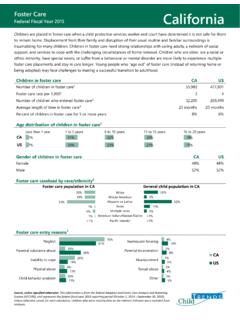
Foster Care California - Child Trends
www.childtrends.orgFoster Care California . Case plan goal for children in foster care8 Number of different foster care placements9 Foster care by placement type10 Outcomes of children exiting foster care11 Aging out of foster care CA US Of children who aged out of foster care, percent who had been in care since before age 13 24% 20%

Transition-Age Youth in Foster Care in California
www.childtrends.orgWho are the transition-age youth in foster care in CA? CA US Number of transition-age youth (16 to 21 year olds) in foster care in 20151 18,277 113,829 Number of transition-age youth who emancipated or aged out of foster care in 2015 4,261 20,698
Fact Sheet - Child Trends
www.childtrends.org2. Fact Sheet: Adverse Childhood Experiences and . the Well-Being of Adolescents. The relationship between adverse experiences and child well-being
Research Brief - Child Trends
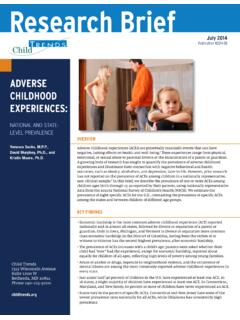
www.childtrends.org2. Research Brief. Adverse Childhood Experiences: NATIONAL AND STATE-LEVEL PREVALENCE . Research Brief. MEASUREMENT OF ADVERSE CHILDHOOD EXPERIENCES. We measured the prevalence of eight adverse childhood experiences (ACEs), consisting of whether
DEFINING THE TERM “AT RISK” - Child Trends
www.childtrends.org1 DEFINING THE TERM “AT RISK” Kristin Anderson Moore, Ph.D WHAT DOES “AT RISK” MEAN? The term at risk is used frequently to describe children and youth and has a strong intuitive meaning. However, the term has no consistent definition and can be viewed as stigmatizing certain groups.

USING INCENTIVES TO INCREASE PARTICIPATION IN OUT-OF ...
www.childtrends.orgcomponents (e.g., skill-building, activities of interest, leadership opportunities, and supportive adult program leadership) retains their interest and involvement.51, 52, 53 REMEMBER THE 4 TIPS FOR CHOOSING AND OBTAINING INCENTIVES 1: Ask program participants for ideas about incentives. 2: Introduce incentives immediately after goals are reached.

Reaching and Engaging with Hispanic Communities
www.childtrends.orgThe Crimsonbridge Foundation is honored to present Reaching and Engaging with the Hispanic Community: A Research-Informed Communication Guide for Nonprofits, Policymakers and Funders. This guide is designed to help service providers and educators build communication strategies to more easily and effectively reach out to Latino children and ...
Related documents
The Windshield Survey will Include the Following: A Cover ...
publichealth.casn.caWindshield Survey “Community Assessment is a systematic process: it is the act of becoming acquainted with a community” (Vollman, Anderson & McFarlane, 2004, p. 203). Its purpose is to become familiar with the community and the population by examining factors which impact the health of the population.

Guidance Notes on the Application and Inspection of Marine ...
ww2.eagle.orgThe Performance Standards for Protective Coatings (PSPC) are intended to standardize the from IMO requirements for protective coatings for ballast tanks, cargo oil tanks and void spaces for a target of 15 years of useful life. A good quality protective coating can delay the onset of corrosion of the structure. The
Preventing Child Sexual Abuse - Centers for Disease ...
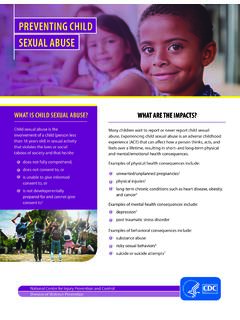
www.cdc.govand protective factors Disseminate and implement evidence-based policies, programs, and practices Improve surveillance systems and data collection Strengthen and develop evidence-based policies, programs, and practices . Youth and family-serving organizations, public/governmental agencies, faith communities, and others must have the
DEFINING THE TERM “AT RISK” - Child Trends
www.childtrends.orgAssets, strengths, and protective factors also can be valuable to assess. Even though some children, families, and communities face multiple risks, most also will have assets and protective factors.1 For example, a positive, caring relationship with a parent can inoculate against many risks.2 Ongoing positive relationships with other adults
What Factors Contribute to Child Abuse and Neglect?
www.childwelfare.govprotective factors can help to prevent child abuse and neglect. For example, prevention programs may focus on increasing social supports for families ... • A national survey of nearly 1,000 parents found that 7.4 percent of children who lived with one
Child Neglect: A Guide for Prevention, Assessment and ...
www.childwelfare.govCHILD ABUSE AND NEGLECT USER MANUAL SERIES . Child Neglect: A Guide for . Prevention, Assessment . and Intervention. U.S. Department of Health and Human Services
Risk Factors for Delinquency: An Overview
www.ojp.govprotective factors. Pollard, Hawkins, and Arthur (1999:146) note that “protective factors are those factors that mediate or moderate the effect of exposure to risk factors, resulting in reduced incidence of problem behavior.” Rutter (1987) believes that protective factors offset the onset of delinquency via four main processes: reducing risk,