Child Well-Being
• Behavior problems, including aggression, oppositional/defiant disorder and bullying Physical health and safety • Overall health status • Special health care needs/ chronic conditions • Growth and weight • Physical safety • Stress-related disorders (hormonal, metabolic, immunologic) • Sleep problems
Download Child Well-Being

Information
Domain:
Source:
Link to this page:
Documents from same domain

Evaluation 8 - Program Quality Assessment Tools
www.childtrends.orgrefer to the criteria, standards, or models that are used to assess program quality. These criteria, standards, or These criteria, standards, or models may be used to assess the different components that comprise “quality.”

Early Childhood Policy Focus: Healthy Eating and Physical ...
www.childtrends.orgHealthy Eating and Physical Activity By David Murphey, Bonnie Mackintosh and Marci McCoy-Roth ... Poor diet and lack of exercise contribute to obesity, which has been associated with higher rates of many diseases (e.g. diabetes ... (nutrition, physical activity, or …
Conceptualizing and Measuring “Healthy Marriage” For ...
www.childtrends.orgConceptualizing and Measuring “Healthy Marriages” For Empirical Research and Evaluation Studies: A Compendium of Measures- Part I (Task One)
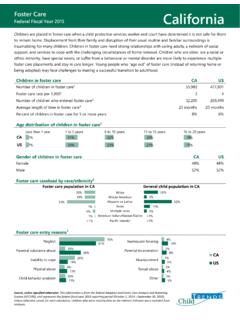
Foster Care California - Child Trends
www.childtrends.orgFoster Care California . Case plan goal for children in foster care8 Number of different foster care placements9 Foster care by placement type10 Outcomes of children exiting foster care11 Aging out of foster care CA US Of children who aged out of foster care, percent who had been in care since before age 13 24% 20%

Transition-Age Youth in Foster Care in California
www.childtrends.orgWho are the transition-age youth in foster care in CA? CA US Number of transition-age youth (16 to 21 year olds) in foster care in 20151 18,277 113,829 Number of transition-age youth who emancipated or aged out of foster care in 2015 4,261 20,698
Fact Sheet - Child Trends
www.childtrends.org2. Fact Sheet: Adverse Childhood Experiences and . the Well-Being of Adolescents. The relationship between adverse experiences and child well-being
Research Brief - Child Trends
www.childtrends.org2. Research Brief. Adverse Childhood Experiences: NATIONAL AND STATE-LEVEL PREVALENCE . Research Brief. MEASUREMENT OF ADVERSE CHILDHOOD EXPERIENCES. We measured the prevalence of eight adverse childhood experiences (ACEs), consisting of whether
DEFINING THE TERM “AT RISK” - Child Trends
www.childtrends.org1 DEFINING THE TERM “AT RISK” Kristin Anderson Moore, Ph.D WHAT DOES “AT RISK” MEAN? The term at risk is used frequently to describe children and youth and has a strong intuitive meaning. However, the term has no consistent definition and can be viewed as stigmatizing certain groups.

USING INCENTIVES TO INCREASE PARTICIPATION IN OUT-OF ...
www.childtrends.orgcomponents (e.g., skill-building, activities of interest, leadership opportunities, and supportive adult program leadership) retains their interest and involvement.51, 52, 53 REMEMBER THE 4 TIPS FOR CHOOSING AND OBTAINING INCENTIVES 1: Ask program participants for ideas about incentives. 2: Introduce incentives immediately after goals are reached.

Reaching and Engaging with Hispanic Communities
www.childtrends.orgThe Crimsonbridge Foundation is honored to present Reaching and Engaging with the Hispanic Community: A Research-Informed Communication Guide for Nonprofits, Policymakers and Funders. This guide is designed to help service providers and educators build communication strategies to more easily and effectively reach out to Latino children and ...
Related documents

Functional Family Therapy - Office of Justice Programs
www.ojp.govrelational systems (i.e., are functional). FFT is a multisystemic prevention pro-gram, meaning that it focuses on the mul-tiple domains and systems within which adolescents and their families live. FFT is also multisystemic and multilevel as an intervention in that it focuses on the treatment system, family and individual

Bullying in Elementary Schools: Its Causes and Effects on ...
files.eric.ed.govthe aggression against the target, assistants are considered followers who help the bully and engage in aggression against friends, rein forcers are those group members who provide attention to then bully and provide feedback about the bully’s destructive behavior (Salmivalli et al., 1996). While two roles are associated with victim in two
Psychologically Safe and Healthy Workplaces: Risk ...
www.commerce.wa.gov.auRelational fairness refers to the degree of dignity and respect afforded to an employee during the process. Employees may also experience psychological injuries from aggressive or violent incidents that occur in the workplace. Psychological injuries from aggression and violence can occur from either

Bullying in School: Prevalence, Contributing Factors, and ...
www.rochester.eduForms of bullying: physical, verbal, relational, and cyber. Research has explored the prevalence of traditional bullying, which encompasses both physical, verbal, and relational aggression that occurs during the day, usually in or near school (e.g., bus), where perpetrators and victims are known to each other in the physical world.

Human Sexuality: How Do Men and Women Differ?
sites.oxy.eduAGGRESSION A third gendered pattern con-cerns the association between sexu-ality and aggression. This link has been demonstrated in many do-mains, including individuals’ sex-ual self-concepts, the initiation of sex in heterosexual relationships, and coercive sex. Andersen, Cyranowski, and Es-pindle (1999) investigated the di-

2022 NEW OR REVISED MATERIAL IS FLAGGED ON ITEM …
www.naeyc.orgJan 01, 2022 · Examples of challenging behavior: Physical aggression (hitting, biting, shoving, whacking with toys), relational aggression ["You can't play with us"], verbal bullying, tantrums, whining, testing limits, refusal to follow directions or observe classroom rules. 3.C - Supervising Children 3C.9 I T NEW ITEM LANGUAGE 2022

BULLYING IN SOCIAL MEDIA: AN EFFECT STUDY OF CYBER ...
www.pjcriminology.comJan 09, 2019 · aggression, stress or depression due to the cyber bullying. Academic performance denotes to an educational status of youth that is being affected by the cyber bullying. Social relationship gap refers to the disturbance between the bonding of two close friends or family due to cyber bullying. Findings and Results

2022 SEPA program - first draft
www.sepaonline.comCluster 1: Aggression 1. Retrospective Beliefs About Same-Sex Child Sexual Abuse. Kayla Spenard, Nicholas Simons, & Daniella Cash, Sam Houston State University 2. The Effects of Race on Bystander Intervention in Sexual Assaults. Laura Pazos, Adriana Lopez, & Daniella Cash, Sam Houston State University 3.