“Children SEE – Children DO”
Tom is frustrated when his stuffed animal, Pippo, keeps falling off the back of his bike. However, his older friend helps him make a seat for Pippo and reassures him that someday he will have a
Download “Children SEE – Children DO”

Information
Domain:
Source:
Link to this page:
Documents from same domain

Overview of Resilience- and Strength-based …
www.reachinginreachingout.comAPPENDIX E: Annotated Compendium of Resilience Measures Compendium of Selected Resilience and Related Measures for Children and Youth
“Children SEE – Children DO”
www.reachinginreachingout.com• Set up different stations with activities – blow pretend balloons, bubbles or play cotton ball hockey. • Have parent-child dyads rotate through the activities OR have parent-child dyads all do the same
Introducing Thinking Skills to Promote Resilience …
www.reachinginreachingout.comRIRO –Thinking skills and resilience 1 Introducing Thinking Skills to Promote Resilience in Young Children* Darlene Kordich Hall Jennifer Pearson Reaching IN…Reaching OUT Project (RIRO)
Flexible Thinking
www.reachinginreachingout.comA young girl of Chinese descent resents that her family’s garden is full of vegetables, instead of the beautiful flowers in the neighbouring gardens.

Reaching IN … Reaching OUT
www.reachinginreachingout.comSpecial acknowledgement goes to the Early Childhood Educators and child care centres that participated in Phases 1 & 2 of the RIRO Skills Training program development.

An Introduction to Resilient Thinking
www.reachinginreachingout.comReaching IN … Reaching OUT (RIRO) An Introduction to Resilient Thinking: RIRO ECE COLLEGE CURRICULUM MODULES Connie Winder George Brown College
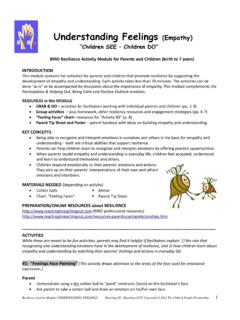
“Children SEE – Children DO”
www.reachinginreachingout.com• Ask parent to look through a book or magazine and name the feelings in the faces for the child. • Have parent and child imitate the faces while looking at each other (being silly helps).
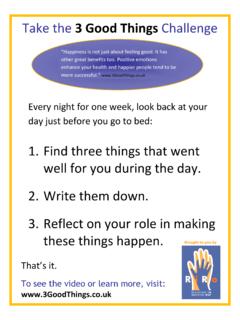
Take the 3 Good Things Challenge Feb24
www.reachinginreachingout.comBrought to you by Take the 3 Good Things Challenge Every night for one week, look back at your day just before you go to bed: 1. Find three things that went well for you during the day.
Related documents
Helping Children Make Transitions between Activities
csefel.vanderbilt.eduProject funded by the Child Care and Head Start Bureaus in the U.S. Department of Health and Human Services Helping Children Make Transitions between Activities
cial, and emotional development. Talking With …
southernearlychildhood.orgFall 2010 DIMENSIONS OF EARLY CHILDHOOD Volume 38, Number 3 3 Everything teachers say—questions, comments, guidance—can influence what children

Photo used with permission: The Princess Royal …
www.caregiving.orgCaregiving in the U.S. 200 9 – A Focused Look at Caregivers of Children Photo used with permission: The Princess Royal Trust for Carers Caregivers of Children:

A Study for Children About the Bible - Children …
www.childrendesiringgod.orgI STAND IN AWE 7 PREFACE 9 INTRODUCTION 11 LESSONS 1 A Message from God 27 2 The Most Special Book 33 3 Written by God 39 4 The Bible is True 45
FAMILY POLICY BRIEFING 7 Caring for children after ...
www.nuffieldfoundation.orgfamily policy briefing 7 isbn 978 -0-9562623-2-5 £5.00 barnett house 32 wellington sq. oxford ox1 2er tel 01865 270325 fax 01865 270324 www.spi.ox.ac.uk

Cyberbullying: What Parents Can Do to Protect …
www.pacer.orgCyberbullying: What Parents Can Do to Protect Their Children Sponsored by: CenturyLink.com/Help
“Children SEE – Children DO”
www.reachinginreachingout.com• Set up different stations with activities – blow pretend balloons, bubbles or play cotton ball hockey. • Have parent-child dyads rotate through the activities OR have parent-child dyads all do the same

Communicating with Children - Response Ability
www.responseability.org© Commonwealth of Australia as represented by the Department of Health and Ageing 2010 What should I do? Remember that children will notice both your verbal and non-verbal communication, so you