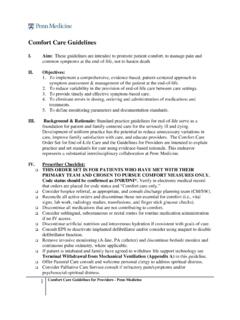
Comfort Care Guidelines
2 Comfort Care Guidelines for Providers - Penn Medicine *Evaluate each patient case individually as extubation may not be appropriate for every patient on comfort care. V. Nursing Orders: Comfort Care Measures Assess patient comfort q15-30 mins initially for pain, dyspnea, secretions, delirium/agitation, anxiety/fear and nausea/vomiting, constipation, and fever.
Download Comfort Care Guidelines

Information
Domain:
Source:
Link to this page:
Documents from same domain

Cross Cultural Communication in Medicine
www.med.upenn.eduCross Cultural Communication in Medicine: Looking Within To See The Outside Better Jerry Johnson, MD

DEPARTMENT OF BIOCHEMISTRY AND BIOPHYSICS …
www.med.upenn.eduprotein form and function friday research discussions department of biochemistry and biophysics spring 2014 from the shorter lab department of biochemistry and biophysics
Symptom Management at the End of Life
www.med.upenn.eduSymptom Management at the End ... • Employ existing knowledge base to provide excellent symptom management to patients • Support skill set of geriatrics fellow on call. Symptoms and Symptom Management ... Smith. Management of hiccups in the palliative care population.
Pennsylvania Department of Health - Cancer Evaluation ...
www.med.upenn.eduThe Pennsylvania Department of Health (PADOH) and the federal Agency for Toxic Substances and Disease Registry (ATSDR) conclude that, based on available data, residents are not currently being exposed to asbestos at a
SEDATION AND PAIN MANAGEMENT/ORIGINAL RESEARCH …
www.med.upenn.eduSEDATION AND PAIN MANAGEMENT/ORIGINAL RESEARCH Randomized Clinical Trial of Etomidate Versus Propofol for Procedural Sedation in the Emergency Department

NIST SP 800-66
www.med.upenn.eduThis Special Publication 800 series reports on ITL’s research, guidelines, and outreach efforts in information system security and its ... SP 800-66 Page 1. DRAFT 2. DRAFT 800-66 assists all agencies seeking further information on the security safeguards discussed in the HIPAA . • • ...
Pain Management for the Geriatric Patient
www.med.upenn.eduAmerican Geriatrics Society, Pharmacologic Management of Persistent Pain in Older Persons. JAGS 2009. Patient controlled analgesia •Barriers •The built in safety • Negated by proxy dosing • Consider provider administered bolus •Hospital • Post op • Pain crisis ...
Benign Paroxysmal Positional Vertigo
www.med.upenn.eduBenign Paroxysmal Positional Vertigo Solomon 421 Figure 2. The Epley maneuver. A, Turn the head 45 degrees toward the affected ear. B, Deliberately move the patient into the supine position, maintaining the head turn. Extend the neck just enough so that the downward ear is below the shoulder.

Cold Weather Outdoor Play Boosts Immune System!
www.med.upenn.eduEmpty water bottle 2 spoonfuls of baking soda 1 spoonful dish soap A few drops of food coloring (red makes it look like lava) 1 ounce of vinegar Next steps: Make a volcano in the snow with hole in the center to hold the water bottle. Add everything except the vinegar to the water bottle.
Coping With and Responding to Psychosis Symptoms
www.med.upenn.edu• Show understanding of the persons feelings about the hallucinations • Can ask about the experience if the person wants to talk about what they are seeing/hearing • Can say when something is not real, while acknowledging they seem real to your relative • Can help him/her tell the difference between real and imaginary (e.g., “it’s your
Related documents

DRUGS USED IN ICU - Weebly
chestgmcpatiala.weebly.comsympathetic drive due to pain, agitation or delirium. ii) Patients in the recovery phase of acute renal failure are often hypertensive.. iii) Hypertension following an ... The following guidelines are used for 1 hour of nebulization. For prescribed dose of 10 mg/h at 15 …

Guidelines for the Overview of the New Pain, Agitation ...
ashpmedia.orgThe Pharmacist's Role in Implementing the New Pain, Agitation, and Delirium Guidelines in the Critical Care Setting 2. Perceived Barriers to Use of Daily Sedation Interruption: Engaging the Bedside RN is the Key! 6.0% 8.0% 11.0% ...

Management of Post Traumatic Brain Injury Agitation
medicine.uams.eduManagement of Post Traumatic Brain Injury (TBI) Agitation Author(s): Peer Reviewed: Finalized: Drafted: Date: Published: 2020 I. Definition, Assessment, Diagnosis A. Agitation Definitions: No consensus 1. Subtype of delirium unique to …
Guidelines for the Management of Excited Delirium / Acute ...
rcem.ac.ukGuidelines for the Management of Excited Delirium / Acute Behavioural Disturbance (ABD) 4 from mildly erratic to a state of extreme agitation and physical exertion. Patients have signs of hyper-adrenergic autonomic dysfunction such as significant tachycardia, marked metabolic acidosis and hyperthermia and
End-of-Life Care: Managing Common Symptoms
www.aafp.orgMar 15, 2017 · Delirium and agitation may be caused by reversible etiologies, which should ... Pain is a common symptom occurring in approximately ... clinical guidelines from …

Example Policies / Protocols Guidelines & Procedures
www.acep.orgassessment including vitals, document chief complaint, and the patient's Richmond Agitation Sedation Scale (RASS). A nonzero RASS has very good sensitivity and specificity for delirium (Han, AEM 2015). An older adult with a non-zero RASS should also have an ESI of 1 or 2. From our Jan 2018 data (most
PALLIATIVE CARE PAIN & SYMPTOM CONTROL GUIDELINES …
www.england.nhs.ukDELIRIUM AND CONFUSION 58 ANXIETY 61 DEPRESSION 64 CONTENTS. ... and/or agitation 106 ¡ Algorithm 6 – Respiratory tract secretions 107 ¡ Algorithm 7 – Breathlessness 108 ... PALLIATIVE CARE PAIN & SYMPTOM CONTROL GUIDELINES FOR ADULTS 9 PAIN 1. Pain assessment

Assessment Algorithm for Sedated Adult ICU Patients ICU ...
www.hqinstitute.orgJul 22, 2005 · ICU Sedation Guidelines of Care Is patient comfortable and at goal for Sedation and ... Intensive Care Delirium Screening Checklist (ICDSC) Pain Delirium Consider potential causes Consider potential ... TSet goal for sedation TARGET: Richmond Agitation Sedation Scale (RASS): 0 to -3 Riker Sedation-Agitation Scale (SAS): 3 to 4 Sedation ...

Essential Medicines in Palliative Care
www.who.intPain 8 Respiratory tract secretions 8 Table 1 – GRADE system 9 Table 2 – Summary of recommended medicines in palliative care 10 References for executive summary 13 Appendix - Monographs and Summary of the Evidence Anorexia 16 Anxiety 20 Constipation 24 Delirium 29 Depression 33 Diarrhoea 40