Communication Chapter 1 - cu
diagram of human communication, we must remember that the process itself is more complicated than a picture or description of it, which are likely to draw. Most of the communication process is in the black box of our central nervous system, the content which we understand vaguely. Most of our current communication models are similar to
Download Communication Chapter 1 - cu

Information
Domain:
Source:
Link to this page:
Documents from same domain

10. Radiation Heat Transfer - cu
www.pathways.cu.edu.egPart B: Heat Transfer Principals in Electronics Cooling MPE 635: Electronics Cooling 98 10. Radiation Heat Transfer 10.1Introduction Radiation heat transfer plays a major role in the cooling of electronics.
9. Forced Convection Correlations - cu
www.pathways.cu.edu.egPart B: Heat Transfer Principals in Electronics Cooling MPE 635: Electronics Cooling 75 9. Forced Convection Correlations Our primary objective is to determine heat transfer coefficients (local and average) for different flow

C3-1 Research Methods and Writing Research Proposals
www.pathways.cu.edu.egResearch Methods and Writing Research Proposals First Published 2005 Published by Center for Advancement of Postgraduate Studies and Research in Engineering Sciences, Faculty of Engineering - Cairo University (CAPSCU)

Chapter 3: Cost Analysis and Estimation
www.pathways.cu.edu.egBreakeven analysis called Cost-volume-profit analysis is an important analytical technique used to study relations among costs, revenues, and profit. Both graphic and algebraic methods are used. For simple problems, simple graphic methods work best. In more complex situations, analytic methods, possibly involving spreadsheet
9. Forced Convection Correlations
www.pathways.cu.edu.egPart B: Heat Transfer Principals in Electronics Cooling MPE 635: Electronics Cooling 77 9.1.1.2 Turbulent Boundary Layer (Rex > 5x10 5) With heating or cooling starting from the leading edge the following correlations are recommended. - Local heat transfer coefficient Recr< Rex ≤10 7 0.0296Re4 / 5 Pr1/ 3 Nux = x Rex >10 7 =1.596Re (lnRe )−2 ...
Related documents
Formal Communication Channels: Upward, Downward ...
www.nationalforum.comFormal Communication Channels: Upward, Downward, Horizontal, and External ... leaving it to the individual staff member to get the big picture. 3. Procedures and practices. These are messages defining the school organization's policies, rules, regulations, benefits, and …

Helping Children Express Their Wants and Needs
csefel.vanderbilt.edupicture schedule (receptive communication). The entire class can be included in this strategy to facilitate transi-tions. For instance, Jeffrey has a difficult time following the schedule of the classroom. His teacher, Mr. Jung, makes a picture schedule for Jeffrey. Mr. Jung takes pictures of things in the room that represent every activity ...
NONVERBAL BEHAVIOR AND NONVERBAL COMMUNICATION
www.columbia.eduNONVERBAL BEHAVIOR AND NONVERBAL COMMUNICATION: WHAT DO CONVERSATIONAL HAND GESTURES TELL US? ROBERT M. KRAUSS, YIHSIU CHEN, AND PURNIMA CHAWLA Columbia University This is a pre-editing version of a chapter that appeared in M. Zanna (Ed.), Advances in experimental social psychology (pp. 389-450). San …
The Psychology of Verbal Communication
www.columbia.eduThe Psychology of Verbal Communication Robert M. Krauss Columbia University Note: This is an unedited version of an article to appear in the forthcoming edition of the International Encyclopedia of the Social and Behavioral Sciences (edited by N. Smelser & P. Baltes). scheduled for publication in 2002.
Lesson Effective Communication Skills
workplacereadinessskills.weebly.comcommunication to the class. Communication is the exchange of information between a sender and a receiver. Communication involves speaking, listening, reading and writing. To be an effective communicator you need to be clear and direct. Ask students what types of communication occur. Some answers might be written, verbal or nonverbal. 2.
Language and Communication-Focused IEPs for Learners …
mn.govcommunication needs of the child, and in the case of the child who is deaf or hard of hearing, consider the child’s ... The following components are vital to the IEP process: presenting a clear picture of the student's fluency in language compared to his/her peers, the mode of communication used by the student both at home and school, the optimal

The Power of Visual Communication
www.pwc.com.auGet the picture? So with an abundance of visual communication channels and tools at our disposal, not to mention compelling scientific research to prove its impact, we just need to add a little more imagery to our words, right? Not quite. Though exceptionally powerful, the use of visual elements in communications is easy to get wrong.
Communication Styles: A Self Assessment Exercise
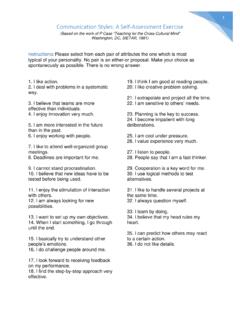
ogefacultymentoring.web.unc.eduCommunication Styles: A Self‐Assessment Exercise (Based on the work of P Case “Teaching for the Cross-Cultural Mind” Washington, DC, SIETAR, 1981) 3 Scoring Sheet for the Communication Styles Assessment Instructions: Circle the items you have selected and add up the totals for each style (one point per answer).
WORKPLACE communication
www.uts.edu.auEffective communication in the workplace is essential but not everybody is skilled at it, so as university students it is good to know what to expect, and how you can improve your communication so that when you are ‘on the job’, you give your best, show motivation and enthusiasm, and communicate to the best of y our ability.