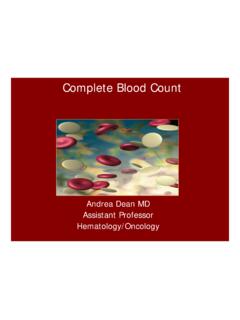
Complete Blood Count
Hemoglobin : M: 13.0 to 17.5 gm/dL F: 11.5 to 15.5 gm/dL Hematocrit : Percentage of the volume of whole blood that is made up of red blood cells. (Hint: Hb x 3) M: 38 to 54 %
Download Complete Blood Count

Information
Domain:
Source:
Link to this page:
Documents from same domain
Neurologic Exam Evaluation Checklist - Stritch …
www.meddean.luc.eduIntroduction to the Practice of Medicine 2 NEUROLOGIC EXAM DETAILS FROM NEURO EXAM VIDEO WASH HANDS (Patient is seated.) Cranial Nerves: 1. Visual fields (screening test for CN2 & Visual system: peripheral vision)

I. MAKING THE TRANSITION FROM HISTORY TO …
www.meddean.luc.eduPatient Centered Medicine 2 General Appearance ... Moving from history to physical examination, ... data to verify your clinical impression ...
Assessment of Liver Function and Diagnostic Studies
www.meddean.luc.eduAssessment of Liver Function and Diagnostic Studies 2011 Joseph Ahn, M.D., M.S. Assistant Professor of Medicine Medical Director, Liver Transplantation
Guidelines for Adult Patients Intravenous PCA Orders
www.meddean.luc.eduPT. NAME MR # ROOM # Guidelines for Adult Patients Intravenous PCA Orders Loading Dose: PCA should be initiated after an initial bolus dose of morphine 5 – 20 mg (2-3 mg every 5 minutes

Specific Testing/Maneuvers of the Knee
www.meddean.luc.edu3 Specific Testing/Maneuvers of the Knee Structure/sign being tested: Provocative test for patellofemoral etiology of pain Position of Patient : Lying supine with the knees extended
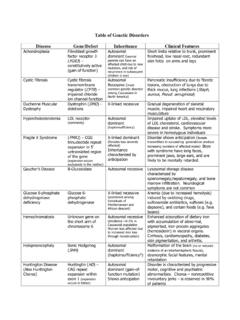
Table of Genetic Disorders - meddean.luc.edu
www.meddean.luc.eduancestry and French Canadians). Hypotonia, spasticity, seizures, blindness, death by age 2. An early indication is a cherry red spot on the retina. (Incidence greatly reduced by screening) Thalasemias Autosomal Recessive Severe anemia Turner Syndrome 45,X females Usually due to a ...

DATA BASE SAMPLE: PHYSICAL EXAMINATION WITH ALL …
www.meddean.luc.eduwith all normal findings GENERAL APPEARANCE: (include general mental status) 45 y/o female who is awake and alert and who appears healthy and looks her stated age
![WOUND HEALING lecture.ppt [Read-Only]](/cache/preview/2/b/6/c/1/4/7/f/thumb-2b6c147f08025508ccf4ec201274f3ba.jpg)
WOUND HEALING lecture.ppt [Read-Only]
www.meddean.luc.edubody through evaporation – production of vasodilatation which assists in facilitating heat loss from the body through radiation and conduction ... to 9-12 months. – This is where collagen III is converted to collagen I, and the tensile strength continues
MALE GENITOURINARY EXAMINATION
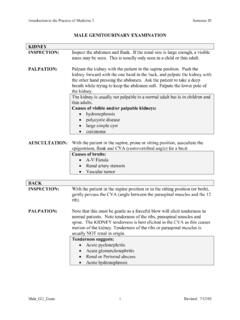
www.meddean.luc.eduJul 13, 2001 · Sebaceous cysts Impetigo Condylomata accuminata Cherry angioma Lichen planus Psoriasis Edema may be due to systemic causes as hepatic, renal or cardiac failure. Fluid overload (often seen with burn therapy). Enlargement may be due to intrascrotal pathology (see below). Note: The right testicle usually lies in a higher position than the left.
Table of Genetic Disorders - Loyola University Chicago
www.meddean.luc.eduPolycystic Kidney Disease Mutations in either polycystin-1 (PKD1) or polycystin-2 (PKD2) gene Autosomal dominant (disease appears to follow a “two-hit model”, requiring the loss of both alleles of PDK1 or PDK2 for the disease to be evident. Heterozygous individuals are predisposed to polycystic kidney disease because they are likely to
Related documents

A Patient’s Guide to Erythromelalgia
erythromelalgia.org• Polycythemia vera, a myeloproliferative blood disorder that causes an increased production of blood cells, primarily red blood cells[7] • Thrombocytopenia, a blood disorder that involves a low platelet count[8] • Peripheral neuropathy, including diabetic neuropathy[9] • Autoimmune diseases, such as lupus,[10] vasculitis,[11] rheumatoid
![Heart Failure Pathophysiology.ppt [Read-Only]](/cache/preview/5/6/a/8/a/5/4/1/thumb-56a8a5411198557184679ccfbe445eec.jpg)
Heart Failure Pathophysiology.ppt [Read-Only]
www.columbia.edu– Polycythemia vera – Carcinoid syndrome –Obesity Heart Failure: Classifications Heart Failure Systolic vs. Diastolic High vs. Low Output Right vs. Left Sided Acute vs. Chronic Cardiac vs. Non-cardiac Forward vs. Backward Dilated vs. Hypertrophic vs. Restrictive Compensated vs.
The Medical History Written Example Chief Concern: Chest ...
www.lumen.luc.eduHPI: Mr. PH is a 52 y/o accountant with hypercholesterolemia and polycythemia vera who has been in relatively good health (except for problem #2 below) until one month ago when he noticed chest tightness with exertion. The patient decided to …

HIGHLIGHTS OF PRESCRIBING INFORMATION • …
us.pharmaessentia.compolycythemia vera (1) -----DOSAGE AND ADMINISTRATION----- • Recommended starting dose: 100 mcg by subcutaneous injection every 2 weeks (50 mcg if receiving hydroxyurea). • Increase the dose by 50 mcg every 2 weeks (up to a maximum of 500 mcg) until hematological parameters are stabilized (2.1)
Importancia de las enfermedades hematológicas en ...
www.medigraphic.com(anemia, polycythemia). Conclusions: It is important that the dentist be aware of oral manifestations of abnormal erythrocytes, it can be the first symptom in some cases helping to diagnose of disease and preventing complications. Keywords: Anemia, polycythemia, oral manifestations, stomatological management.

NCCN Guidelines for Patients Myeloproliferative Neoplasms
www.nccn.orgPolycythemia vera PV causes too many red blood cells. High levels of white blood cells and platelets may also be present. The red blood cells build up in bone marrow and blood. As a result, blood becomes thicker than normal. Essential thrombocythemia ET causes too many megakaryocytes and platelets. Megakaryocytes are a type of blood