
COMPOSITION AND QUANTITY OF SOLID WASTE
cases although the active agents may be liquid or gaseous, they are classified as solid wastes because they are confined in solid containers. Typical examples are: solvents, paints and pesticides whose spent containers are frequently mixed with municipal wastes and become part of the urban waste stream. Certain hazardous
Download COMPOSITION AND QUANTITY OF SOLID WASTE

Information
Domain:
Source:
Link to this page:
Documents from same domain

CHAPTER 6: DESIGN AND CONSTRUCTION OF SLUDGE …
cpheeo.gov.inPart A: Engineering 6 - 10 CHAPTER 6: DESIGN AND CONSTRUCTION OF SLUDGE TREATMENT FACILITIES Figure 6.3 d Types of sludge pumps-continued 6.2.2.1 Centrifugal Pumps

CHAPTER 4 DESIGN AND CONSTRUCTION OF SEWAGE …
cpheeo.gov.in10. Hoisting equipment shall be provided for handling of equipment and materials, which cannot be readily lifted or removed by manual labour. Hence, in large pumping stations, gantries of adequate capacities shall be provided to lift the pumps, motors and large piping. 11.

CHAPTER 2: SEWER SYSTEMS 2.1 INTRODUCTION
cpheeo.gov.inSewer collection systems are intended to be a reliable method of conveying sewage from individual discharge to sewage treatment plants. Inspection and examination are the techniques used to gather information to develop operation and maintenance programmes to ensure that new

MUNICIPAL SOLID WASTE MANAGEMENT MANUAL
cpheeo.gov.inSolid Waste Management Rules, 2016 and Other Directives 6 2.2 Modern Integrated Municipal Solid Waste Management: Concepts and Benefits 8 2.3 Preparation of a Municipal Solid Waste Management Plan – A Seven Step Approach 11 2.3.1 Step …

CHAPTER 5: SLUDGE TREATMENT FACILITIES 5.1 …
cpheeo.gov.inCHAPTER 5: SLUDGE TREATMENT FACILITIES 5.2.2 Centrifugal Thickening Thickening by centrifugation is chosen only when space is limited or sludge characteristics will not permit the adoption of other methods. This method involves high …

CHAPTER 10 REPAIR OF PIPE LINE - CPHEEO
cpheeo.gov.inThis may be the only transmission main of the system. It may be one of the two or many parallel transmission mains. It may be initial portion of the distribution system serving as the only main to supply water to the rest of the area to be served. It may be a distribution pipe serving only a part of the system. ii) Size and material of the ...

ANNEXURE 17.1 ESTIMATION OF LANDFILL CAPACITY, …
cpheeo.gov.in(a) Landfill Section and Plan is evaluated on the basis of (i) 4:1 side slope for the above -ground portion of the landfill. (ii) 2:1 side slope for the bel ow-ground portion of the landfill.
CHAPTER 3: PUMPING STATION 3.1 INTRODUCTION
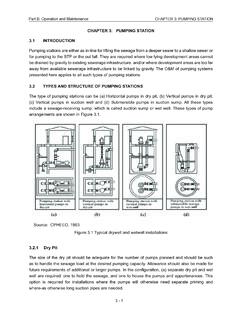
cpheeo.gov.inarrangements are shown in Figure 3.1. Source: CPHEEO, 1993 Figure 3.1 Typical drywell and wetwell installations 3.2.1 Dry Pit The size of the dry pit should be adequate for the number of pumps planned and should be such as to handle the sewage load at the desired pumping capacity. Allowance should also be made for future requirements of ...

CONSTRUCTION AND DEMOLITION WASTE
cpheeo.gov.in• Rubble, brick bats, broken plaster/concrete pieces etc. can be used for building activity, such as, leveling, under coat of lanes where the traffic does not constitute of heavy moving loads. • Larger unusable pieces can be sent for filling up low -lying areas. • Fine material, such as, sand, dust etc. can be used as cover material over

Chapter XVII - Municipal Solid Waste Landfills - CPHEEO
cpheeo.gov.inCHAPTER 17 LANDFILLS 17.1 INTRODUCTION 17.1.1 Definition The term ‘landfill’ is used herein to describe a unit operation for final disposal of ‘Municipal Solid Waste’ on land, designed and constructed with the objective of minimum impact to the environment by incorporating eight essential components described in Section 17.3.
Related documents
Waste to Resources
cbs.teriin.org(municipal, industrial, hazardous) is more than 4 billion tonnes, the municipal solid waste is between 1.6 to 2.0 billion tonnes. [1] Also, the global impacts of solid waste are growing fast as solid waste management costs will increase from today’s annual $205.4 billion to about $375.5 billion in 2025. [2]

National Solid Waste Management Status Report [ î ì8
emb.gov.ph1a Sources of municipal solid wastes in the Philippines, 2008-2013 1 1b Composition of municipal solid wastes in the Philippines, 2008-2013 2 1c Projected waste generation 2008-2020 (metric tons per year) 3 2a Solid waste exposure pathway 4
Standard Operating Procedure: Waste Management
www.fm.virginia.eduThis procedure covers solid waste, which encompasses material typically disposed of in a landfill, and recyclable, recoverable, or reusable materials, which are materials that can be diverted from landfills by UVA’s Recycling program. This includes, but is not limited to, Municipal Solid Waste (MSW), Construction and Demolition

Active Municipal Solid Waste Landfills in Texas
www.tceq.texas.govActive Municipal Solid Waste Landfills in Texas . Type I landfills are authorized to accept all types of municipal solid waste. Type IV landfills may only accept brush, construction and demolition debris, and rubbish. Type IV landfills may not accept putrescible wastes, conditionally exempt small-quantity generator waste, or household wastes.