
Computing Ages in SAS
Computing ages with YRDIF The SAS Help and Documentation states that the YRDIF function "Returns the difference in years between two dates." Since age is the difference in years between two dates (a birth date and some other date), the YRDIF function has
Download Computing Ages in SAS

Information
Domain:
Source:
Link to this page:
Documents from same domain
027-2009: Tips and Tricks for Creating the Reports …
support.sas.comPaper 027-2009 TIPS AND TRICKS FOR CREATING THE REPORTS YOUR CLIENTS NEED TO SEE Michael J Molter, INC Research, Raleigh, NC ABSTRACT Advanced reporting tools such as PROC REPORT have progressed by leaps and …
Step-by-Step Programming with Base SAS Software
support.sas.comThe correct bibliographic citation for this manual is as follows: SAS Institute Inc. 2001. Step-by-Step Programming with Base SAS® Software.Cary, NC: SAS Institute Inc.
227-2012: Executing a PROC from a DATA Step - …
support.sas.com2 Using RUN_MACRO to execute a PROC from a DATA step requires writing three blocks of code, described in the Introduction: a macro to execute a PROC, a user-written function to execute the macro, and a DATA step to call the
149-2012: Queries, Joins, and WHERE Clauses, Oh …
support.sas.comPaper 149-2012 Queries, Joins, and WHERE Clauses, Oh My!! Demystifying PROC SQL Christianna S. Williams, Chapel Hill, NC ABSTRACT Subqueries, inner joins, outer joins, HAVING expressions, set operators…just the terminology of PROC SQL might
158-2010: How to Use Arrays and DO Loops: Do I …
support.sas.com1 Paper 158-2010 How to Use ARRAYs and DO Loops: Do I DO OVER or Do I DO i? Jennifer L Waller, Medical College of Georgia, Augusta, GA ABSTRACT
248-2009: Learning When to Be Discrete: …
support.sas.com1 Paper 248–2009 Learning When to Be Discrete: Continuous vs. Categorical Predictors David J. Pasta, ICON Clinical Research, San Francisco, CA ABSTRACT
338-2011: An Introduction to Survival Analysis …
support.sas.com2 (Censored) Study Ends (From Applied Survey Data Analysis, p. 306) Figure 1. Prospective View of Event History Survey Data Time can be regarded as continuous or discrete and this basic distinction affects the analytic approach selected.
Dongsheng Yang and Jarrod E. Dalton - SAS
support.sas.com1 Paper 335-2012 A unified approach to measuring the effect size between two groups using SAS® Dongsheng Yang and Jarrod E. Dalton Departments of Quantitative Health Sciences and Outcomes Research

SAS/STAT 9.2 User's Guide: Introduction to Power …
support.sas.comSAS/STAT ® 9.2 User’s Guide Introduction to Power and Sample Size Analysis (Book Excerpt) SAS® Documentation
249-2012: A Tutorial on the SAS® Macro Language
support.sas.com1 Paper 249-2012 A Tutorial on the SAS® Macro Language John J. Cohen, Advanced Data Concepts LLC, Newark, DE ABSTRACT The SAS macro language is another language layering on top of regular SAS code.
Related documents
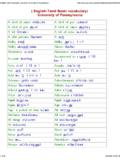
( English-Tamil Basic vocabulary) University of Pennsylvania
ccat.sas.upenn.edu( English-Tamil Basic vocabulary) University of Pennsylvania A kind of sauce ¶Ô£½Ô¯ A kind of pot ½ÔÙÆ A kind of pot Þ¹£ A kind of sauce Þãä

Neural Networks and Statistical Models
people.orie.cornell.eduologists, psychologists, or computer scientists who know little about statistics and nonlinear optimization. NN researchers rou-tinely reinvent methods that have been known in the statistical or mathematical literature for decades or centuries, but they often fail to understand how these methods work (e.g., Specht 1991).
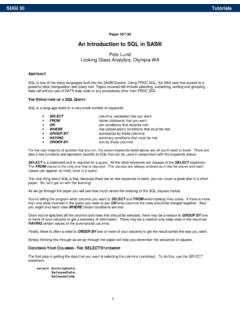
257-30: An Introduction to SQL in SAS®
support.sas.comAn Introduction to SQL in SAS® Pete Lund Looking Glass Analytics, Olympia WA ABSTRACT SQL is one of the many languages built into the SAS® System. Using PROC SQL, the SAS user has access to a ... shortcut can also be a little more problematic when you start working with multiple tables in joins and other set operations. CREATING NEW COLUMNS
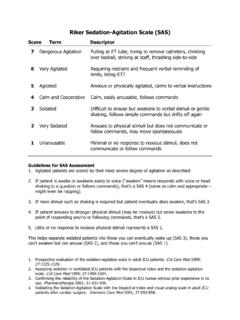
Riker Sedation-Agitation Scale (SAS)
www.bmc.org3. If more stimuli such as shaking is required but patient eventually does awaken, that’s SAS 3. 4. If patient arouses to stronger physical stimuli (may be noxious) but never awakens to the point of responding yes/no or following commands, that’s a SAS 2. 5. Little or no response to noxious physical stimuli represents a SAS 1.

Introduction to SAS Programming
www.library.kent.eduSAS Dates Dates are treated as special kind of numeric data. They are the number of days since January 1st, 1960. January 1st 1960 is the 0 point. SAS dates can go back to 1582 (Gregorian Calendar) and forward to the year 20000. Dates are displayed using a format. There are a number of different date formats supported by SAS.

SAS Enterprise Guide
www.sas.comSAS Enterprise Guide is a point-and-click, menu- and wizard-driven tool that empowers users to analyze data and publish their results. It provides fast-track learning for quick data investigations, generating the code for greater productivity, accelerating deployment of ... even those with little expertise using SAS. SAS ...
h Little SAS Book
www.sas.com2 The Little SAS Book 1.1 The SAS Language Many software applications are either menu driven, or command driven (enter a command—see the result). SAS is neither. With SAS, you use statements to write a series of instructions called a SAS program. The program communicates what you want to do and is written using the SAS language.
Chapter 15 Chemical Equilibrium
www.sas.upenn.edusince the density of any given liquid or solid is constant and changes very little with temperature, we can effectively say it is a constant. Kc = (constant 1) [CO2] ----- (constant 2) Kc ’ = K c constant 2/constant 1 = [CO2] We can therefore exclude liquids …