
Concurrency Control in Distributed Database Systems
systems, locking, senahzability, synchromzation, tunestamp ordering, timestamps, two- phase commit, two-phase locking CR Categories: 4.33, 4.35 INTRODUCTION The Concurrency Control Problem Concurrency control is the activity of co- ordinating concurrent accesses to a data- base in a multiuser database management
Download Concurrency Control in Distributed Database Systems

Information
Domain:
Source:
Link to this page:
Documents from same domain
Fundamentals of HVAC Controls Course Content …
people.eecs.berkeley.eduFundamentals of HVAC Controls The application of Heating, Ventilating, and Air-Conditioning (HVAC) controls starts with an understanding of the building and the use of the spaces to be conditioned and controlled.
SIA: Secure Information Aggregation in Sensor Networks
people.eecs.berkeley.eduSIA: Secure Information Aggregation in Sensor Networks Bartosz Przydatek Carnegie Mellon University Pittsburgh, PA 15213, USA bartosz@cmu.edu Dawn Song
Lecture Notes on Probability Theory and Random Processes
people.eecs.berkeley.educourse on probability and random processes in the Department of Electrical Engineering and Computer Sciences at the University of California, Berkeley. The notes do not replace a textbook.

Introduction to Database Systems What Is a DBMS? CS186
people.eecs.berkeley.edu1 Introduction to Database Systems CS186 “Knowledge is of two kinds: we know a subject ourselves, or we know where we can find information upon it.”
ABC: An Academic Industrial-Strength Verification Tool
people.eecs.berkeley.eduABC: An Academic Industrial-Strength Verification Tool Robert Brayton Alan Mishchenko EECS Department, University of California, Berkeley, CA 94720, USA {brayton, alanmi}@eecs.berkeley.edu Abstract. ABC is a public-domain system for logic synthesis and formal verification
1 Simultaneous Localisation and Mapping (SLAM): Part II ...
people.eecs.berkeley.edu1 Simultaneous Localisation and Mapping (SLAM): Part II State of the Art Tim Bailey and Hugh Durrant-Whyte Abstract —This tutorial provides an introduction to the Si-multaneous Localisation and Mapping (SLAM) method and the extensive research on SLAM that has been undertaken.
1 Simultaneous Localisation and Mapping (SLAM): Part I The ...
people.eecs.berkeley.edu1 Simultaneous Localisation and Mapping (SLAM): Part I The Essential Algorithms Hugh Durrant-Whyte, Fellow, IEEE, and Tim Bailey Abstract|This tutorial provides an introduction to Simul- taneous Localisation and Mapping (SLAM) and the exten-
Paths in graphs - People
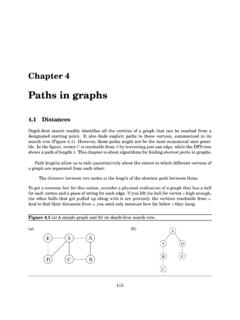
people.eecs.berkeley.edushows a path of length 3. This chapter is about algorithms for nding shortest paths in graphs. Path lengths allow us to talk quantitatively about the extent to which different vertices of a graph are separated from each other: The distance between two nodes is the length of the shortest path between them.
Chapter 13 The Multivariate Gaussian - People
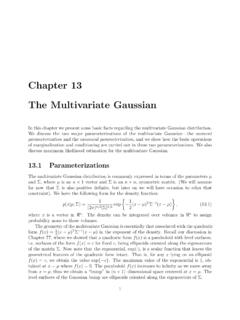
people.eecs.berkeley.edu2 CHAPTER 13. THE MULTIVARIATE GAUSSIAN The factor in front of the exponential in Eq. 13.1 is the normalization factor that ensures that the density integrates to one.
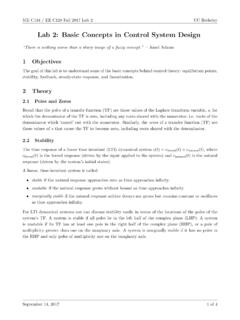
Lab 2: Basic Concepts in Control System Design
people.eecs.berkeley.eduLab 2: Basic Concepts in Control System Design \There is nothing worse than a sharp image of a fuzzy concept." { Ansel Adams 1Objectives The goal of this lab is to understand some of the basic concepts behind control theory: equilibrium points, stability, feedback, steady-state response, and linearization.
Related documents

Chapter 3: Rigid Bodies; Equivalent Systems of forces
engineering.purdue.eduChapter 3: Rigid Bodies; Equivalent Systems of forces • Rigid Bodies: Bodies in which the relative position of any two points does not change. In real life no body is perfectly rigid. We can approximate the behavior of most structures with rigid bodies because the deformations are usually small and negligible.

6.061 Class Notes, Chapter 3: Polyphase Networks
ocw.mit.eduThe phasor relationship of line-to-neutral and line-to-line voltages is shown in Figure 8. Two things should be noted about this relationship: • The line-t√o-line voltage set has a magnitude that is larger than the line-ground voltage by a factor of 3.

Handbook of Intercom Systems Engineering
products.rtsintercoms.comLIST OF FIGURES Simple Party-Line System - - - - - - - - - - - - - - - - - - - - - - - - - - - - - - - - - - - - - - - - - - - - - - - 1 Simple Matrix System ...

CHAPTER 6: SYSTEMS OF TWO LINEAR EQUATIONS IN TWO ...
sccollege.eduIf the two lines are parallel to each other (not touching), then there is no solution for the system. Case 3: Same Lines . If one line is on top of the other line (equivalent lines), then there are infinitely many solutions for the system. MEDIA LESSON Solve by graphing

Linear Equations in Two Variables
www.math.utah.eduline 5x +2y =4isdierent from slope of the line 2x + y =11. Thosetwo slopes are 5 2 and 2 11 respectively. No solutions. If you reach into a hat and pull out two dierent linear equations in two variables, it’s highly unlikely that the two corresponding lines would have exactly the same slope. But if they did have the same slope, then there 4 5 ...

Promoting Excellence in First-Line Supervision
www.policeforum.orgSergeants Are Key to Effective Policing, But Systems for Selecting and Training Sergeants Are Outdated and Weak — 3 If you ask a group of police chiefs to name the one key position in their department, most chiefs would say, “My sergeants.” Sergeants and other first-line supervisors ensure that the vision and goals of a police chief or ...
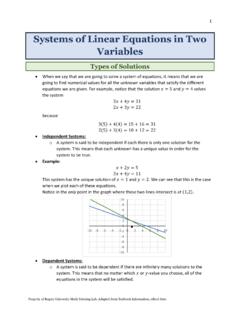
Systems of Linear Equations in Two Variables
www.regent.eduNotice the two equations form the same line (which has infinitely many points). Inconsistent Systems: o Inconsistent systems are system that have no solution to them. In other words, there is no pair of and -values that satisfy one equation that will also satisfy the other. Example: 1 2 −2 =5 −4 =7 This system has no solution.

Radar Systems - Tutorialspoint
www.tutorialspoint.comRadar Systems — Delay Line Cancellers ... The two way distance between the Radar and target will be 2R, since the distance between the Radar and the target is R. Now, the following is the formula for Speed. =