
CONDITIONAL EXPECTATION AND MARTINGALES
conditional expectations behave like ordinary expectations, with random quantities that are functions of the conditioning random variable being treated as constants.2 Let Y be a random variable, vector, or object valued in a measurable space, and let X be an integrable random variable (that is, a random variable with EjXj˙1).
Download CONDITIONAL EXPECTATION AND MARTINGALES

Information
Domain:
Source:
Link to this page:
Documents from same domain

Prologue - University of Chicago
galton.uchicago.eduLECTURE 5: BROWNIAN MOTION 1. Prologue We have seen in previous lectures that, for discrete multiperiod markets which admit no …

Bernoulli Distribution - University of Chicago
galton.uchicago.eduBernoulli Distribution Example: Toss of coin Deflne X = 1 if head comes up and X = 0 if tail comes up. Both realizations are equally likely: (X = 1) = (X = 0) = 1 2
A Review of Methods for Missing Data - University …
galton.uchicago.eduEducational Research and Evaluation 1380-3611/01/0704-353$16.00 2001, Vol. 7, No. 4, pp. 353–383 # Swets & Zeitlinger A Review of Methods for Missing Data …

Department of Statistics, University of Chicago
galton.uchicago.eduDepartment of Statistics, Columbia University PER A. MYKLAND Department of Statistics, University of Chicago We propose a methodology for evaluating the hedging errors of derivative securities due to the discreteness of trading times or the observation times of market prices, or
MARKOV CHAINS: BASIC THEORY - University of Chicago
galton.uchicago.eduMARKOV CHAINS: BASIC THEORY 3 Definition 2. A nonnegative matrix is a matrix with nonnegative entries. A stochastic matrix is a square nonnegative matrix all of whose row sums are 1. A substochastic matrix is a square nonnegative matrix all of whose row sums are 1.

CONVERGENCE RATES OF MARKOV CHAINS
galton.uchicago.eduMarkov chains for which the convergence rate is of particular interest: (1) the random-to-top shuffling model and (2) the Ehrenfest urn model. Along the way we will encounter a number of fundamental concepts and techniques, notably reversibility, total variation distance, and
Chapter 3. Multivariate Distributions.
galton.uchicago.edu3-1 Chapter 3. Multivariate Distributions. ... structure to include multivariate distributions, the probability distributions of pairs of random variables, triplets of random variables, and so forth. We will begin with the simplest such situation, that of pairs of ... describes a surface in 3-dimensional space, and the probability that (X;Y) ...
ONE-DIMENSIONAL RANDOM WALKS
galton.uchicago.edupost- y process is just an independent simple random walk started at y. But (10) (with the roles of x,y reversed) implies that this random walk must eventually visit x. When this happens, the random walk restarts again, so it will go back to y, and so on. Thus, by an easy induction argu-ment (see Corollary 14 below): Theorem 4.
BROWNIAN MOTION - Department of Statistics
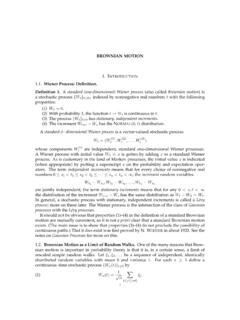
galton.uchicago.eduMany stochastic processes behave, at least for long stretches of time, like random walks with small but frequent jumps. The argument above suggests that such processes will look, at least approximately, and on the appropriate time scale, like Brownian motion. Second, it suggests that many important “statistics” of the random walk will have lim-

CONDITIONAL EXPECTATION AND MARTINGALES
galton.uchicago.eduadapted sequence of integrable real-valued random variables, that is, a sequence with the prop-erty that for each n the random variable Xn is measurable relative to Fn and such that EjXnj˙ 1. The sequence X0,X1,... is said to be a martingale relative to the filtration {Fn}n‚0 if it is adapted and if for every n, (1) E(Xn¯1 jFn) ˘ Xn.
Related documents
Random Processes for Engineers 1 - University of Illinois ...
www.ifp.illinois.edu1.2 Independence and conditional probability 5 1.3 Random variables and their distribution 8 1.4 Functions of a random variable 11 1.5 Expectation of a random variable 17 1.6 Frequently used distributions 22 1.7 Failure rate functions 25 1.8 Jointly distributed random variables 26 1.9 Conditional densities 28 1.10 Correlation and covariance 28
Section 8.2 Conditional Probability and Bayes Theorem
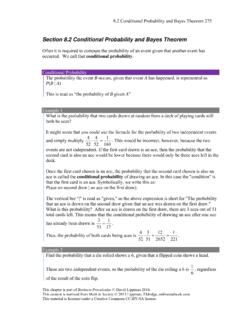
www.opentextbookstore.comoccurred. We call that conditional probability. Conditional Probability The probability the event B occurs, given that event A has happened, is represented as P(B | A) This is read as “the probability of B given A” Example 1 What is the probability that two cards drawn at random from a deck of playing cards will both be aces?

Chapter 12 Conditional densities
www.stat.yale.eduConditional densities 12.1Overview Density functions determine continuous distributions. If a continuous distri-bution is calculated conditionally on some information, then the density is called a conditional density. When the conditioning information involves another random variable with a continuous distribution, the conditional den-

Labels to Street Scene Labels to Facade BW to Color
arxiv.orgcontrast, conditional GANs learn a mapping from observed image xand random noise vector z, to y, G: fx;zg!y. The generator Gis trained to produce outputs that cannot be distinguished from “real” images by an adversarially trained discriminator, D, which is trained to do as well as possible at detecting the generator’s “fakes”.

Conditional Expectation - Department of Mathematics ...
web.ma.utexas.eduJan 24, 2015 · Lecture 10: Conditional Expectation 2 of 17 Example 10.2. Suppose that (W,F,P) is a probability space where W = fa,b,c,d,e, fg, F= 2W and P is uniform. Let X, Y and Z be random variables given by (in the obvious notation)
1 Sufficient statistics
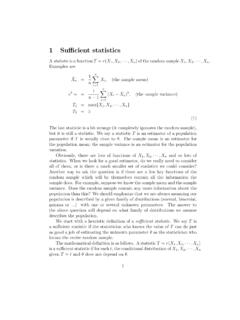
www.math.arizona.educonditional distribution. But then his random sample has the same distri-bution as a random sample drawn from the population (with its unknown value of θ). So statistician B can use his random sample X0 1,···,X0 n to com-pute whatever statistician A computes using his random sample X1,···,Xn, and he will (on average) do as well as ...

Lecture 10 : Conditional Expectation
www.stat.berkeley.eduLecture 10: Conditional Expectation 10-2 Exercise 10.2 Show that the discrete formula satis es condition 2 of De nition 10.1. (Hint: show that the condition is satis ed for random variables of the form Z = 1G where G 2 C is a collection closed under …

General Bivariate Normal - Duke University
www2.stat.duke.edu6.5 Conditional Distributions General Bivariate Normal - RNG Consequently, if we want to generate a Bivariate Normal random variable with X ˘N( X;˙2 X) and Y ˘N( Y;˙2 Y) where the correlation of X and Y is ˆwe can generate two independent unit normals Z 1 and Z 2 and use the transformation: X = ˙ XZ 1 + X Y = ˙ Y [ˆZ 1 + p 1 ˆ2Z 2] + Y