
CONTENTS
8 CHEMISTRY Unit 4 Chemical Bonding and Molecular Structure 96 4.1 Kössel-Lewis Approach to Chemical Bonding 97 4.2 Ionic or Electrovalent Bond 102
Download CONTENTS

Information
Domain:
Source:
Link to this page:
Documents from same domain

REAL NUMBERS 1 - Prashanth Ellina
ncertbooks.prashanthellina.comREAL NUMBERS 1 1 1.1 Introduction In Class IX, you began your exploration of the world of real numbers and encountered irrational numbers. We continue our discussion on real numbers in this chapter.
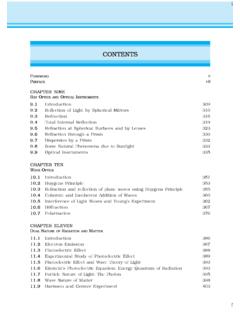
CONTENTS
ncertbooks.prashanthellina.comCONTENTS FOREWORD v PREFACE vii CHAPTER NINE RAY OPTICS AND OPTICAL INSTRUMENTS 9.19.1 Introduction 309 9.29.2 Reflection of Light by Spherical Mirrors 310 9.39.3 Refraction 316 9.49.4 Total Internal Reflection 319

AIR OF L IN INEAR TWO E V QUATIONS ARIABLES 3
ncertbooks.prashanthellina.com40 MATHEMATICS In fact, this is true for any linear equation, that is, each solution (x, y) of a linear equation in two variables, ax + by + c = 0, corresponds to a point on the

Chapter Four MOVING CHARGES AND MAGNETISM
ncertbooks.prashanthellina.comPhysics 132 4.1 INTRODUCTION Both Electricity and Magnetism have been known for more than 2000 years. However, it was only about 200 years ago, in 1820, that it was

Wave Optics Chapter Ten WAVE OPTICS - …
ncertbooks.prashanthellina.com351 Wave Optics Chapter Ten WAVE OPTICS 10.1 INTRODUCTION In 1637 Descartes gave the corpuscular model of light and derived Snell’s law. It explained the laws of reflection and refraction of light at an interface.

Chapter Twelve ATOMS - Prashanth Ellina
ncertbooks.prashanthellina.comPhysics 416 Fig. 12.1, they directed a beam of 5.5 MeV α-particles emitted from a 214 83 Bi radioactive source at a thin metal foil made of gold. Figure 12.2 shows a schematic diagram of this experiment.

Chapter Fifteen COMMUNICATION SYSTEMS
ncertbooks.prashanthellina.com15.1 INTRODUCTION Communication is the act of transmission of information. Every living creature in the world experiences the need to impart or receive information

Chapter Thirteen NUCLEI
ncertbooks.prashanthellina.comPhysics 438 13.1 INTRODUCTION In the previous chapter, we have learnt that in every atom, the positive charge and mass are densely concentrated at the centre of the atom
MICROBES IN HUMAN WELFARE - Prashanth Ellina
ncertbooks.prashanthellina.com181 MICROBES IN HUMAN WELFARE In chapter 8, you have read that microbes cause a large number of diseases in human beings. They also cause diseases in …

Chapter Nine RAY OPTICS AND OPTICAL …
ncertbooks.prashanthellina.comChapter Nine RAY OPTICS AND OPTICAL INSTRUMENTS 9.1 INTRODUCTION Nature has endowed the human eye (retina) with the sensitivity to detect electromagnetic waves within a small range of the electromagnetic
Related documents
SYLLABI FOR THREE-YEAR B.Sc. HONOURS & …
www.caluniv.ac.inuniversity of calcutta syllabi for three-year b.sc. honours & general courses of studies chemistry 2010 w.e.f. 2010-2011
CORRIGENDUM: CHEMISTRY PRACTICAL (PAPER 2)
www.cisce.org164 CHEMISTRY (862) Aims: 1. To foster acquisition of knowledge and understanding of terms, concepts, facts, processes, techniques and principles relating to …
1 Lecture 2 Simple Molecular Orbitals - Sigma and …
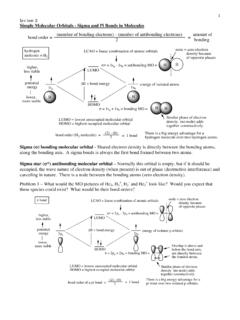
www.cpp.edu1 Lecture 2 Simple Molecular Orbitals - Sigma and Pi Bonds in Molecules bond order = (number of bonding electrons) - (number of antibonding elect rons)
Input Description 2-1 - Gordon Group/GAMESS …
www.msg.chem.iastate.eduInput Description 2-1 (1 July 2016) ***** * * * Section 2 - Input Description *
12 UnitUnitUnit - National Council of Educational …
www.ncert.nic.in353 Aldehydes, Ketones and Carboxylic Acids The carbonyl carbon atom is sp2-hybridised and forms three sigma (σ) bonds. The fourth valence electron of carbon remains in its p-orbital
ANOTHER LOOK AT THE COVALENT BOND: …
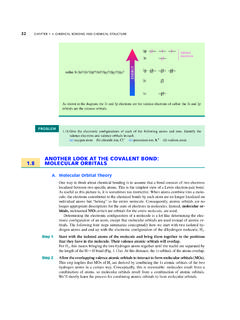
www.saplinglearning.com1.8 ANOTHER LOOK AT THE COVALENT BOND: MOLECULAR ORBITALS 33 Step 3. Arrange the MOs in order of increasing energy. Steps 1 and 2 will yield two MOs for H