
Conversion Factors 3.14 89
Volume (V) equals 0.785 times the . Diameter squared (D. 2) times its . Height (H) divided by 3. Remember: the diameter is 2 times the radius (D = 2 x R) length. width. height height diameter. adius. height diameter. adius. Volume. Volume. To convert volume from cubic feet to gallons: multiply cubic feet x 7.48 gallons per cubic feet
Download Conversion Factors 3.14 89

Information
Domain:
Source:
Link to this page:
Documents from same domain
Developing Surface Water Nitrate Standards and …
www.pca.state.mn.usDeveloping Surface Water Nitrate Standards and Strategies for Reducing Nitrogen Loading • wq-s6-23 • December 2010 Page 2 of 2 Total Nitrogen Loading Study
B5. Nitrogen Transport, Losses, and …
www.pca.state.mn.usNitrogen in Minnesota Surface Waters • June 2013 Minnesota Pollution Control Agency B5-1 B5. Nitrogen Transport, Losses, and Transformations within Minnesota Waters
Analyzing Alternatives for Sulfate Treatment in Municipal ...
www.pca.state.mn.ussome municipal wastewater treatment plants having to reduce the sulfate in their discharge. This two-part study evaluated options for sulfate treatment and examined the implications of those treatment options for typical municipal wastewater treatment plants in Minnesota.
Quick Guide – Creating an e-Services account
www.pca.state.mn.usaq-ei3-18 Quick Guide – Creating an e-Services account. To get started using the Minnesota Pollution Control Agency’s (MPCA) electronic reporting system, sign up
Collecting Pharmaceuticals from Households and Long Term ...
www.pca.state.mn.usCollecting Pharmaceuticals from Households and ... regulated by the Minnesota Board of Pharmacy (Board), which include any drugs ... Collection of discarded pharmaceuticals from households or LTCFs is voluntary for pharmacies in Minnesota and will not change the pharmacy’s hazardous waste generator ‘size’ or increase its annual fees.
Pharmaceutical Reverse Distribution
www.pca.state.mn.usEnsure each reverse distributor you intend to use is licensed by the Minnesota Board of Pharmacy (Board) as a pharmaceutical manufacturer or wholesaler. ... If you operate a pharmaceutical reverse distribution site in Minnesota, comply with all the conditions and other differences discussed above in …
Environmental Justice Principles and Practices
www.pca.state.mn.us"Environmental Justice" (EJ) is a phrase and concept thatmeans many things to many people. The U.S. Environmental Protection Agency Office of Environmental Justice offers the following definition: "Thefair treatment and meaningful
Environmental Justice Framework Report
www.pca.state.mn.usenvironmental justice framework document. This framework represents our commitment to act using our expertise, relationships, and resources to focus our work where it will have the greatest effect in reducing the impact of environmental pollution.
Bacteria: Sources, Types, Impact on Water Quality
www.pca.state.mn.usAlthough bacteria water quality standards apply to all waters in Minnesota, the MPCA generally focuses its assessment work on rivers and streams rather than lakes
U List of Hazardous Wastes - Minnesota Pollution Control ...
www.pca.state.mn.usU List of Hazardous Wastes • w-hw2-03 • February 2011 page 2 Sole active ingredient A waste is regulated under the U List only if the ingredient contained in …
Related documents
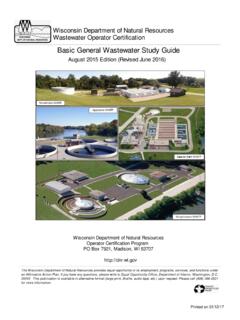
Basic General Wastewater Study Guide
dnr.wi.govA clarifier is a circular or rectangular tank used to remove floatable and settleable solids in wastewater. Disinfection is a process used to destroy most pathogens to a safe level in the effluent. Disinfection does not destroy all microorganisms. Grit is the fine, abrasive particles removed from wastewater, such as sand and eggshells.
SEQUENCING BATCH REACTOR DESIGN AND OPERATIONAL …
neiwpcc.orgSeptember 2005 Prepared by the NEW ENGLAND INTERSTATE WATER POLLUTION CONTROL COMMISSION 116 John Street Lowell, MA 01852-1124 Tel: (978)323-7929 Fax: (978)323-7919 mail@neiwpcc.org www.neiwpcc.org Ronald F. Poltak, Executive Director

CHAPTER 3 WATER SUPPLY SYSTEM - JICA
openjicareport.jica.go.jp(Clarifier) Detention Time 2 - 2.5 hours - Length of tank (rectangular) 30 - 100 m - Ratio of length to width 3:1 - 5:1 3:1 - 5:1 Length of square tank up to 20 m - Diameter of tank up to 60 m - Depth of tank 2.5 - 5 m 3 - 4 (Water m Inlet velocity 0.2 - 0.3 m/s less than 0.4 m/s Weir Loading up to 300 m3 /d/500 m3

SEQUENCING BATCH REACTOR DESIGN AND OPERATIONAL …
www.neiwpcc.orgSeptember 2005 Prepared by the NEW ENGLAND INTERSTATE WATER POLLUTION CONTROL COMMISSION 116 John Street Lowell, MA 01852-1124 Tel: (978)323-7929 Fax: (978)323-7919 mail@neiwpcc.org www.neiwpcc.org Ronald F. Poltak, Executive Director

WASTEWATER MATH CONVERSION FACTORS
www.adeq.state.ar.usRevised 0316 WASTEWATER MATH CONVERSION FACTORS 1. 1 acre = 43,560 sq ft 2. 1 acre = 2.47 hectares 3. 1 cu ft [of water] = 7.48 gallons 4. 1 cu ft [of water] = 62.4 lbs/ft 3 5.

SBR PROCESS FOR WASTEWATER TREATMENT
www.fondazioneinternazionale.orgeliminate the need for a separate clarifier. •The treatment cycle can be adjusted to undergo aerobic, anaerobic, and anoxic conditions in order to achieve biological nutrient removal, including nitrification, denitrification, and some phosphorus removal. •Biochemical oxygen demand (BOD) levels of less than 5 mg/L can be achieved consistently.

Sugar Manufacturing Industry. Mini Sugar Plant. Sugarcane ...
www.entrepreneurindia.co1991-92 11.83 1996-97 14.29 1997-98 14.91 1998-99 15.06 1999-00 15.49 2000-01 ... Cane Shredder Sugarcane Juice clarifier Micro filteration for Juice. www.entrepreneurindia.co Project at a Glance PROJECT AT A GLANCE (Rs. in lacs) COST OF PROJECT MEANS OF FINANCE ... What is the Sensitivity Analysis-Price/Volume of Sugar Manufacturing plant? 25 ...

Wastewater Math and Excel Equations
www.structurepoint.comvolume, in million gallons (MG), for aeration tanks and secondary clarifier • Calculate weir length for secondary clarifiers • Conversion: 1 cubic foot = 7.48 gallons (divide by 1 million to get MG!) • Total Number of: • Aeration Tanks: 4 • Secondary Clarifiers: 4 • Refer to handouts for aeration tank and secondary clarifier plan ...

Polymer 101: Fundamentals of Flocculation
www.wef.org11 Two-Step Dilution with post-dilution primary mixing at high %, then post-dilution to feed High Concentration*at Initial Wetting, Optimum 0.5% wt. = 1.0 ~ 1.5% vol. Need to post-dilute to < 0.5% vol. * AWWA Standard for Polyacrylamide (ANSI-AWWA B453-06), 11, 2006 Two-Step Dilution facilitates Polymer Activation Primary Mixing Post‐Dilution