
Coordinate Attention for Efficient Mobile Network Design
same size to X. To provide a clear description of the pro-posed coordinate attention, we first revisit the SE attention, which is widely used in mobile networks. 3.1. Revisit SqueezeandExcitation Attention As demonstrated in [18], the standard convolution it-self is difficult to model the channel relationships. Explic-
Download Coordinate Attention for Efficient Mobile Network Design

Information
Domain:
Source:
Link to this page:
Documents from same domain
What Have We Learned From Deep Representations for …
openaccess.thecvf.comwhat these powerful models actually have learned. In this paper we shed light on deep spatiotemporal net-works by visualizing what excites the learned models us-ing activation maximization by backpropagating on the in-put. We are the first to visualize the hierarchical features
Finding Tiny Faces in the Wild With Generative Adversarial ...
openaccess.thecvf.comfaces, which are unfriendly for the face classifier. Toward-s this end, we design a refinement sub-network to recover some detailed information. In the discriminator network, the basic GAN [17, 12, 8] is trained to distinguish the real and fake high resolution images. To classify faces or non-
Squeeze-and-Excitation Networks - openaccess.thecvf.com
openaccess.thecvf.comSqueeze-and-Excitation Networks Jie Hu1∗ Li Shen2∗ Gang Sun1 hujie@momenta.ai lishen@robots.ox.ac.uk sungang@momenta.ai 1 Momenta 2 Department of Engineering Science, University of Oxford Abstract Convolutional neural networks are built upon the con-
RegularFace: Deep Face Recognition via Exclusive ...
openaccess.thecvf.comRegularFace: Deep Face Recognition via Exclusive Regularization Kai Zhao Jingyi Xu Ming-Ming Cheng ∗ TKLNDST, CS, Nankai University kaiz.xyz@gmail.com cmm@nankai.edu.cn
Protecting World Leaders Against Deep Fakes
openaccess.thecvf.comProtecting World Leaders Against Deep Fakes Shruti Agarwal and Hany Farid University of California, Berkeley Berkeley CA, USA {shrutiagarwal, hfarid}@berkeley.edu
Auto-DeepLab: Hierarchical Neural Architecture Search for ...
openaccess.thecvf.comAuto-DeepLab: Hierarchical Neural Architecture Search for Semantic Image Segmentation Chenxi Liu1∗, Liang-Chieh Chen 2, Florian Schroff2, Hartwig Adam2, Wei Hua2, Alan Yuille1, Li Fei-Fei3 1Johns Hopkins University 2Google 3Stanford University Abstract Recently, NeuralArchitectureSearch(NAS)hassuccess-
PointNet: Deep Learning on Point Sets ... - CVF Open Access
openaccess.thecvf.comPointNet: Deep Learning on Point Sets for 3D Classification and Segmentation Charles R. Qi* Hao Su* Kaichun Mo Leonidas J. Guibas Stanford University
Frustum PointNets for 3D Object Detection From RGB-D Data
openaccess.thecvf.comFrustum PointNets for 3D Object Detection from RGB-D Data Charles R. Qi1∗ Wei Liu2 Chenxia Wu2 Hao Su3 Leonidas J. Guibas1 1Stanford University 2Nuro, Inc. 3UC San Diego Abstract In this work, we study 3D object detection from RGB-D data in both indoor and outdoor scenes.
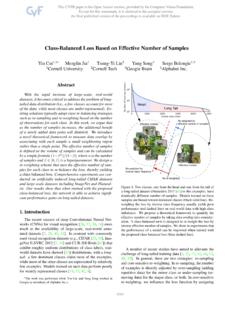
Class-Balanced Loss Based on Effective Number of Samples
openaccess.thecvf.comand large-scale datasets including ImageNet and iNatural-ist. Our results show that when trained with the proposed class-balanced loss, the network is able to achieve signifi-cant performance gains on long-tailed datasets. 1. Introduction The recent success of deep Convolutional Neural Net-works (CNNs) for visual recognition [26, 37, 38, 16] owes
ESRGAN: Enhanced Super-Resolution Generative Adversarial ...
openaccess.thecvf.comESRGAN: EnhancedSuper-Resolution Generative Adversarial Networks Xintao Wang 1, Ke Yu , Shixiang Wu2, Jinjin Gu3, Yihao Liu4, Chao Dong 2, Yu Qiao , and Chen Change Loy5 1 CUHK-SenseTime Joint Lab, The Chinese University of Hong Kong 2 Shenzhen Institutes of Advanced Technology, Chinese Academy of Sciences 3 The Chinese University of Hong Kong, …
Related documents
Standard Test Methods for Deep Foundations Under Static ...
www.centurionfondation.comto bear on a concrete pile cap in a thin layer of quick-setting, non-shrink grout, less than 6 mm (0.25 in) thick and having a compressive strength greater than the pile cap at the time of the test. For tests on steel piles, or a steel load frame, weld the test plate to the pile or …

Standard Flexboy bioprocessing bags (For Europe, Asia and ...
www.sartorius-sd.com.uaLL male + Cap, pinch clamp LL female + Cap, pinch clamp (1.97 in.) + septum 1.3. ®Standard Flexboy with EVA tubes (50mL to 3L with MPC Connection) Part Number Description Tubing Bag Port 1 Bag Port 2 Bag Port 3 Qty/box
![arXiv:1512.00567v3 [cs.CV] 11 Dec 2015](/cache/preview/e/9/b/2/7/3/a/d/thumb-e9b273ad52b2edb6f94a58f5caa30476.jpg)
arXiv:1512.00567v3 [cs.CV] 11 Dec 2015
arxiv.orgOf course, a 5 5 filter can cap-ture dependencies between signals between activations of units further away in the earlier layers, so a reduction of the geometric size of the filters comes at a large cost of expres-siveness. However, we can ask whether a 5 5 convolution could be replaced by a multi-layer network with less pa-

From ESG to the SDGs: The shift from process and policies ...
www.credit-suisse.comcap. 2. The company also offers solutions to large industrial and municipal clients that can dramatically reduce water usage in industrial processes, increase renewable energy production and cut CO2 emissions. Outotec’s products generate clear positive impact and contribute to SDGs 6 (Clean Water and Sanitation), 7 (Affordable and Clean Energy)

Inherent Factors Affecting Soil Infiltration
www.nrcs.usda.gov1. Clear all residue from the soil surface. Drive the ring into the soil to a depth of 3 inches using a rubber mallet or weight and a plastic insertion cap or block of wood. Take care to drive the ring downward evenly and vertically. Gently tamp down the soil inside the ring to eliminate gaps. 2. Cover the inside of the ring with plastic
Inherent Factors Affecting Bulk Density and Available ...
www.nrcs.usda.gov1. Carefully clear all residue then drive ring to a depth of 3 inches (2 inches from top see ; Figures 6 and 7) with small mallet or weight and block of wood or plastic cap (same process as used for infiltration test). Figure 6. Drive ring to 3-inch depth.