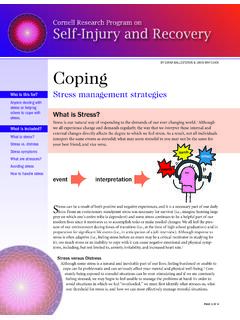
Coping - Cornell University
Stress can be a result ofboth positive and negative experiences, and it is a necessary part of our daily ... developing a support network will allow you to consider new ways to cope healthily. It’s also a good way to get your worries off your chest. HEALTHY COPING STRATEGIES 7 UNHEALTHY COPING STRATEGIES • Exercise • Alcohol/drug use
Download Coping - Cornell University

Information
Domain:
Source:
Link to this page:
Documents from same domain

The Neurobiology of Non-suicidal Self-injury (NSSI): A review
www.selfinjury.bctr.cornell.eduSuicidology Online 2012; 3:24-32. ISSN 2078-5488 proposes that these behaviours function as a method of regulation of both affective experience and social situations in the occurrence of a stressful event.

www.selfinjury.bctr.cornell.edu
www.selfinjury.bctr.cornell.eduCHILDHOOD ABUSE (ESPECIALLY SEXUAL ABUSE) PTSD EATING DISORDERS SEVERE ABUSE/ABUSE BY A FAMILY MEMBER ANXIETY DISORDERS DANCERS Self-injury can become habitual and hard to stop Self-injury can be contagious esp. in teen peer groups Broad consensus that self- injury is rising in prevalence SELF-INJURY The Idea of self-in.ury can be

Distraction Techniques and - Cornell University
www.selfinjury.bctr.cornell.eduChew slowly, noticing how the texture and even the taste of the raisin change as you chew it. • Choose an object in the room. Examine it carefully and then write as detailed a description of it as you can. • Choose a random object, like a twist-tie, and try to list 30 different uses for it. • Pick a subject and research it on the web.

Information for parents
www.selfinjury.bctr.cornell.eduFathers spend only 3 minutes. Understanding the Role of Relationships No, no person causes another person to act in a certain way. Like most negative behaviors, however, self-injury is often a result of two things. That is, a person's belief that he or she
Adolescent Non-Suicidal Self-Injury (NSSI) Interventions
www.selfinjury.bctr.cornell.edufor suicidal adolescent inpatients. Journal of the American Academy of Child and Adolescent Psychiatry, 43(3), 276–282. DBT on a pediatric inpatient unit Reduced parasuicidal behavior at 1-year F/U Quasi-experimental trial of DBT versus TAU in 62 suicidal adolescents No difference between groups III Taylor, L. M. W., Oldershaw, A., Richards ...
ELIZABETH LLOYD-RICHARDSON, PHD What ... - Cornell …
www.selfinjury.bctr.cornell.eduto a deep need to dosomething that will stop the intensity. Self-injury can serve as a short-term fix to stop t h eov r w lm ing- s f– a . The role of emotions and how they contribute to self-injury is discussed in greater detail on an Information Brief here on this website (see Prussien, Rosenblum & Whitlock). The purpose of our conversation ...

Distraction Techniques - Cornell University
www.selfinjury.bctr.cornell.edu• Bang pots and pans. • Stomp around in heavy shoes. • Play handball or tennis. Feeling sad or depressed: • Do something slow and soothing. • Take a hot bath with bath oil or bubbles. • Curl up under a comforter with hot cocoa and a good book. • Baby yourself somehow. • Give yourself a present. • Hug a loved one or stuffed animal.

The Brief Non-Suicidal Self-Injury Assessment Tool (BNSSI-AT)
www.selfinjury.bctr.cornell.eduThe Brief Non-Suicidal Self-Injury Assessment Tool (BNSSI-AT) Developed by: Janis Whitlock and Amanda Purington The Cornell Research Program on Self-Injury and Recovery www.selfinjury.bctr.cornell.edu Revised: March 15, 2013 How to Interpret this Document: This document shows main questions as well as sub-

The Non-Suicidal Self-Injury Assessment Tool (NSSI-AT)
www.selfinjury.bctr.cornell.eduThe Non-Suicidal Self-Injury Assessment Tool (NSSI-AT) Developed by: Janis Whitlock and Amanda Purington The Cornell Research Program on Self-Injury and Recovery www.selfinjury.bctr.cornell.edu Revised: March 15, 2013 How to Interpret this Document: This document shows main questions as well as sub-
ELIZABETH LLOYD-RICHARDSON, PHD What is emotion …
www.selfinjury.bctr.cornell.eduALL OF US FEEL AND EXPERIENCE EMOTIONS – negative and positive – each and every day. Emotions are a normal part of our everyday lives. Everyone experiences them. For some though, feeling these emotions can seem overwhelming, like an out-of-control roller coaster. It is common for one or more strong emotions
Related documents

Developing Positive Coping Strategies - distance.vic.edu.au
www.distance.vic.edu.auDeveloping positive coping strategies Working out the right coping strategies to help you handle different situations can be tough, but it’s worth it. Find out more about different coping strategies, including how to put them into practice, and tips for what to do when they don’t work. Why positive coping strategies are useful. Positive ...

Stages of Change and Motivational Interviewing
ogg.osu.eduHelp client build strategies for coping with risk situations and avoiding relapse. Relapse Person has experienced a relapse and must now cope with consequences, and decide what to do next. Help client reenter the change cycle and praise willingness to reconsider positive change. Knowing factors which may trigger relapse
The Coping Strategy Wheels - PositivePsychology.com
positivepsychology.comIn reviewing 44 studies on coping and coping strategies that individuals develop from infancy through adolescence, Skinner and Zimmer-Gembeck (2007) structured the wide range of coping strategies and identified twelve general, most frequently appearing hierarchical categories of coping. The referred to these categories as “coping families.” The
Relapse Prevention - National Institutes of Health
pubs.niaaa.nih.govhol). A person’s coping behavior in a high-risk situation is a particularly criti-cal determinant of the likely outcome. Thus, a person who can execute effec-tive coping strategies (e.g., a behavioral strategy, such as leaving the situation, or a cognitive strategy, such as positive self-talk) is less likely to relapse com-

STRESS MANAGEMENT COPING STRATEGIES
srjis.comIn the last category of situation, positive steps are necessary for effective management of time and avoiding wastage of time. This requires appropriate attitude towards and a feeling of importance. Management of time is encompassed by the function of controlling. Organizational Coping Strategies-

Developing resilience An evidence-based guide for ... - CIPD
www.cipd.co.uk2 Developing resilience: An evidence-based guide for practitioners ... coping strategies and stress management techniques, strategies for challenging negative thoughts and promoting positive thinking, dealing with difficult or challenging people/ situations.
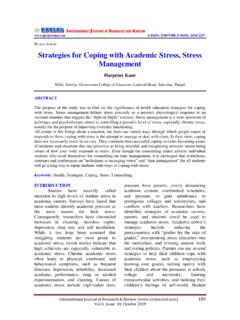
Review Article Strategies for Coping with Academic Stress ...
www.ijrrjournal.com11. Help students develop effective coping strategies. STUDENT STRATEGIES FOR COPING WITH STRESS Researchers have identified strategies that can help students deal with their academic stress. 1. Eat well. 2. Exercise. 3. Sleep well at night. 4. Don’t use drugs, alcohol, or tobacco. 5. Set realistic goals for yourself. 6.
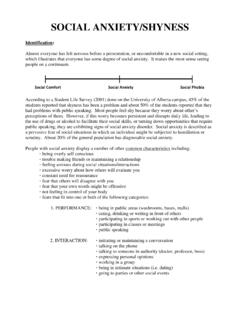
SOCIAL ANXIETY/SHYNESS - McGill University
www.mcgill.casituation. It is even more helpful to develop specific realistic coping statements, related to each negative automatic thought you have identified. Always make these statements based on evidence rather than just positive thinking, because they will have a lot more power. For example: Negative Automatic Thoughts Realistic Coping Statements 1.