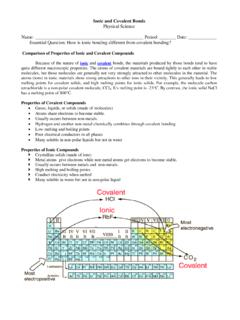
Covalent Compounds Worksheet
melting points for covalent solids, and high melting points for ionic solids. For example, the molecule carbon tetrachloride is a non-polar covalent molecule, CCl 4. It's melting point is -23°C. By contrast, the ionic solid NaCl has a melting point of 800°C. Properties of Covalent Compounds Gases, liquids, or solids (made of molecules)
Download Covalent Compounds Worksheet

Information
Domain:
Source:
Link to this page:
Documents from same domain
AP English Poetry Terms
www.wsfcs.k12.nc.usAP English Literature | Literary Terms | Sabolcik Listed and defined below are literary terms that you will (most likely) need to know in order to discuss and write
WS/FCS Unit Planning Organizer
www.wsfcs.k12.nc.usWS/FCS Unit Planning Organizer ... The points of focus for this unit include an understanding of the five themes of ... Lesson Essential Questions H G C & G ...
THE OUTSIDERS - Winston-Salem/Forsyth County …
www.wsfcs.k12.nc.usFUN AND CREATIVE LESSONS ON… THE OUTSIDERS This package provides students with everything they need to complete a Novel Study on The Outsiders!
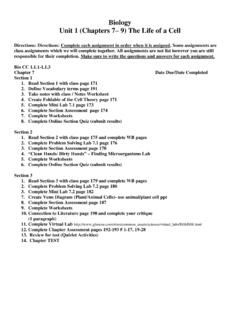
Biology Unit 1 (Chapters 7 9) The Life of a Cell
www.wsfcs.k12.nc.usBiology Unit 1 (Chapters 7 ... Chapter 7 Date Due/Date Completed Section 1 1. Read Section 1 with class page 171 ... 7. Complete Online Section Quiz (Submit results) Sections 2 1. Read section with class page 225 and complete WB pages 2. Complete Foldable “Photosynthesis” page 225 3. Complete Mini Lab 9.1 page 226
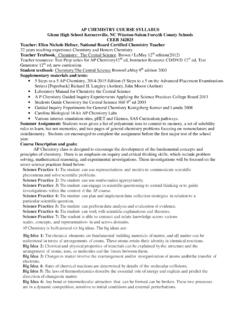
AP CHEMISTRY COURSE SYLLABUS - Winston-Salem/Forsyth ...
www.wsfcs.k12.nc.us• A P Chemistry Guided Inquiry Experiements Applying the Science Practices College Board 2013 • Students Guide Chemistry the Central Science Hill 9 th ed 2003 • Guided Inquiry Experiments for General Chemistry Konigsberg Kerner and Lamda 2008

“Little Things” by Raymond Carver
www.wsfcs.k12.nc.us“Little Things” by Raymond Carver Early that day the weather turned and the snow was melting into dirty water. Streaks of it ran down from the little shoulder-high window that faced the backyard. Cars slushed by on the street outside, where it was getting dark. But it was getting dark on the inside too.
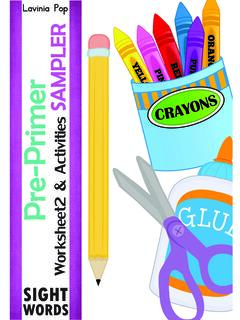
BUNDLE Worksheets and Activities - Pre-Primer
www.wsfcs.k12.nc.ussentence on a handwriting line, drawing a picture to demonstrate comprehension and cutting ... Kindergarten (Prep) and Grade 1 as assessment or revision tool. Directions for use: The worksheets in this unit have children completing 2 tasks. First, they are asked to trace the sight word in focus on two writing lines. Next, they practice writing ...
Study Guide for Content Mastery SE
www.wsfcs.k12.nc.usThis Study Guide for Content Mastery for Earth Science: Geology, the Environment, and the Universe will help you learn more easily from your textbook. Each textbook chapter has six study guide pages of questions and activities for you to complete as you read the text. These activities will help
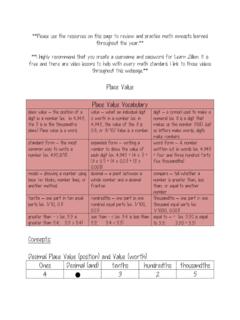
Place Value Place Value Vocabulary
www.wsfcs.k12.nc.usPlace Value Place Value Vocabulary place value – the position of a digit in a number (ex. In 4.345, the 5 is in the thousandths place.) Place value is a word. value – what an individual digit is worth in a number (ex. in 4.345, the value of the 3 is 0.3, or 3/10.) Value is a number.
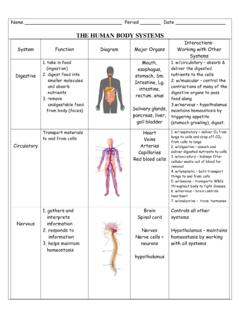
THE HUMAN BODY SYSTEMS
www.wsfcs.k12.nc.usTHE HUMAN BODY SYSTEMS System Function Diagram Major Organs Interactions- Working with Other Systems Digestive 1. take in food (ingestion) 2. digest food into smaller molecules and absorb nutrients 3. remove undigestable food from body (feces) ... 1. w/respiratory – deliver O 2 from lungs to cells and drop off CO 2
Related documents
The Free High School Science Texts: Textbooks for High ...
nongnu.askapache.comNov 09, 2008 · FHSST Authors The Free High School Science Texts: Textbooks for High School Students Studying the Sciences Chemistry Grades 10 - 12 Version 0 November 9, 2008
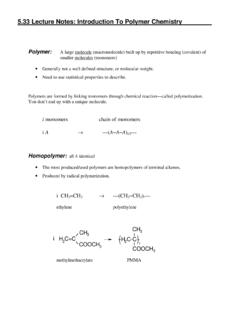
5.33 Lecture Notes: Introduction To Polymer Chemistry
web.mit.edu5.33 Lecture Notes: Introduction To Polymer Chemistry Polymer: A large molecule (macromolecule) built up by repetitive bonding (covalent) of smaller molecules (monomers) • Generally not a well defined structure, or molecular weight.
COVALENT
chemunlimited.comUnit 4 (Covalent Compounds) 1. Write the electron dot structure (Lewis Dot Structure) for covalent compounds or ions. 2. Use electronegativity to determine the polarity of a bond or molecule. 3. Given the formula of a covalent compound, write its correct name; given the name of a covalent compound, write its formula. 4.
Chemical Bonding - Colorado State University
www.smallscalechemistry.colostate.eduIonic Bonding In COVALENT BONDING the valence electrons are shared as pairs between the bonded atoms. Pure covalent bonding only occurs when two nonmetal atoms of the same kind bind to each other. When two different nonmetal atoms are bonded or a nonmetal and a metal are bonded, then the bond is a mixture of cova-
CHAPTER 5: STRUCTURE OF POLYMERS - UW Osh
www.uwosh.eduTo determine how many covalent bonds can be formed between atoms, first the number of valence electrons must be counted. This can be determined by using a periodic table. The group number matches the number of valence electrons. Example: Carbon is element 6. It is found in Group IV so has four valence electrons. Oxygen is element 8.
WORKSHEET: Chemical Bonding Ionic & Covalent!
www.wlwv.k12.or.usWLHS / Conc Chem Name Date Per WORKSHEET: Chemical Bonding – Ionic & Covalent! REMEMBER… Ionic Bond between a Metal and Non-Metal (M + NM) Covalent Bond between a Non-Metal and Non-Metal (NM + NM) PART 1: Determine if the elements in the following compounds are metals or non-metals.Describe the type of bonding that occurs in the compound.

Basic Concepts of Chemical Bonding
www.lamar.eduCovalent Bonding When two atoms of the same kind bond, neither of them wants to lose or gain an electron Therefore, they must share electrons Each pair of shared electrons constitutes one chemical bond. Strengths of Covalent Bonds • We know that multiple bonds are shorter
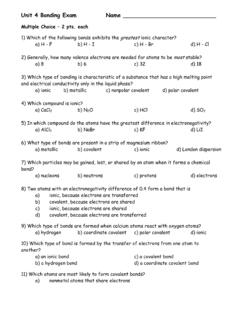
Unit 4 Bonding Exam Name
www.lmghs.orgDec 12, 2017 · a) 8 b) 6 c) 32 d) 18 3) Which type of bonding is characteristic of a substance that has a high melting point and electrical conductivity only in the liquid phase? a) ionic b) metallic c) nonpolar covalent d) polar covalent 4) Which compound is …
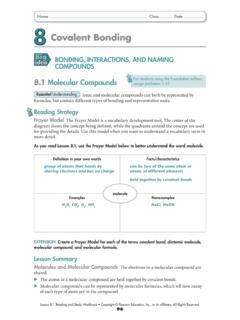
Covalent Bonding - simplychemistry.org
www.simplychemistry.org8.3 Bonding theories essential Understanding Scientists use a variety of theories and models to explain how and why covalent bonds form. Lesson summary molecular orbitals One model of molecular bonding pictures a molecular orbital that is a combination of individual atomic orbitals. A bonding orbital can be occupied by a pair of electrons.
Lecture B1 Lewis Dot Structures and Covalent Bonding
www.chem.uci.edu2. Lewis proposed that Covalent bonds consist of shared pairs of electrons. He created a powerful empirical formalism (Lewis dot structures) for understanding bonding in simple compounds. 3. Linus Pauling created a picture of covalent bonding that employed Quantum Mechanics (and won the 1954 Nobel Prize for it). The Covalent Bond