
CS229 Lecture notes - Stanford Engineering Everywhere
1 2 Xm i=1 (hθ(x(i))−y(i))2. If you’ve seen linear regression before, you may recognize this as the familiar least-squares cost function that gives rise to the ordinary least squares regression model. Whether or not you have seen it previously, lets keep going, and we’ll eventually show this to be a special case of a much broader family ...
Download CS229 Lecture notes - Stanford Engineering Everywhere

Information
Domain:
Source:
Link to this page:
Documents from same domain
Probability Theory Review for Machine Learning
see.stanford.eduProbability Theory Review for Machine Learning Samuel Ieong November 6, 2006 1 Basic Concepts Broadly speaking, probability theory is the mathematical study of uncertainty.

Lecture 3 Linear Equations and Matrices
see.stanford.eduso multiplication by matrix inverse solves a set of linear equations some comments: • x = A−1b makes solving set of 100 linear equations in 100 variables look simple, but the notation is hiding alot of work!
Much of this handout was written by Justin Manus and ...
see.stanford.eduDownloading Eclipse Much of this handout was written by Justin Manus and Brandon Burr. This quarter we’ll be using Stanford’s customized version of Eclipse to build our programs. Eclipse is an enormously popular industrial strength Java environment with many, many features. Fortunately, Eclipse is also open source—anyone is free to change

cvx Users’ Guide - Stanford Engineering Everywhere
see.stanford.edu1.2 What is disciplined convex programming? Disciplined convex programming is a methodology for constructing convex optimiza-tion problems proposed by Michael Grant, Stephen Boyd, and …
EE364a Homework 3 solutions
see.stanford.eduEE364a Homework 3 solutions 3.42 Approximation width. Let f0,...,fn: R → R be given continuous functions. We ... Use part (c) to verify that f ... 4.8 Some simple LPs. Give an explicit solution of each of the following LPs. (a) Minimizing a linear function over an affine set. minimize cTx subject to Ax = b.

CS 229, Public Course Problem Set #1 Solutions: Supervised ...
see.stanford.edu2. Locally-weighted logistic regression In this problem you will implement a locally-weighted version of logistic regression, where we weight different training examples differently according to the query point. The locally-weighted logistic regression problem is to maximize ℓ(θ) = − λ 2 θTθ + Xm i=1 w(i) h y(i) logh θ(x (i))+(1−y ...
Lecture 5 Least-squares - Stanford Engineering Everywhere
see.stanford.eduLeast-squares (approximate) solution • assume A is full rank, skinny • to find xls, we’ll minimize norm of residual squared, krk2 = xTATAx−2yTAx+yTy • set gradient w.r.t. x to zero: ∇xkrk2 = 2ATAx−2ATy = 0 • yields the normal equations: ATAx = ATy • assumptions imply ATA invertible, so we have xls = (ATA)−1ATy. . . a very famous formula
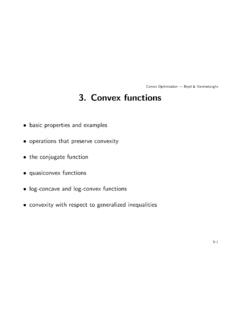
Convex Optimization — Boyd & Vandenberghe 3. Convex …
see.stanford.edu2. for twice differentiable functions, show ∇2f(x) 0 3. show that f is obtained from simple convex functions by operations that preserve convexity • nonnegative weighted sum • composition with affine function • pointwise maximum and supremum • composition • minimization • perspective Convex functions 3–13

Lecture 15 Symmetric matrices, quadratic forms, matrix ...
see.stanford.edu• rotate by QT • diagonal real scale (‘dilation’) by Λ • rotate back by Q decomposition A = Xn i=1 λiqiq T i expresses A as linear combination of 1-dimensional projections Symmetric matrices, quadratic forms, matrix norm, and SVD 15–5

Lecture 13 Linear dynamical systems with inputs & outputs
see.stanford.edu• output is state: y = x • unit resistors, unit capacitors • step response matrix shows delay to each node Linear dynamical systems with inputs & outputs 13–14. system is
Related documents
Graph Theory Lecture Notes - Pennsylvania State University
www.personal.psu.edu1.14 A graph and its complement with cliques in one illustrated and independent sets in the other illustrated.17 1.15 A covering is a set of vertices so that ever edge has at least one endpoint inside the covering set.17 2.1 A walk (a), cycle (b), Eulerian trail (c) and Hamiltonian path (d) are illustrated.20 2.2 We illustrate the 6-cycle and 4 ...
LECTURE 1 MINERALOGY AND CRYSTALLOGRAPHY
profiles.uonbi.ac.keLecture Series: SGL 201 – Principles of Mineralogy 9 Although crystals of a particular chemical and structural species tend to grow with a particular shape (e.g., cube for Halite (NaCl) and octahedron for Spinel (MgAl 2O4)), the shape may vary (but not the angles) for some species (e.g. orthoclase feldspar in Fig 1.4). The causes of
Listening and Note-taking unit 1 Introduction: Lecture ...
www.ed.ac.ukLecture Listening and Note-taking Independent Study unit 1: Introduction 2 In the conversational – or interactive – style, the lecturer speaks from brief notes, using relatively informal language, and probably encourages the students to contribute by asking questions or …

Lecture 26 : Comparison Test
www3.nd.eduarn 1 converges if jrj<1; diverges if jrj 1: I Comparison Test Suppose that P a n and P b n are series with positive terms. (i) If P b n is convergent and a n b n for all n, than P a n is also convergent. (ii) If P b n is divergent and a n b n for all n, then P a n is divergent. Annette Pilkington Lecture 26 : Comparison Test