Curing Concrete, Chapter 12 - Memphis
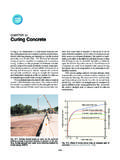
Curing Concrete Fig. 12-1. Curing should begin as soon as the concrete stiffens enough to prevent marring or erosion of the sur-face. Burlap sprayed with water is an effective method for moist curing. (69973) 60 50 40 30 20 10 0 0 7 28 90 365 8 6 4 2 0 Age at test, days Moist-cured entire time In air after 28 days moist curing In air after 7 ...
Download Curing Concrete, Chapter 12 - Memphis

Information
Domain:
Source:
Link to this page:
Documents from same domain
Chapter 11 SEISMIC DESIGN CRITERIA - Civil …
www.ce.memphis.eduP1: JsY ASCE003-11.tex ASCE003/SIE-v1.cls September 29, 2005 17:5 Chapter 11 SEISMIC DESIGN CRITERIA 11.1 GENERAL 11.1.1 Purpose. Chapter 11 presents criteria for the design and
Chapter 6. Compression Reinforcement - Flexural …
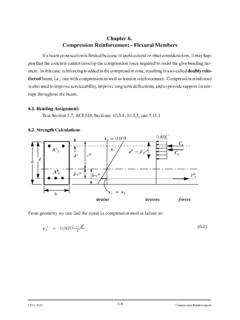
www.ce.memphis.eduCIVL 4135 118 Compression Reinforcement Chapter 6. Compression Reinforcement - Flexural Members Ifabeamcrosssectionislimitedbecauseofarchitecturalorotherconsiderations,itmayhap-

Review of Engineering Fundamentals - University …
www.ce.memphis.eduReview of Engineering Fundamentals CIVL 4197. Course Format ... FE Chemical 853 77% FE Civil 4,874 70% FE Electrical & Computer 1,217 …
ASCE Requirements for Citations f13 - Civil …
www.ce.memphis.eduASCE Requirements for Citations Books Feld, J. and Carper, K. (1997). Construction Failure, 2nd Ed., Wiley, New York. Book references must include author, book title, publisher, and the publisher’s
2 - Aggregate Gradation and Sampling - Civil …
www.ce.memphis.eduCIVL 3137 3 Gradation Analysis percent coarser or percent retained percent finer or percent passing
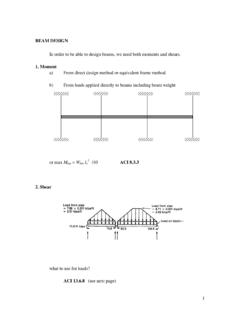
BEAM DESIGN - University of Memphis
www.ce.memphis.edu6 2. SHEAR DESIGN IN FLAT PLATES AND FLAT SLABS When two-way slabs are supported directly by columns, as in flat slabs and flat plates, or when slabs carry concentrated loads, as in footings, shear near the columns is of critical

Topic 14 - Foundation Design - Civil Engineering
www.ce.memphis.eduInstructional Materials Complementing FEMA 451, Design Examples Foundation Design 14-7 Reinforced Concrete Footings: Basic Design Criteria (concentrically loaded) d/2 …
AAA CE4135 ver2 - Civil Engineering
www.ce.memphis.eduCIVL 4135 Chapter 1. Introduction • 2 A problem unique to the design of reinforced concrete structures is the need to detail each member throughout.
Aggregates for Concrete - Department of Civil …
www.ce.memphis.eduT 27). The range of particle sizes in aggregate is illustrated in Fig. 5-4. The aggregate particle size is determined by using wire-mesh sieves with square openings.
Aggregate Specifications - The University of …
www.ce.memphis.eduCIVL 3137 125 Specifications TDOT Specs for Concrete Fine Aggregate Percent Passing by Weight 3/8 in. (9.5 mm) 100 No. 4 (4.75 mm) 95 ‐ 100
Related documents
The GelBottle Inc (TGB) Gel Polish / Builder in A Bottle ...
dlwdwurqx1ngf.cloudfront.netthe cuticle area. Avoid thick build-up around the free edge and the cuticle area. • Seal the free edge. • Build and cure one nail at a time, turn the hand over to help create apex if necessary. • Cure using the TGB Light The Way Lamp on low heat mode (99 seconds), the lamp has been specifically designed to cure TGB products.
PROPER ENVIRONMENT FOR POTATO STORAGE
vric.ucdavis.eduthe curing period because the heat and moisture generated by the potatoes may provide an environment that is favorable for wound healing. Do not allow free moisture (condensation) to form during storage. If that does occur, air circulation may be necessary. Thereafter, air movement may be required to maintain the desired temperature and humidity

INTRODUCTION TO POLYMERS (RESINS)
web.statler.wvu.eduCuring Agents Importance of curing agents (also called crosslinking agents, hardeners, or catalysts): • determines the type of curing reaction • influences the processing cycle: viscosity versus time, gelation • affects properties of the cured system: Tg, modulus, strength Examples of curing agents for epoxies:

Technical Data Sheet - Jotun
www.jotun.comDrying and Curing time Surface (touch) dry Walk-on-dry 16 h11 h4 h2 h1 h30 min 38 h24 h10 h6 h3 h2 h 21 d13 d8 d4 d3 d Substrate temperature 0 °C5 °C10 °C23 °C40 °C Dried/cured for service-5 °C Dry to over coat, minimum 24 h14 h8 h4 h2 h1 h Walk-on-dry: Minimum time before the coating can tolerate normal foot traffic without permanent marks,
Safety Tips for Using UV Curing Systems
www2.lbl.govSafety Tips for Using UV Curing Systems . What Are UV Curing Systems? UV curing is a speed curing process in which high-intensity ultraviolet (UV) light is used to create a photochemical reaction that instantly cures inks, adhesives, and coatings. Curing systems are widely used in optical, fiber-optic, electronic, laser, microelectronic, and