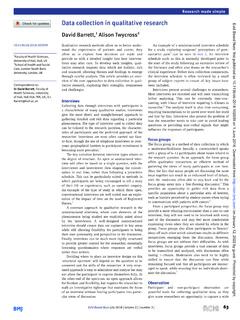
Data collection in qualitative research
Focus groups The focus group is a method of data collection in which a moderator/facilitator (usually a coresearcher) speaks with a group of 6–12 participants about issues related to the research question. As an approach, the focus group offers qualitative researchers an efficient method of gathering the views of many participants at one time.
Download Data collection in qualitative research

Information
Domain:
Source:
Link to this page:
Documents from same domain

Review: nursing interventions increase smoking cessation ...
ebn.bmj.comRice VH,Stead LF.Nursing interventions for smoking cessation.(Cochrane Review,latest version 21 May 1999).In:Cochrane ... This meta›analysis by Rice and Stead provides a review of ... Professor V H Rice, College of Nursing, Wayne State University, 5557 Cass Avenue, Detroit,MI 48202,USA.
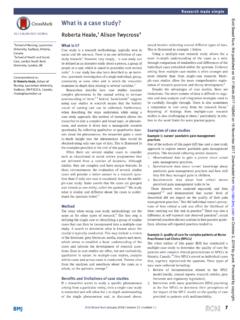
What is a case study? - Evidence-Based Nursing
ebn.bmj.comE e What aisW?MeoWd WBnf lmW?eWWt lcmiWeWd dW 7 What is it? Case study is a research methodology, typically seen in social and life sciences. There is no one definition of case
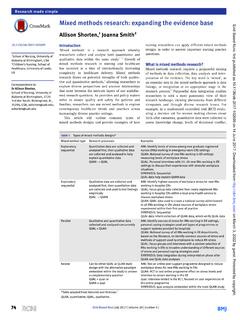
Mixed methods research: expanding the evidence base
ebn.bmj.commixed methods research? When reading mixed methods research or writing a proposal using mixed methods to answer a research question, the six questions below are a useful guide12: 1. Does the research question justify the use of mixed methods? 2. Is the method sequence clearly described, logical in flow and well aligned with study aims? 3.

How to appraise quantitative research
ebn.bmj.comresponsibility to critique research to improve their prac-tice, care and patient safety.1 This article provides a step by step guide on how to critically appraise a quantitative paper. Title, keywords and the authors The title of a paper should be clear and give a good idea of the subject area. The title should not normally exceed

Reviewing the literature: choosing a review design
ebn.bmj.comReviewing the literature: choosing a review design Helen Noble,1 Joanna Smith 2 Research made simple 10.1136/eb-2018-102895 Many health professionals, students and academics including health researchers will have grappled with the challenges of undertaking a review of the literature and choosing a suitable design or framework to structure the ...

Blinding: an essential component in decreasing risk of ...
ebn.bmj.comin experimental designs Dorothy Forbes What is blinding? Blinding (or masking) is the process used in experimen-tal research by which study participants, persons caring for the participants, persons providing the intervention, data collectors and data analysts are kept unaware of group assignment (control vs intervention). Blinding

Reviewing the literature
ebn.bmj.comto data synthesis for quantitative studies may include a meta-analysis (statistical analysis of data from multiple studies of similar designs that have addressed the same question), or findings can be reported descriptively.6 Methods applicable for synthesising qualitative studies include meta-ethnography (themes and concepts from

Interpretive phenomenological analysis applied to ...
ebn.bmj.comphenomenological research approaches, IPA offers direc-tion on how to approach a phenomena of interest with guidance for sampling, data collection and analysis. Table 2 details the prescriptive methods of IPA.3 The role of the researcher in IPA The phenomenological and …

Service evaluation, audit and research: what is the ...
ebn.bmj.comnovice researcher. Put simply, nursing research involves ... service site/s such as the hospital’s Research and Development Department. If you are carrying out an ... While researchers seek to provide evidence to guide practice, it often takes time for evidence to make the
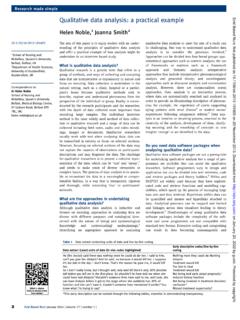
Qualitative data analysis: a practical example
ebn.bmj.comRepetitions within data can be quantified and memos and hyperlinks attached to data. Analytical processes can be mapped and tracked ... researchers must demonstrate rigour, associated with openness, relevance to practice and congruence of the ... methodological rigour. J Adv Nurs 2001;35:373–87. Table 2 Development of initial themes from ...
Related documents
Focus Group Brief - Project Management Tools
www.mmgconnect.comFocus groups are group interviews that give the researcher the ability to capture deeper information more economically than individual interviews. Economy is an important benefit but there are other benefits of focus groups when compared to interviews. Group interaction and non-verbal communication are primary benefits of focus groups.

Qualitative Data Collection
www.sagepub.comInterviews: one-on-one question-and-answer sessions where the researcher may use a variety of techniques. Interviews average 30–45 minutes per person. Focus groups: group interviews, using the same variety of techniques and taking approximately the same length of time as interviews. Data collected directly in words from people (Continued)

Anthropological Approaches: Uncovering Unexpected Insights ...
pcmh.ahrq.gov3. Skillful group facilitation by a trained focus group moderator. 4. The presence of an observer who keeps process notes, operates the recording equipment, and assists the moderator as needed. Focus groups usually include 6 to 12 participants, and last 1 to 2 hours. Discussions are audio . recorded and transcribed with participants ...
BASIC TOOLS FOR DATA COLLECTION - INTRAC
www.intrac.orgset of basic tools. These include interviews, focus group discussions, observation, photography, video, surveys, questionnaires and case studies. Data may also be generated through direct measurement, reviewing secondary data, and informal project / programme management processes. Many different methodologies can be used for data

Focus Groups as Qualitative Research
study.sagepub.comwhere focus groups depart most from standard practices in other qualitative methods. The fact that they are group interviews is the source of most of these planning needs. In particular, the need to bring together several participants requires attention to who the participants are and how the researcher will interact with them as a group. Once

PRACTICAL GUIDE Focus Group Discussions
www.crs.orgA focus group discussion is a qualitative data collection method that engages 6 to 12 people—with shared characteristics pertinent to the specific discussion topic—and is led by a trained facilitator. The shared characteristics may relate to a particular problem, livelihoods occupation, age, social group, place of residence, experience of ...
Qualitative data collection techniques
www.gfmer.chconduct observation • Understand the practical communication skills for interviews to ask good questions , probe and follow up questions • Able to prepare for interview • Understand the characteristics and uses of focus group discussions • Conduct focus group discussions

Data Gathering Methods and Instruments Introduction
www.icao.int(b) Interviews (c) Focus groups (d) Surveys (e) Observation or testing. While each has many possible variations, we will discuss their typical use here. Basic Principles . Here are some basic principles to keep in mind when selecting methods. 1. Consider the characteristics of your target population. A target population is the group of people