Data Sheet Tolerance for Concrete Surfaces
concrete surface is either not visible, or the surface finish quality is no critical (e.g. footings, concrete frames covered by other finishes). While specifications for “Face step” and “Undulations” for Class 4 finishes are included in AS 3610.11, the tolerances for Class 4 and 5 finishes are generally governed by the
Download Data Sheet Tolerance for Concrete Surfaces

Information
Domain:
Source:
Link to this page:
Documents from same domain
Joints in Concrete Buildings - CCAA
www.ccaa.com.auUnplanned construction joints These are joints that are forced upon the concrete-placing crew because of an interruption in supply of a duration long enough for the concrete to take its initial set.
Joints in Concrete Buildings - ccaa.com.au
www.ccaa.com.auDEFINITION The word ‘joint’ is used in building parlance to cover elements which have to perform quite different functions, eg beam-column joints and isolation
CCAA T57 Guide
www.ccaa.com.au4 Guide to off-form ConCrete finishes 2.3 INSITU v PRECAST While the more-appropriate approach will vary from project to project, precast has some advantages over insitu work in terms of the range and quality

Durability of Masonry Mortar - CCAA
www.ccaa.com.auDurability of Masonry Mortar Page 3 Typical cement:lime:sand mortar compositions were chosen with one exception of an M3 mix of cement and sand without lime.
CCAA T57 Guide
www.ccaa.com.auConcrete is the most commonly used construction material for loadbearing and non-loadbearing elements. its ability to be shaped and reflect the

RESIDENTIAL Concrete Driveways and Paths
www.ccaa.com.auby weight of cement to be used will need to be specified. Aggregates. Any information necessary to identify the coarse aggregate required – size, type, texture, colour (e.g. nominal 10-mm aggregate consisting of 90% brown rounded river gravel and 10% crushed white quartz). Cement colour. Normal grey, off-white or white.
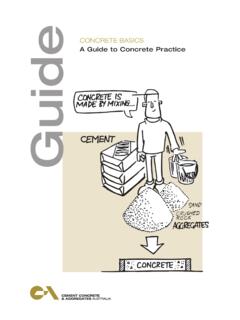
Guide
www.ccaa.com.auConcrete Basics provides a clear, concise explanation of all aspects of making quality concrete; from the Materials and Properties involved through Planning, Preparation, Finishing and Curing. Concrete Basics addresses the needs of unskilled and semi-skilled persons undertaking general concreting projects including home and handyman projects.

Curing of Concrete
www.ccaa.com.auPage of 7 > curing of ncreteco n Curing by preventing excessive loss of moisture from the concrete: either by > leaving formwork in place > 20covering the concrete with an impermeable membrane after the formwork has been removed > by the application of a suitable chemical curing agent (wax etc) > or by a combination of such methods n Curing by continuously …
Guide to Residential Floors Guide
www.ccaa.com.aufloors suitable for residential buildings ranging from single, detached houses to medium density buildings of apartments and flats. For slab-on-ground floors it provides an understanding of the footing/slab selection, design, detailing and construction requirements contained in AS 2870 and the Housing Provisions of the BCA. The requirements of

Residential Concrete Driveways and Paths
www.ccaa.com.au5.3 Assessment of Cracks 10 6 SPECIFICATION CHECKLIST 10 7 REFERENCES 12 july 2006 Data sheet > > ResidentiAl Concrete driveways and Paths the bAsiC funCtion of residential pavements such as driveways, paths and patios is to provide safe, easy access onto or around a property. > 1 INTRODUCTION 2 2 PLANNING otpath2.1 fo Area 2 2.2 Pavement Grades 2
Related documents
CONCRETE DIVISION 3 -50, -60, -80, -90 2 RODUCT O
www.quikrete.comCut the concrete away from the forms by running an edging tool or trowel along the forms to compact the slab edges. Cut 1 in (25 mm) deep control joints into the slab every 6 ft to 8 ft (1.8 m to 2.4 m) using a grooving tool. Allow concrete to stiffen slightly, waiting until all water has evaporated from the surface before troweling or applying a

Vermiculite Concrete
www.vermiculite.orgVermiculite concrete roof screeds are suitable for concrete flat slab, low pitched and barrel vault roofs, and those constructed of wood wool slabs, hollow tile or pre-cast concrete beams. Vermiculite concrete roof screeds should be protected with a minimum of 13mm (½ inch) sand/cement topping before the application of surfacing materials.

MOROCCAN CONCRETE - Daltile
digitalassets.daltile.commoroccan concrete™ colorbody ™ & glazed porcelain & ceramic mosaic with stepwise ™ technology floor usage material pricing special features floor wall countertop shower floor exterior stepwise ™truedge made in the u.s.a. large format mosaic/ deco encaustic finishes: matte colorbody™ porcelain floor tile mc50 off white mc51 taupe mc52 ...

Formwork and finishes - final.ppt
www.concretecentre.comFormwork and finishes for cast in situ concrete Elaine Toogood BA(HONS) Grad Dip Arch RIBA Senior Architect, The Concrete Centre The Concrete Centre: ... Matt non- shiny surface fi nish to the concrete –less re-use High Quality Birch faced (or other) ply – Matt finish, light timber grain expressed. Often little re- use possible

EXTERIOR FINISHES - Nudura
www.nudura.comConcrete Form Systems under the term DAEFS (Direct Applied Exterior Finishing Systems). This system is a 2 ... system first, to give the base coat a rough surface texture to bond properly to. ... As with all finishes, NUDURA Inc. always recommends that the product specified as a finish material for the building ...
Checklist for the Concrete Pre-Construction Conference
www.vrmca.comTypes of finishes • Area 1 • Area 2 • Area 3 • Area 4 b. Special materials for finishes Dry-shake hardener • Rate of application • Procedure to install ... Refer to ASCC Guide for Surface Finish of Formed Concrete b. Slabs-on-grade and floors

C-8 Concrete Study Guide - California Contractors State ...
www.cslb.ca.gov• Placing concrete • Applying finishes • Curing and testing . 4. Post-placement Tasks (5%) • Applying stains and sealers • Stripping forms; repairing, grouting, and caulking concrete . 5. Safety (18%) • Employee safety • Job site safety *Percentages are approximate* Test Site Policy . This is a closed-book examination. No reference