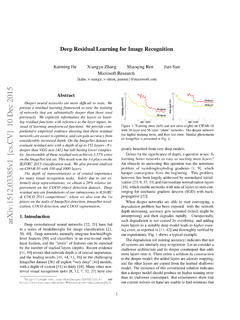
Deep Residual Learning for Image Recognition
the residual learning principle is generic, and we expect that it is applicable in other vision and non-vision problems. 2. Related Work Residual Representations. In image recognition, VLAD [18] is a representation that encodes by the residual vectors with respect to a dictionary, and Fisher Vector [30] can be
Download Deep Residual Learning for Image Recognition

Information
Domain:
Source:
Link to this page:
Documents from same domain
![arXiv:0706.3639v1 [cs.AI] 25 Jun 2007](/cache/preview/4/1/3/9/3/1/4/b/thumb-4139314b93ef86b7b4c2d05ebcc88e46.jpg)
arXiv:0706.3639v1 [cs.AI] 25 Jun 2007
arxiv.orgarXiv:0706.3639v1 [cs.AI] 25 Jun 2007 Technical Report IDSIA-07-07 A Collection of Definitions of Intelligence Shane Legg IDSIA, Galleria …
![arXiv:1301.3781v3 [cs.CL] 7 Sep 2013](/cache/preview/4/d/5/0/4/3/4/0/thumb-4d504340120163c0bdf3f4678d8d217f.jpg)
arXiv:1301.3781v3 [cs.CL] 7 Sep 2013
arxiv.orgFor all the following models, the training complexity is proportional to O = E T Q; (1) where E is number of the training epochs, T is the number of …
![@google.com arXiv:1609.03499v2 [cs.SD] 19 Sep 2016](/cache/preview/c/3/4/9/4/6/9/b/thumb-c349469b499107d21e221f2ac908f8b2.jpg)
@google.com arXiv:1609.03499v2 [cs.SD] 19 Sep 2016
arxiv.orgwhere 1 <x t <1 and = 255. This non-linear quantization produces a significantly better reconstruction than a simple linear quantization scheme. …
A Tutorial on UAVs for Wireless Networks: …
arxiv.orgA Tutorial on UAVs for Wireless Networks: Applications, Challenges, and Open Problems Mohammad Mozaffari 1, ... to UAVs in wireless communications is the work in …
Adversarial Generative Nets: Neural Network …
arxiv.orgAdversarial Generative Nets: Neural Network Attacks on State-of-the-Art Face Recognition Mahmood Sharif, Sruti Bhagavatula, Lujo Bauer Carnegie Mellon University
Massive Exploration of Neural Machine Translation ...
arxiv.orgMassive Exploration of Neural Machine Translation Architectures Denny Britzy, Anna Goldie, Minh-Thang Luong, Quoc Le fdennybritz,agoldie,thangluong,qvlg@google.com Google Brain
Mastering Chess and Shogi by Self-Play with a …
arxiv.orgMastering Chess and Shogi by Self-Play with a General Reinforcement Learning Algorithm David Silver, 1Thomas Hubert, Julian Schrittwieser, Ioannis Antonoglou, 1Matthew Lai, Arthur Guez, Marc Lanctot,1
Going deeper with convolutions - arXiv
arxiv.orgGoing deeper with convolutions Christian Szegedy Google Inc. Wei Liu University of North Carolina, Chapel Hill Yangqing Jia Google Inc. Pierre Sermanet
Andrew G. Howard Menglong Zhu Bo Chen Dmitry ...
arxiv.orgMobileNets: Efficient Convolutional Neural Networks for Mobile Vision Applications Andrew G. Howard Menglong Zhu Bo Chen Dmitry Kalenichenko Weijun Wang Tobias Weyand Marco Andreetto Hartwig Adam
Densely Connected Convolutional Networks
arxiv.orgDensely Connected Convolutional Networks Gao Huang Cornell University gh349@cornell.edu Zhuang Liu Tsinghua University liuzhuang13@mails.tsinghua.edu.cn
Related documents
Faster R-CNN: Towards Real-Time Object Detection with ...
arxiv.orgoped for learning segmentation proposals. Shared computation of convolutions [9], [1], [29], [7], [2] has been attracting increasing attention for ef-ficient, yet accurate, visual recognition. The OverFeat paper [9] computes convolutional features from an image pyramid for …
ImageNet Classification with Deep Convolutional Neural …
www.cs.toronto.eduCurrent approaches to object recognition make essential use of machine learning methods. To im-prove their performance, we can collect larger datasets, learn more powerful models, and use bet-ter techniques for preventing overfitting. Until recently, datasets of …
![Wide Residual Networks arXiv:1605.07146v4 [cs.CV] 14 Jun ...](/cache/preview/f/7/8/5/a/7/7/4/thumb-f785a7744743f4acbd6636c813dabbb6.jpg)
Wide Residual Networks arXiv:1605.07146v4 [cs.CV] 14 Jun ...
arxiv.orgFigure 1: Various residual blocks used in the paper. Batch normalization and ReLU precede each convolution (omitted for clarity) [28], which is an architecture that had been proposed prior to residual networks. The essen-tial difference between residual and highway networks is that in the latter residual links are
![arXiv:1812.01187v2 [cs.CV] 5 Dec 2018](/cache/preview/c/b/1/2/d/d/5/b/thumb-cb12dd5b147004c786bfda6881481412.jpg)
arXiv:1812.01187v2 [cs.CV] 5 Dec 2018
arxiv.orginitial learning rate is , then at batch i, 1 i m, we will set the learning rate to be i =m. Zero . A ResNet network consists of multiple residual blocks, each block consists of several convolutional lay-ers. Given input x, assume block(x) is the output for the last layer in the block, this residual block then outputs x+ block(x).
Local Relation Networks for Image Recognition
openaccess.thecvf.comLocal Relation Networks for Image Recognition ... recognition tasks1. By learning how to adaptively compose 1For example, geometric priors are intrinsically encoded in the con- ... is also achieved with basic residual blocks and on deeper networks (50 and 101 layers).

Residual Attention Network for Image Classification
openaccess.thecvf.comResidual Attention Network for Image Classification Fei Wang1, Mengqing Jiang2, Chen Qian1, Shuo Yang3, Cheng Li1, Honggang Zhang4, Xiaogang Wang3, Xiaoou Tang3 1SenseTime Group Limited, 2Tsinghua University, 3The Chinese University of Hong Kong, 4Beijing University of Posts and Telecommunications 1{wangfei, qianchen, chengli}@sensetime.com, …

Aggregated Residual Transformations for Deep Neural …
openaccess.thecvf.comAggregated Residual Transformations for Deep Neural Networks Saining Xie1 Ross Girshick2 Piotr Dollar´ 2 Zhuowen Tu1 Kaiming He2 1UC San Diego 2Facebook AI Research {s9xie,ztu}@ucsd.edu {rbg,pdollar,kaiminghe}@fb.com Abstract We present a simple, highly modularized network archi-tecture for image classification. Our network is constructed
A Closer Look at Spatiotemporal Convolutions for Action ...
openaccess.thecvf.comresidual learning, which has been shown to be a powerful tool in the field of still-image recognition. We demonstrate that 3D ResNets significantly outperform 2D ResNets for the same depth when trained and evaluated on large-scale, challenging action recognition benchmarks such as Sports-1M [16] and Kinetics [17].
Deep Residual Learning for Image Recognition
www.cv-foundation.orgthe residual learning principle is generic, and we expect that it is applicable in other vision and non-vision problems. 2. Related Work Residual Representations. In image recognition, VLAD [18] is a representation that encodes by the residual vectors with respect to a dictionary, and Fisher Vector [30] can be