DEVELOPING HYPOTHESIS AND RESEARCH QUESTIONS
experimental test when possible”. (Eric Rogers, 1966) “A hypothesis is a conjectural statement of the relation between two or more variables”. (Kerlinger, 1956) “Hypothesis is a formal statement that presents the expected relationship between an independent and dependent variable.”(Creswell, 1994)
Download DEVELOPING HYPOTHESIS AND RESEARCH QUESTIONS

Information
Domain:
Source:
Link to this page:
Documents from same domain
Interview as a Method for Qualitative Research
www.public.asu.eduTypes of Interviews Informal, conversational interview - no predetermined questions are asked, in order to remain as open and adaptable as possible to the
DEVELOPING HYPOTHESIS AND RESEARCH …
www.public.asu.eduDEVELOPING HYPOTHESES & RESEARCH QUESTIONS Definitions of hypothesis “It is a tentative prediction about the nature of the relationship between two or
Accounting for Equity Investments & Acquisitions
www.public.asu.edu2 Equity Method - Introduction Records the initial purchase of an investment at acquisition cost Each period, the investor captures …
STYLE MANUAL FOR WRITING IN GEOLOGY - Arizona State …
www.public.asu.eduone printing mode, always use the one that produces the “best” quality printing. Everything, including the abstract, references, and figure captions, should be double spaced.
Chapter 8 Basic Concepts of Chemical Bonding
www.public.asu.eduPolarity of Covalent Bonds • Unequal sharing of electrons in a bond leads to the development of partial charges separated from one another - this phenomenon is called polarity.
Eyewitness Memory Enhancement in the Police Interview ...
www.public.asu.eduEyewitness Memory Enhancement in the Police Interview: ... chology classes and one psychology of learning class at the University of California, Los Angeles. Before agreeing to participate the study, all subjects were informed ... Journal Journal . California Journal American . …
Programming Embedded Systems I - Arizona State University
www.public.asu.eduOverall, C may not be an perfect language for developing embedded systems, but it is a good choice (and is unlikely that a ‘perfect’ language will ever be created).
and Present Lessons in Urbanization and the Environment
www.public.asu.eduConnecting Past and Present. Lessons in Urbanization . and the Environment [ Special Section ] Urban Sustainability — What We Can Learn from Archaeology. 15 ... amount of data about past societies, but efforts to synthesize the new finds are still in their infancy (Smith, 2012). In a recent

CHINATOWN Screenplay by Robert Towne
www.public.asu.edu3. There is the SOUND of ANOTHER MOAN coming from Gittes' Office --something made of glass shatters. The Woman grows more edgy. INT. GITTES' OFFICE - GITTES & CURLY
What are our options? - Arizona State University
www.public.asu.eduthose actions that it is logically possible for her to perform, those actions that it is physically possible for her to perform, those actions that it is personally possible for her to perform, etc. 3 For now, though, let me sidestep the issue by stipulating
Related documents
Hypothesis Testing - Duke University
www2.stat.duke.edu23.1 How Hypothesis Tests Are Reported in the News 1. Determine the null hypothesis and the alternative hypothesis. 2. Collect and summarize the data into a test statistic. 3. Use the test statistic to determine the p-value. 4. The result is statistically significant if the p-value is less than or equal to the level of significance.
Chapter 206 Two-Sample T-Test - Statistical Software
ncss-wpengine.netdna-ssl.comTwo-Sample T-Test Introduction This procedure provides several reports for the comparison of two continuous-data distributions, including confidence intervals for the difference in means, two-sample t-tests, the z-test, the randomization test, the Mann- ... For comparing two means, the basic null hypothesis is that the means are equal,
Type II Error and Power Calculations
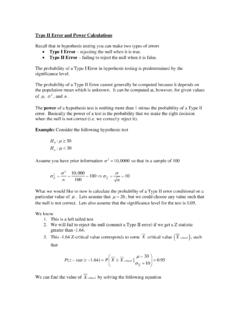
www.ssc.wisc.eduthe null is not correct. Lets also assume that the significance level for the test is 0.05. We know 1. This is a left tailed test 2. We will fail to reject the null (commit a Type II error) if we get a Z statistic greater than -1.64. 3. This -1.64 Z-critical value corresponds to some X critical value (Xcritical), such that 30 ( 1.64) | 0.95 ...
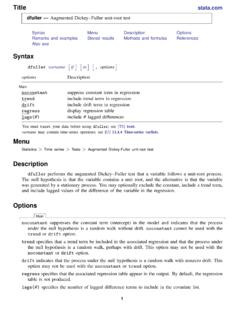
dfuller — Augmented Dickey–Fuller unit-root test
www.stata.comAugmented Dickey-Fuller test for unit root Number of obs = 87 Interpolated Dickey-Fuller Test 1% Critical 5% Critical 10% Critical Statistic Value Value Value Z(t) -1.318 -4.069 -3.463 -3.158 MacKinnon approximate p-value for Z(t) = 0.8834 As we might expect from economic theory, here we cannot reject the null hypothesis that log
Chapter 5 Measurement Operational Definitions
uca.edu5 - 2 Operational Definitions An essential component of an operational definition is measurement. A simple and accurate definition of measurement is the assignment of numbers to a variable in which we are interested. These numbers will

Multiple Hypothesis Testing: The F-test
www.mattblackwell.orgtest, say, the hypothesis that some variable has no effect on the dependent variable. All we do is calculate a t-statistic for this null hypothesis and our data and see if that test statistic is unlikely under the null distribution (the Student’s t-distribution). Unfortunately, when we have more complicated hypotheses, this test no longer works.

Understanding the Dependent t Test
oak.ucc.nau.eduTHE DEPENDENT-SAMPLES t TEST PAGE 4 our example, t obt = 27.00 and t cv = 2.052, therefore, t obt > t cv – so we reject the null hypothesis and conclude that there is a statistically significant difference between the two conditions. That is, the average reaction time for the alcohol condition (M = 42.07) was significantly longer (slower) than the average reaction time for the no …