DIFFERENTIAL EQUATIONS - Mathematics
differential equations. Linear Homogeneous Differential Equations – In this section we’ll take a look at extending the ideas behind solving 2nd order differential equations to higher order. Undetermined Coefficients – Here we’ll look at undetermined coefficients for higher order differential equations. order differential equations in ...
Download DIFFERENTIAL EQUATIONS - Mathematics

Information
Domain:
Source:
Link to this page:
Documents from same domain
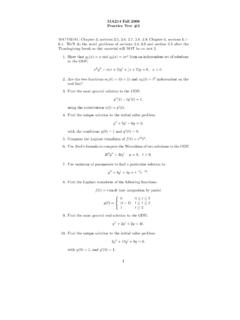
MA214 Fall 2008 Practice Test #2 - University of …
www.ms.uky.edu11. Find the unique solution to the initial value problem y00 +4y = 3sin2t, with y(0) = 2 and y0(0) = −1. 12. Consider a driven, undamped harmonic oscillator …
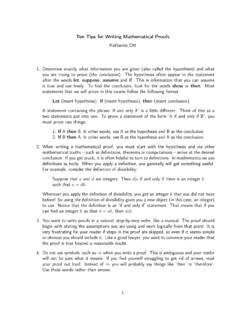
hypothesis conclusion - Mathematics
www.ms.uky.eduTen Tips for Writing Mathematical Proofs Katharine Ott 1. Determine exactly what information you are given (also called the hypothesis)andwhat …
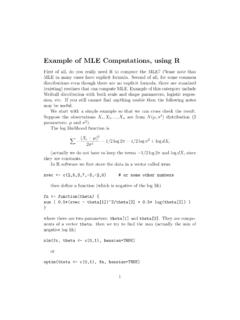
Example of MLE Computations, using R - …
www.ms.uky.eduExample of MLE Computations, using R First of all, do you really need R to compute the MLE? Please note that MLE in many cases have explicit formula.
Galois Theory of Power Series Rings in Characteristic p
www.ms.uky.eduGALOIS THEORY OF POWER SERIES RINGS IN CHARACTERISTIC p.* By TZOUNG TSIENG MOH. Introduction. 0. 1. Let kc be an algebraically closed field of clharac-

Student Quick Start Guide - University of Kentucky
www.ms.uky.edustudent_guide/ Revised August 2016 STUDENT QUICK START GUIDE This Quick Start Guide provides information to help you start using WebAssign. ENROLL Either your instructor enrolled you in a class and created a WebAssign account for you, or she gave you a …
A (gentle) Introduction to Sturm-Liouville
www.ms.uky.eduIntroduction The Non-Singular Problem The Singular Problem References A (gentle) Introduction to Sturm-Liouville Problems Ryan Walker March 10, 2010

College Algebra - Mathematics
www.ms.uky.educollege algebra textbooks. In our view, the core material for the (non-remedial) courses defined by these tomes is but a shadow of that traditionally covered material in a reasonable high school program. Moreover, much of the material is substantially repeated from earlier study and it proceeds at a slow pace with extensive practice and

Newton’s Approximation of Pi
www.ms.uky.eduThe History of Pi • Archimedes’ classical method – Using Polygons with inscribed And Circumscribed circles – Found Pi between 223/71 and 22/7 ... side polygon 262 230 • 1630 AD – Grienberger – Pi to 39 decimal places ... – Pi to 2 million and 38 decimal places in 137.30 hours on a FACOM M-200 computer
College Algebra - University of Kentucky
www.ms.uky.eduCollege Algebra by Avinash Sathaye, Professor of Mathematics 1 Department of Mathematics, University of Kentucky Aryabhat¯ .a This book may be freely downloaded for personal use from the author’s web site
Poincar´e’s Disk Model for Hyperbolic Geometry
www.ms.uky.eduThis result is now know as the Saccheri-Legendre Theorem (Theorem 7.3). He was unable to arrive at a contradiction when he looked at ... Note that this arc is clearly orthogonal to Γ by its construction. ... The hyperbolic trigonometric functions cosh(x) and sinh(x) are defined by: sinh(x) = ex −e−x 2 cosh(x) = ex +e−x 2 and tanh(x ...
Related documents
Second Order Differential Equation Non Homogeneous
bionics.seas.ucla.eduSecond Order Linear Differential Equations – Homogeneous & Non Homogenous v • p, q, g are given, continuous functions on the open interval I ¯ ® c ( ) 0 ( ) ( ) g t y p t y q t y Homogeneous Non-homogeneous
SECOND-ORDER LINEAR DIFFERENTIAL EQUATIONS
www.che.ncku.edu.twnd-Order ODE - 9 2.3 General Solution Consider the second order homogeneous linear differential equa-tion: y'' + p(x) y' + q(x) y = 0 where p(x) and q(x) are continuous functions, then (1) Two linearly independent solutions of the equation can always be found. (2) Let y 1 (x) and y 2 (x) be any two solutions of the homogeneous equa-
PARTIAL DIFFERENTIAL EQUATIONS
web.math.ucsb.eduThere are a number of properties by which PDEs can be separated into families of similar equations. The two main properties are order and linearity. Order. The order of a partial di erential equation is the order of the highest derivative entering the equation. In examples above (1.2), (1.3) are of rst order; (1.4), (1.5), (1.6) and (1.8) are ...
Application of Second Order Differential Equations in ...
www.engr.sjsu.eduReview solution method of second order, non-homogeneous ordinary differential equations - Applications in forced vibration analysis ... Review Solution Method of Second Order, Homogeneous Ordinary Differential Equations. Typical form ( ) 0 ( ) ( ) 2 2 + +bu x = dx du x a dx d u x (4.1) where a and b in Equation (4.1) are constants The solution ...

Chapter 2 Ordinary Differential Equations
www.et.byu.eduChapter 2 Ordinary Differential Equations (PDE). In Example 1, equations a),b) and d) are ODE’s, and equation c) is a PDE; equation e) can be considered an ordinary differential equation with the parameter t. Differential operator D It is often convenient to use a special notation when dealing with differential equations.

MATHEMATICS
cisce.orgDifferential equations, order and degree. -Solution of differential equations. -Variable sep arable. NOTE-Homogeneous equations. - = Linear form. Py Q dx dy + where P and Q are functions of x only. Similarly, for dx/d. y. NOTE : The second order differential equations are excluded. 4. Probability. Conditional probability, multiplication theorem
MATHEMATICS
cisce.org(iv) Differential Equations Definition, order and degree, general and particular solutions of a differential equation. Formationof differential equation whose general solution is given. Solution of differential equations by method of separation of variables solutions of homogeneous differential equations of first

VERY BASIC LIE THEORY - University of Oregon
pages.uoregon.edu602 ROGER HOWE [November given should satisfy two conditions. (1.1) (i) The multiplication map (g1, g2) ~ g1g2 from G x G to G should be continuous. (ii) The inverse map g ~ g-1 from G to should be continuous. A topology on G satisfying these two compatibility criteria is called a group topology. A group endowed with a group topology is called a topological group.
Second Order Nonhomogeneous Linear Differential …
people.math.gatech.eduSecond Order Nonhomogeneous Linear Differential Equations with Constant Coefficients: a2y ′′(t) +a1y′(t) +a0y(t) = f(t), where a2 6= 0 ,a1,a0 are constants, and f(t) is a given function (called the nonhomogeneous term). General solution structure: y(t) = y p(t) +y c(t) where y p(t) is a particular solution of the nonhomog equation, and y

Chapter 8 Application of Second-order Differential ...
www.sjsu.edu8.2 Typical form of second-order homogeneous differential equations (p.243) ( ) 0 2 2 bu x dx du x a d u x (8.1) where a and b are constants The solution of Equation (8.1) u(x) may be obtained by ASSUMING: u(x) = emx (8.2) in which m is a constant to be determined by the following procedure: If the assumed solution u(x) in Equation (8.2) is a valid solution, it must SATISFY
Related search queries
Second Order Differential Equation Non Homogeneous, Second Order, Differential equations, Homogeneous, Homogeneous Non, Second, Order, Second order homogeneous, Differential, Equations, Second order differential equations, Homogeneous equations, Homogeneous differential equations, Order Differential, Order homogeneous differential equations