
DOT CHART 17
For POISON (PGl or PGII, other than inhalation hazard) and POISON (PGIII), placard 454 kg (1,001 lbs) or more. For POISON-INHALATION HAZARD (Division 6.1), inhalation hazard only, placard any quantity. Placard any quantity - packages bearing RADIOACTIVE YELLOW-III labels only. Certain low specific activity radioactive
Download DOT CHART 17

Information
Domain:
Source:
Link to this page:
Documents from same domain

Guidelines for Hazardous and Prevention/Mitigation Training
www.phmsa.dot.gov2016 Guidelines for Hazardous Materials Response, Planning and Prevention/Mitigation Training Introduction – Page iv Guidelines Overview The Guidelines is designed to be used as a working reference manual by public sector managers of hazardous materials training.

APR 2012 - phmsa.dot.gov
www.phmsa.dot.gov1200 New Jersey Avenue, SE Washington, D.C. 20590 This is in response to your January 17, 2012letter concerning how to describe and transport disposal and recycling products, including sharps, used by medical facilities to treat human ... 866-436-9264 (WCMI) • www.wastewise.com .

Billing Code: 4910-60-P DEPARTMENT OF TRANSPORTATION ...
www.phmsa.dot.govOn July 29, 2016, PHMSA, in consultation with FRA, published a Notice of Proposed Rulemaking (NPRM) under the same title as this final rule (81 FR 50068).
Guidance Manual for Operators of Small Natural Gas Systems
www.phmsa.dot.govGuidance Manual for Operators of Small Natural Gas Systems US Department of Transportation Pipeline and Hazardous Materials Safety Administration Office of Pipeline ...

Requalification Guidance for Propane Cylinders - PHMSA
www.phmsa.dot.govPropane cylinders have identifying marks on the cylinder neckring (collar), or cylinder shoulder depending on the cylinder type. The diagram below depicts examples of several of the required markings.
Hazmat Transportation Training Requirements - …
www.phmsa.dot.govphmsa pipeline and hazardous materials safety administration 1 hazmat transportation training requirements an overview of 49 cfr parts 172-173 www.phmsa.dot.gov
THIS DOCUMENT SHOULD NOT BE USED TO DANGEROUS …
www.phmsa.dot.govPage 4 saFETy prEcauTions rEsisT rushing in! approach cauTiousLy From UPWIND, UPHILL or UPSTREAM: • Stay clear of Vapor, Fumes, Smoke and Spills • Keep vehicle at a safe distance from the scene sEcur E T hE sc EnE:

172.101 App A Appendix A to §172.101 - List of Hazardous ...
www.phmsa.dot.gov172.101 App A Appendix A to §172.101 - List of Hazardous Substances and Reportable Quantities 1. This Appendix lists materials and their corresponding reportable quantities (RQ's) that are listed or designated as "hazardous
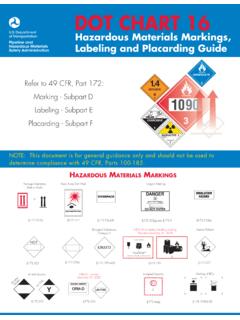
DOT CHART 16 Hazardous Materials Markings,Labeling and ...
www.phmsa.dot.govOct 24, 2017 · §172.436, §172.438, §172.440, §172.441 For Regulated Medical Waste (RMW), an Infectious Substance label is not required on an outer packaging if the OSHA Biohazard marking is used as prescribed in 29 CFR 1910.1030(g). A bulk package of RMW must display a BIOHAZARD marking. §172.323, §172.405(c), §172.429, §172.430, §172.432 §172.450
Pipeline Corrosion Report - FINAL
www.phmsa.dot.govcomprehensively addressing corrosion of offshore pipelines, this study does highlight aspects of corrosion in offshore pipelines in various sections and is specific in reference when discussed. 1.1 Corrosion Overview Corrosion is one of the leading causes of failures in onshore transmission pipelines (both gas and
Related documents
Safety Data Sheet: Liquefied Natural Gas (LNG)
www.pgworks.comInhalation (Breathing): Inhalation of large quantities of LNG vapors may cause central nervous system depression with nausea, headache, dizziness, vomiting, and incoordination. LNG and associated vapor is a simple asphyxiant and may cause loss of consciousness, serious injury, or

49 CFR Version (Ground and Air Packages) - UPS
www.ups.comAdsorbed gas, oxidizing, n.o.s. ‡ 2.2 (5.1) UN3513 NON-FLAMMABLE GAS, OXIDIZER YES NON-FLAMMABLE GAS, OXIDIZER Forbidden Not Accepted 30 kg None 302c Adsorbed gas, toxic, n.o.s. Inhalation hazard zone A ‡ 2.3 UN3512 Not Accepted Forbidden Adsorbed gas, toxic, n.o.s. Inhalation hazard zone B ‡ 2.3 UN3512 Not Accepted Forbidden

SAFETY DATA SHEET Material Name: Oxygen, Compressed …
uigi.comInhalation Immediately remove victim to fresh air if it can be done safely. If not breathing provide artificial respiration or oxygen by trained personnel, get immediate medical attention. Skin Contact No adverse effects expected from gas at normal temperature. Very cold gas may cause frostbite.
Liquefied Petroleum Gas (LPG) Safety Data Sheet (SDS)
www.originenergy.com.auInhalation If inhaled, remove from contaminated area. To protect rescuer, use an Air-line respirator or Self Contained \Breathing Apparatus (SCBA). Be aware of possible ... Stop flow of gas if safe to do so, such as by slowly closing the cylinder or tank valve as …

LIQUEFIED PETROLEUM GAS LPG - National Oceanic and ...
cameochemicals.noaa.gov3.8 Toxicity by Inhalation: Currently not available. 3.9 Chronic Toxicity: None 3.10 Vapor (Gas) Irritant Characteristics: Vapors are nonirritating to the eyes and throat. 3.11 Liquid or Solid Characteristics: No appreciable hazard. Practically harmless to the skin because it is very volatile and evaporates quickly. May cause frostbite.

SAFETY DATA SHEET - Airgas
www.airgas.comInhalation :Fatal if inhaled. May give off gas, vapor or dust that is very irritating or corrosive to the respiratory system. May cause burns to mouth, throat and stomach. As this product is a gas, refer to the inhalation section. Ingestion : Skin contact :Causes severe burns. Contact with rapidly expanding gas may cause burns or frostbite.

SAFETY DATA SHEET - Airgas
www.airgas.comInhalation Ingestion :::: Description of necessary first aid measures Most important symptoms/effects, acute and delayed Inhalation :Harmful if inhaled. Ingestion :As this product is a gas, refer to the inhalation section. Skin contact :Contact with rapidly expanding gas may cause burns or frostbite.

Safety Data Sheet - sisweb.com
www.sisweb.comInhalation Excessive intentional inhalation may cause respiratory tract irritation and central nervous system effect (headaches, dizziness). Vapors may cause dizziness or suffocation. Effects of Acute Exposure - Ingestion Not a normal route of exposure Sensitization Non-hazardous by WHMIS/OSHA criteria.