DSM-5 UPDATE
Bipolar I Disorder, Current or most recent episode hypomanic [effective October 1, 2015] In partial remission . In full remission . Depressive Disorders .....3 7 . Disruptive Mood Dysregulation Disorder [effective October 1, 2016]
Download DSM-5 UPDATE

Information
Domain:
Source:
Link to this page:
Documents from same domain
DSM-5 UPDATE
dsm.psychiatryonline.orgupdate supplement to diagnostic and statistical manual of mental disorders, fifth edition dsm-5 ® august 2015
DSM-5 Coding Update - Psychiatry
dsm.psychiatryonline.orgThis supplement and the digital versions of DSM-5 ® (including the DSM-5 Diagnostic Criteria Mobile App, DSM-5® ®eBook, and DSM-5 on PsychiatryOnline.org) are updated periodically to reflect any coding updates, changes, or corrections, and any other information necessary for compensation in mental health practice.
now used for coding purposes in the United ... - DSM Library
dsm.psychiatryonline.orgneurocognitive disorders should be coded in the same way as their respective probable major neurocognitive disorders, as noted below. For excerpts of the DSM-5 sections with these changes, see pp. 10–22 of this
QUINTA EDICIÓN - Psychiatry
dsm.psychiatryonline.orgTrastorno Código original a utilizar hasta el 30 de septiembre de 2016 Nuevo código a utilizar a partir del 1 de octubre de 2016 Trastorno de comunicación social (pragmático) F80.89 F80.82 Trastorno de desregulación disruptiva del estado de ánimo F34.8 F34.81 Trastorno disfórico premenstrual N94.3 F32.81 Otro trastorno depresivo especificado F32.8 F32.89
Related documents
Depression
adaa.orgDuring the depressive phase, a person experiences the symptoms of major depression. A depressive episode is diagnosed if five or more primary depressive symptoms last most of the day, nearly every day, for a period of two weeks or longer. Signs and symptoms of a depressive episode can include the following: Lasting sad or empty mood
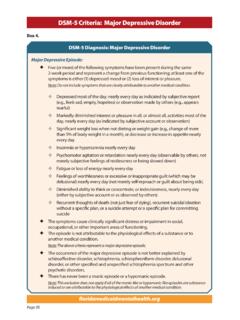
DSM-5 Criteria: Major Depressive Disorder
floridabhcenter.cbcs.usf.eduDSM-5 Criteria: Major Depressive Disorder Major Depressive Episode: F Five (or more) of the following symptoms have been present during the same 2-week period and represent a change from previous functioning; at least one of the symptoms is either (1) depressed mood or (2) loss of interest or pleasure.
Management of Major Depressive Disorder
www.bop.govdeveloped major depressive disorder can evolve subacutely over days to weeks, or more slowly after a prodromal period of anxiety and mild depression that lasts for weeks to months. Between 50–85% of persons with a single episode of major depressive disorder will suffer another episode during their lifetime.
Interviewer Manual - complete
www.cdc.govMajor Depressive Episode / Dysthymic Disorder, Manic / Hypomanic Episode ... This determines whether a worse episode has occurred prior to the last year, and if so the whole life section for that diagnosis will be administered. In negative cases, the whole life module is automatically administered. Certain diagnoses (e.g., enuresis, tics,
Canadian Network for Mood and Anxiety
www.cmh.orgas first-line treatments for patients with a major depressive episode(MDE)ofmoderateorgreaterseverity(asdetermined by symptom scales and/or functional impairment), and this recommendation is unchanged. First-line treatments for indi-viduals with depression of mild severity include psychoedu-cation, self-management, and psychological …
VA/DoD Major Depressive Disorder Clinical Practice …
www.healthquality.va.gov7% of the population —had at least one major depressive episode in the past year. Women are 70% more likely than men to experience depression, and young adults aged 18–25 are 60% more likely to have depression than people aged 50 or older.

Outpatient Treatment Plan - ICANotes
www.icanotes.comMajor depressive disorder, single episode, severe without psychotic features, F32.2 (ICD -10) (Active) Anxiety disorder, unspecified, F41.9 (ICD -10) (Active) Current Medications: #1) Prozac 40 mg PO BID #2) Ambien 10 mg PO QHS PRN Problem / Needs: Problem / Need # 1: Anxiety Problem / Need # 2: Depressed Mood

Highlights for the 2020 National Survey on Drug Use and Health
www.samhsa.govIn 2020, 17.0% of adolescents aged 12 to 17 (or 4.1 million people) had a major depressive episode (MDE) in the past year, and 2.7% (or 644,000 people) had a co-occurring MDE and an SUD in the past year. In 2020, 21.0% of adults aged 18 or …